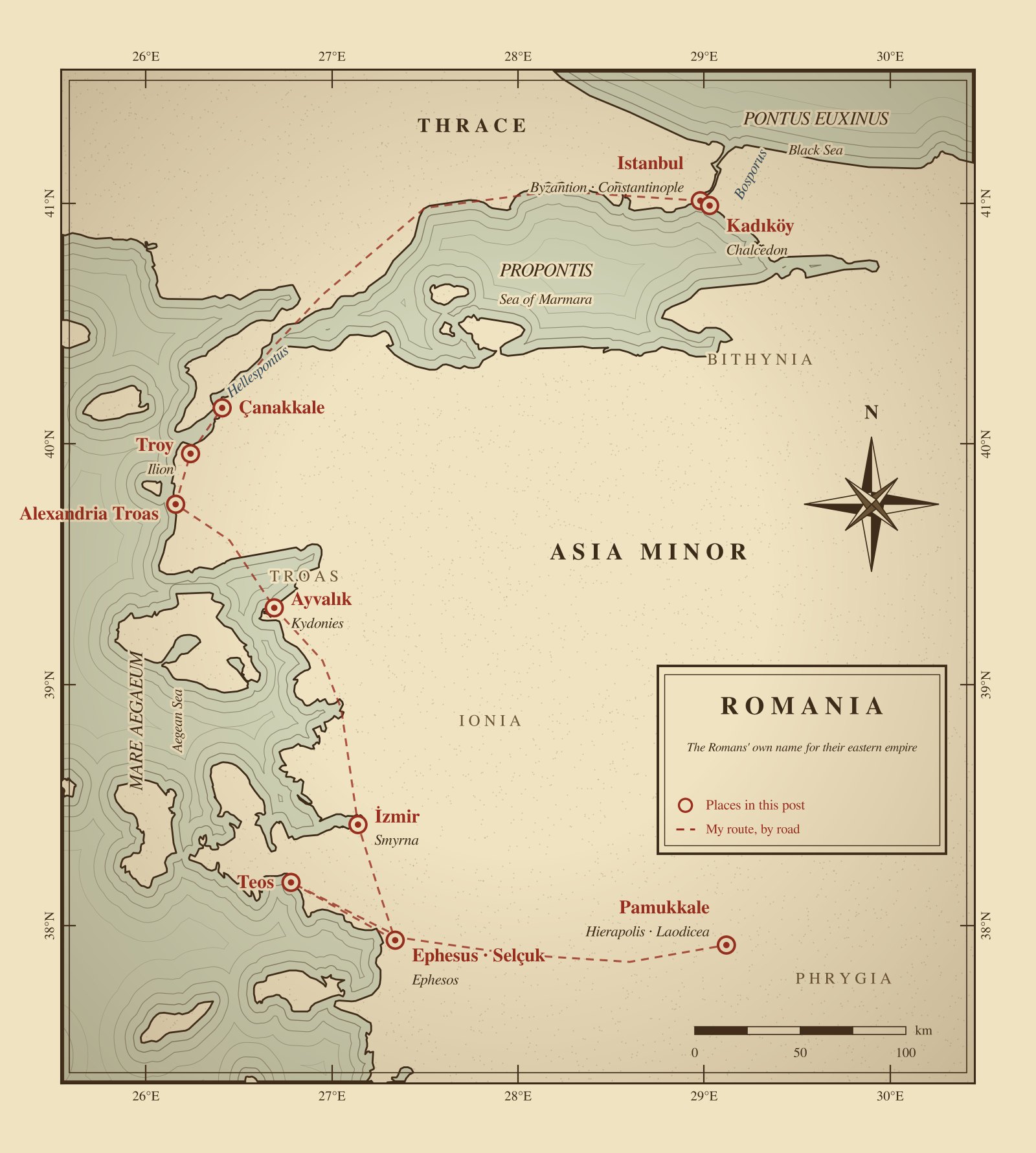
 Western Turkey, drawn for this post in the style of an old map. The dashed line is my route by road; ancient names are in italics. “Romania” was the eastern Romans’ own name for their empire.
Above a doorway in Hagia Sophia, two emperors stand on either side of the Virgin and Child, each holding out a gift. On the right, Constantine offers a model of the city he founded. On the left, Justinian offers a model of the church itself. The mosaic was set in the 10th century, when both men had been dead for centuries, and it reads like a deed of title: this city and this church, given to God by the Romans who built them. In December 2024 I spent nine days between Istanbul and the Aegean coast, and only later realized that the trip had followed how the city came to exist, from the Greek world that produced it to the empire that built it and the one that took it. So I have written it up in the order of that history rather than the order of my route.
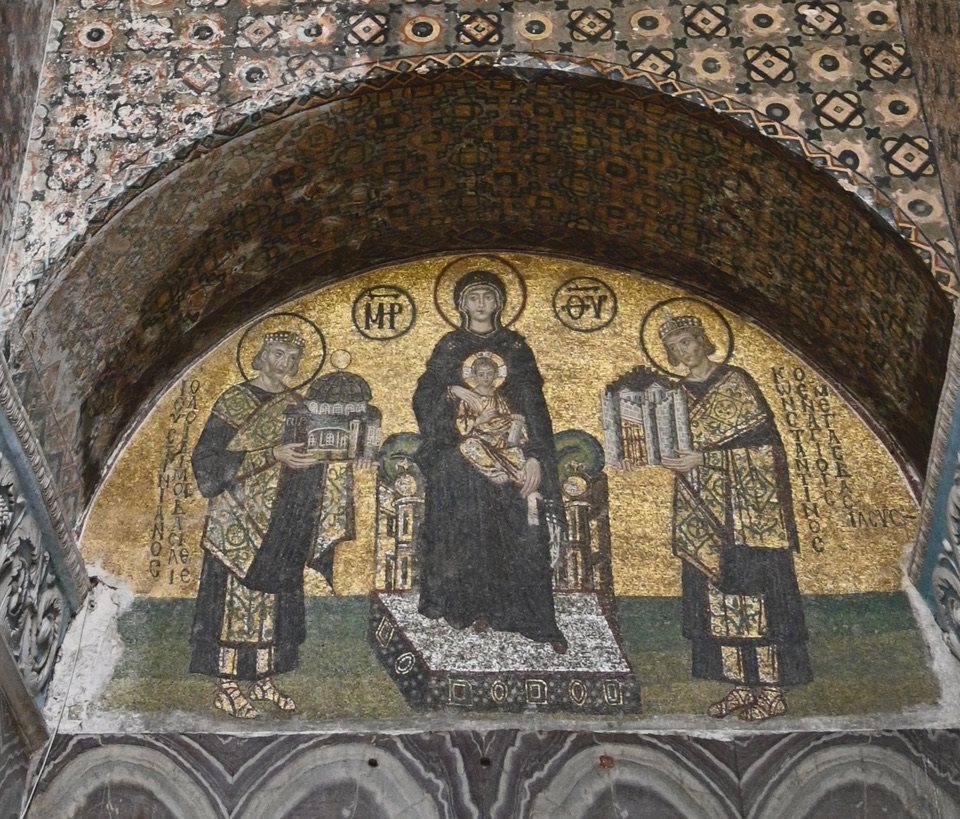 The southwest vestibule mosaic in Hagia Sophia. Justinian, left, offers the church; Constantine, right, offers the city.
The Periods, and Where I Saw Them
Historians usually divide the history of this coast by who ruled it: Bronze Age kingdoms, Greek cities, Alexander’s successors, Rome, the eastern Roman Empire, and the Ottomans. The dates below are approximate.
| Period | Dates | Where I saw it |
|---|---|---|
| Bronze Age | c. 3000–1180 BC | Troy and the Troy Museum |
| Archaic and Classical Greek | c. 1050–334 BC | Kadıköy (Chalcedon), Teos, the Temple of Artemis at Ephesus |
| Hellenistic | 334–133 BC | Alexandria Troas, Kadifekale in İzmir, Hierapolis |
| Roman | 133 BC–AD 330 | Ephesus, the Agora of Smyrna, Hierapolis, Laodicea |
| Eastern Roman (Byzantine) | 330–1453 | Hagia Sophia, Hagia Irene, the Basilica Cistern, the land walls, Chora, the Basilica of St John, Galata Tower |
| Ottoman | 1453–1922 | Topkapı, Süleymaniye, the Blue Mosque, the bazaars, Dolmabahçe, Pera, Çanakkale, Ayvalık, İzmir |
| Republic | 1923– | İstiklal Avenue and Hagia Sophia |
Two Seas and Two Continents
Istanbul sits where Europe and Asia almost touch. The Bosphorus, a strait about 30 kilometers long, joins the Black Sea to the Sea of Marmara, which the Greeks called the Propontis, the “sea before the Pontus.” On the European side, an inlet called the Golden Horn makes a deep, sheltered harbor, and the triangle of land between the Horn and the Marmara is the old city. At the other end of the Marmara, the Dardanelles, the Hellespont of the Greeks, lead out into the Aegean. Whoever held both straits controlled the trade between the Black Sea and the Mediterranean, which is most of the reason this city mattered for 2,700 years.
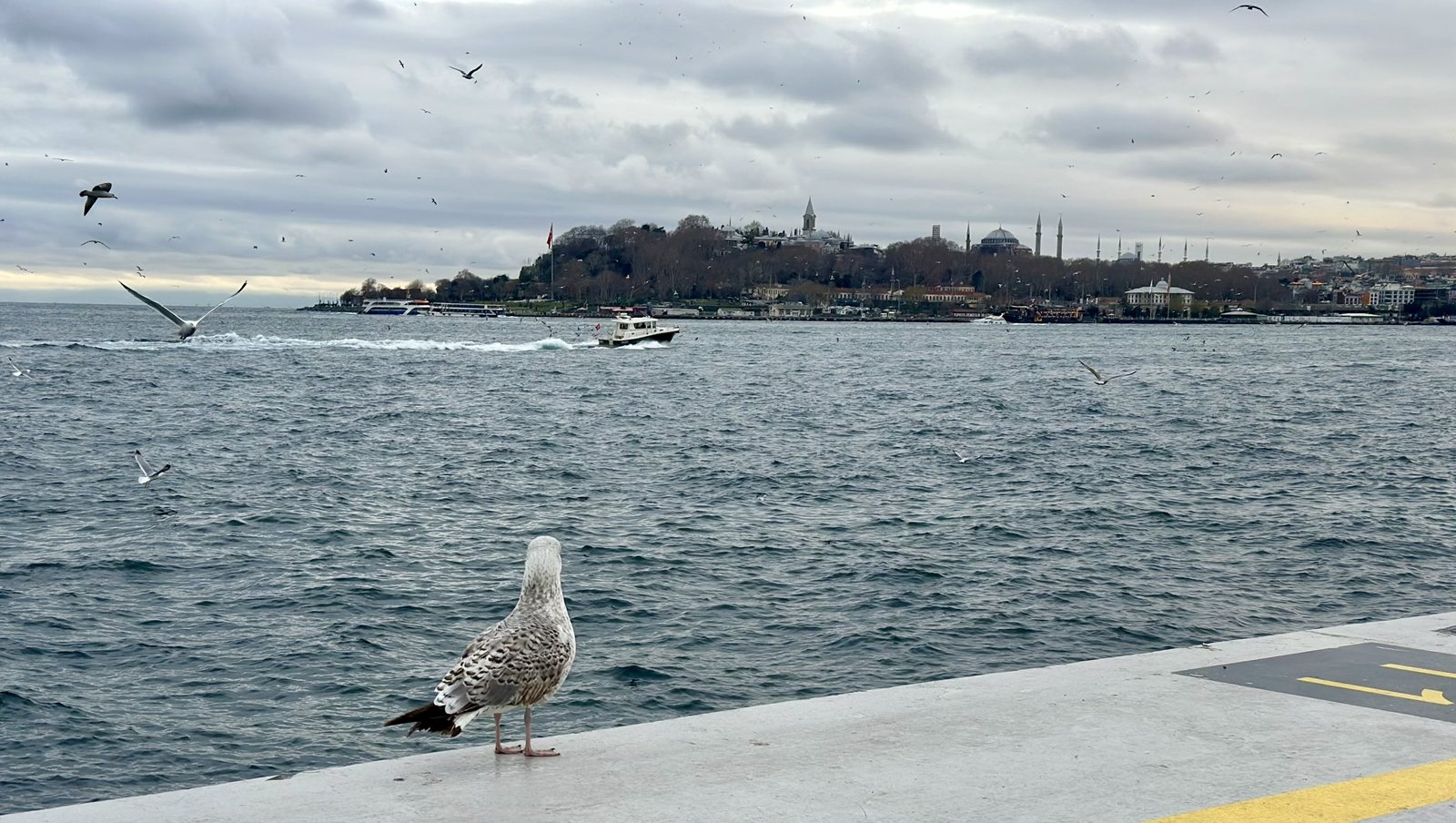 The old city from across the Bosphorus: Topkapı and its Tower of Justice on the point, with Hagia Sophia and the Blue Mosque behind.
The city has had three names, and they are a short history in themselves. Greek settlers called it Byzantion. Constantine refounded it as Constantinople, “the city of Constantine.” Istanbul most likely comes from the Greek eis tin polin, “to the city,” which is what people said when they were heading there.
The people we call Byzantines never used the word. A German scholar, Hieronymus Wolf, introduced “Byzantine” in 1557, and it caught on later. The people themselves were Romans, Rhomaioi, and their state Romania. The Ottomans took them at their word: they called the empire’s Greek-speaking Christians Rum, “Romans,” and after 1453 Mehmed II took the title Kayser-i Rum, “Caesar of Rome.”
Bronze Age: Troy
c. 3000–1180 BC · Troy, Çanakkale · Day 5
I drove south from Istanbul on Christmas Day to the Dardanelles. Troy sits on a low mound called Hisarlık, a few kilometers from the strait it once watched. It is less a single city than about nine of them stacked on top of each other, from around 3000 BC into the Roman period. Heinrich Schliemann began excavating in 1871, convinced he would find Homer’s city, and in his hurry he dug a trench straight through several of the layers he was looking for. The layers usually linked to the Trojan War, Troy VI and VIIa, date to around 1300–1180 BC. The gold he called “Priam’s Treasure” is in fact about a thousand years older, and most of it is now in the Pushkin Museum in Moscow.
The site is modest to look at: low walls, wells, and ramps, seen from wooden boardwalks, with the Troy Museum, opened nearby in 2018, doing much of the work of explaining them. In the rain I had it nearly to myself, apart from a local dog that walked the boardwalks with me.
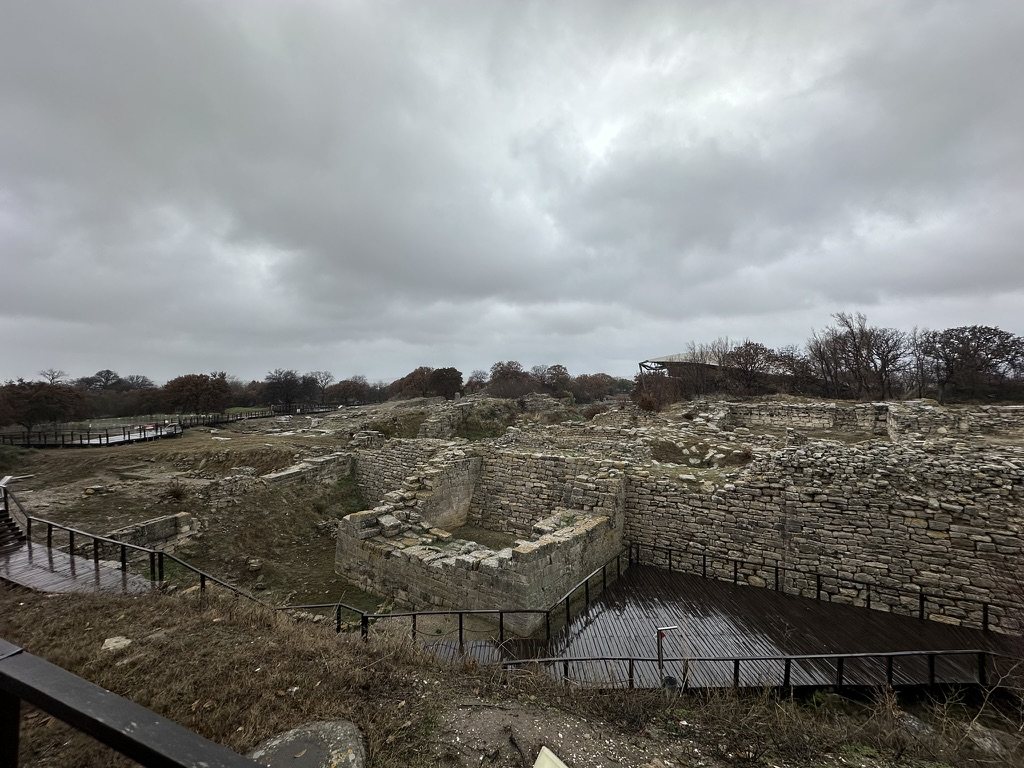 The walls of Troy, with the visitor boardwalks around them.
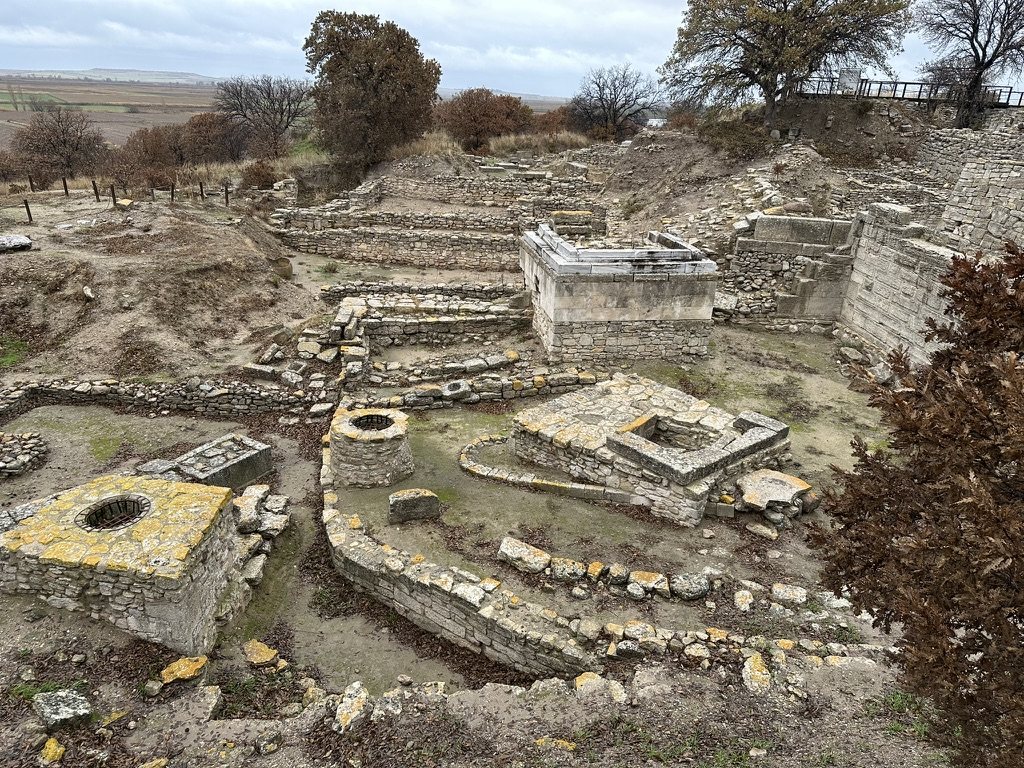 Wells and altars from later Troy, built among the walls of earlier cities.
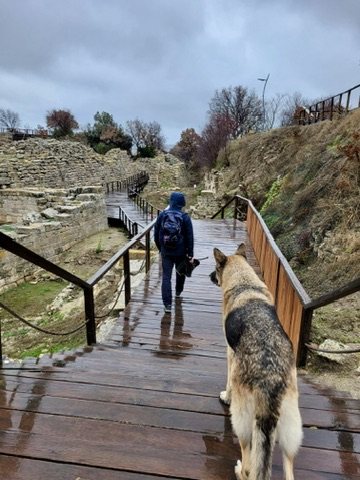 My guide at Troy, who asked for nothing.
Çanakkale, the town on the strait, has its own wooden horse on the waterfront, a film prop that Warner Bros. gave to the city, so the most photographed Trojan horse in Turkey came from Hollywood. Update, 2026: the horse is back on screen in Christopher Nolan’s The Odyssey, released in July, with Matt Damon’s Odysseus waiting inside.
The Hellespont itself carries the next layer of myth. The Greeks named it for Helle, who in legend fell from the golden-fleeced ram into these waters, and Leander was said to swim it nightly to reach Hero on the other side. Lord Byron swam it in 1810 to prove it could be done.
Archaic and Classical Greece: Cities on Two Coasts
c. 1050–334 BC · Kadıköy, Teos, Ephesus · Days 2–4 and 7
From around 1050 BC, Greek settlers spread along the Aegean coast of Anatolia. The central stretch, around Smyrna and Ephesus, became Ionia, and in the 6th century BC it was among the most advanced parts of the Greek world: Thales and the first Greek philosophers came from Miletus, a little south of Ephesus. The Ionian cities then sent colonists of their own. Teos, a small city on the coast southwest of İzmir, was the birthplace of the poet Anacreon and founded colonies as far away as Thrace and the Black Sea. Its Temple of Dionysus was designed by Hermogenes, one of the leading architects of the 2nd century BC, and part of it has been re-erected.
At Ephesus, the Temple of Artemis was counted among the Seven Wonders of the World. A man named Herostratus burned it in 356 BC to make himself famous, by tradition on the night Alexander the Great was born. Today a single column, reassembled from fragments, stands in a marshy field outside Selçuk.
Byzantion was another Greek colony. Settlers from Megara, near Athens, founded it around 667 or 657 BC on the European side of the Bosphorus. Settlers from the same city had founded Chalcedon, on the Asian shore opposite, about 17 years earlier. Herodotus says a Persian general later called the Chalcedonians blind for choosing the worse site when the better one was in plain view across the water. Chalcedon is now Kadıköy, a ferry ride from the old city, and the view from its waterfront makes the general’s point.
Hellenistic: Alexander’s Successors
334–133 BC · Alexandria Troas, İzmir, Pamukkale · Days 5, 6, and 8
Alexander crossed the Hellespont into Asia in 334 BC, and he stopped first at Troy, where he honored the tomb of Achilles. Within a decade he had conquered the Persian Empire, and after his death his generals divided it. On this coast, one of them, Antigonus, founded a port city south of Troy around 306 BC and named it Antigonia; a rival, Lysimachus, took it and renamed it Alexandria Troas. Its ruins lie near the sea, a short drive from Troy.
Smyrna, modern İzmir, was refounded in the same years on the slopes of Mount Pagos, now Kadifekale. Pausanias tells the story that Alexander fell asleep there while hunting and dreamed that the goddesses called the Nemeses told him to build a city on the spot. The hill still looks out over the whole bay.
Inland, the hot springs above the Lycus valley became Hierapolis, the “holy city.” It was founded in the Hellenistic period, by either the Seleucid or the Pergamene kings; the sources differ.
Roman Asia: A Province of Cities
133 BC–AD 330 · Ephesus, İzmir, Hierapolis, Laodicea · Days 7 and 8
In 133 BC, the last king of Pergamon left his kingdom to Rome in his will, and it became the province of Asia, with Ephesus as its leading city. For the next four centuries it was among the wealthiest parts of the empire.
Ephesus is the reason most visitors come to this coast, and it is one of the best places anywhere to see what a Roman city looked like. Its main street runs downhill, paved in marble, to the Library of Celsus. Gaius Julius Aquila built it in the early 2nd century AD in honor of his father, Tiberius Julius Celsus Polemaeanus, a governor of the province, who is buried in a crypt beneath it. It held about 12,000 scrolls. The two-story façade fell in an earthquake and was re-erected in the 1970s from the original pieces. Its niches hold statues of four qualities credited to Celsus: Sophia, Arete, Ennoia, and Episteme, or Wisdom, Virtue, Intelligence, and Knowledge. The ones there now are copies; the originals went to Vienna after they were excavated.
The city’s theater seated about 25,000 people, and it is where, according to the Acts of the Apostles, a crowd of silversmiths drowned out the apostle Paul by shouting “Great is Artemis of the Ephesians” for two hours. Ephesus was a port; silt from the river has since pushed the sea several kilometers away, which is part of why the city declined.
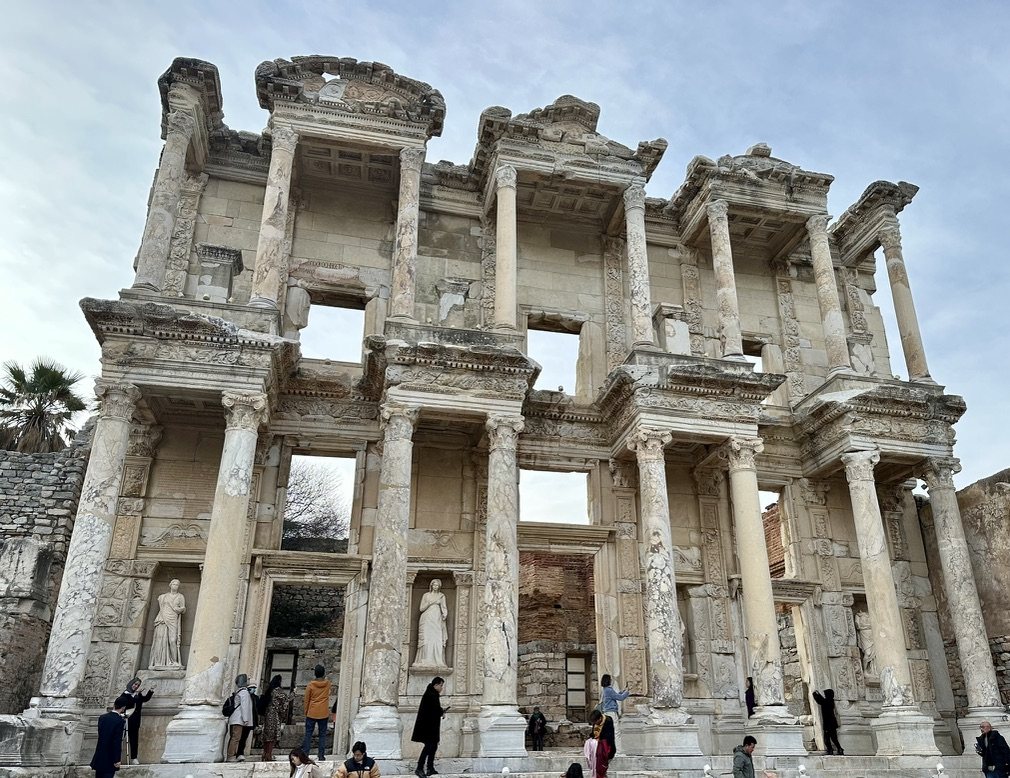 The Library of Celsus, with copies of its statues in the niches.
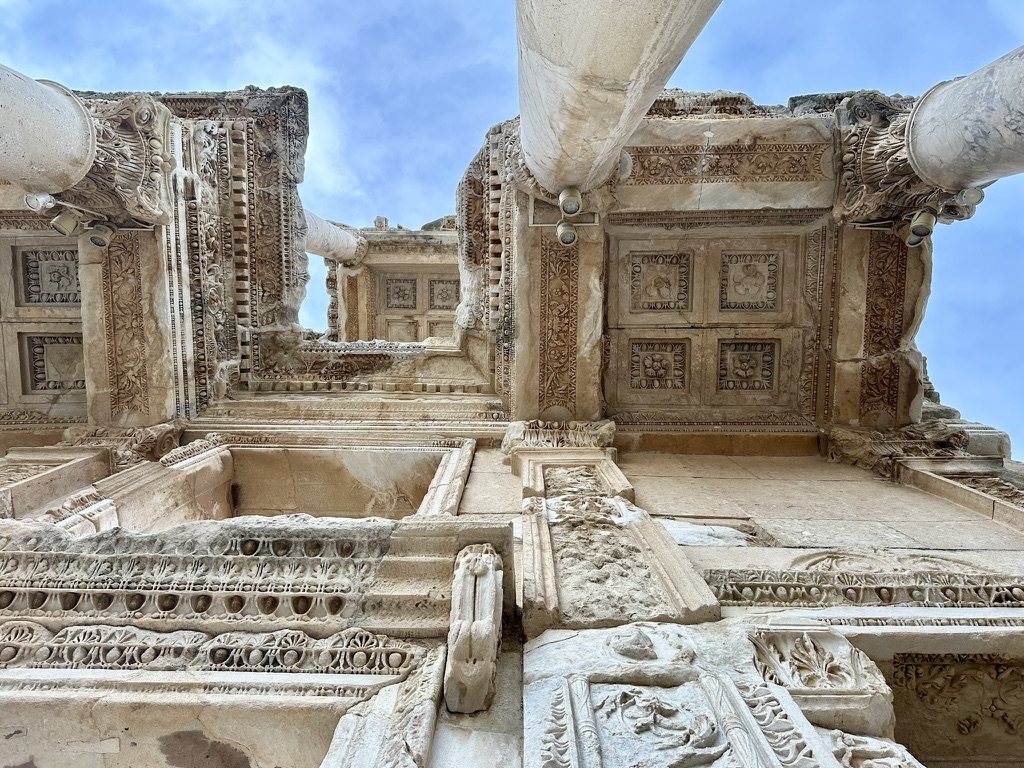 Looking up between the columns of the façade.
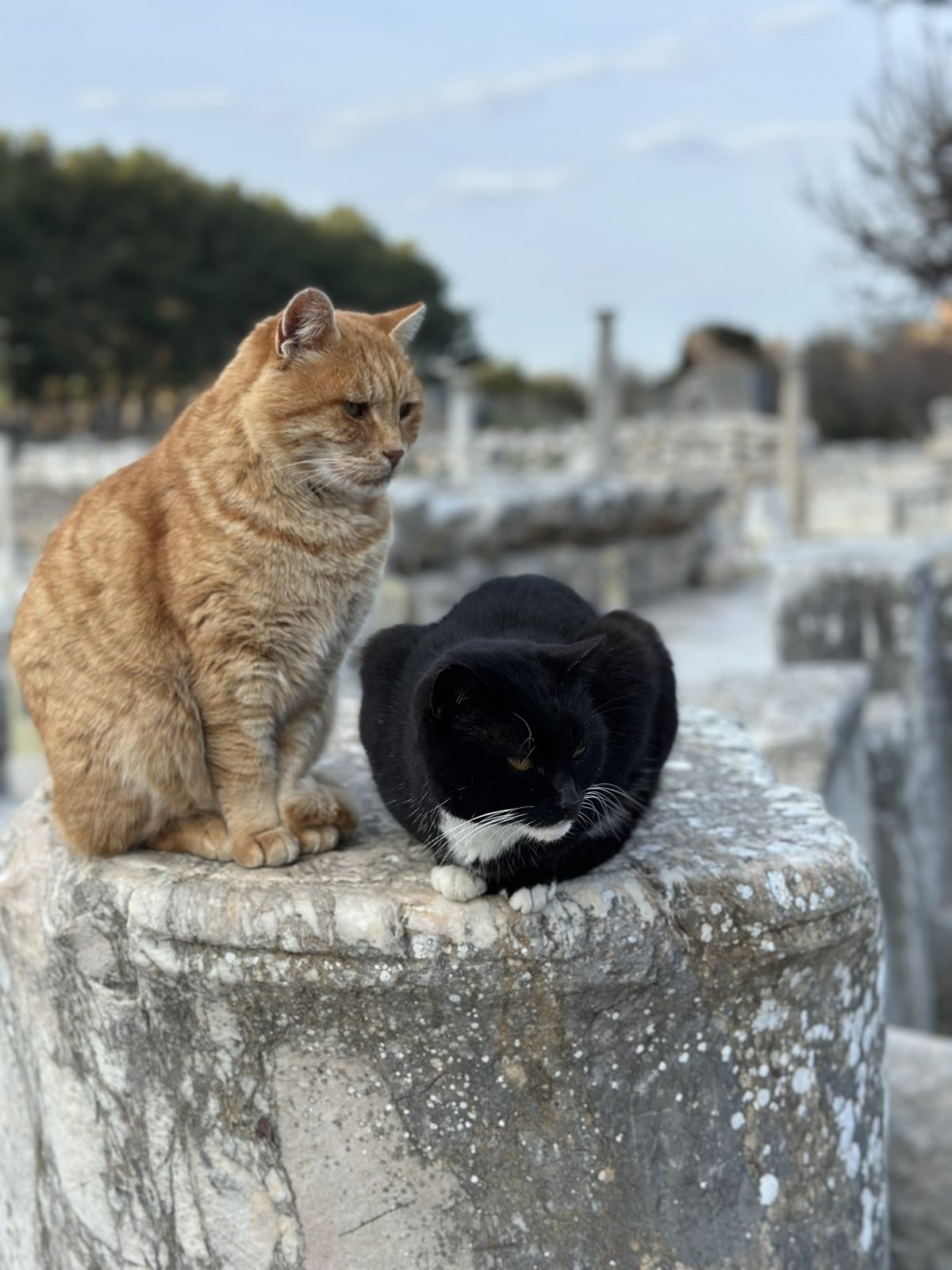 The present tenants of Ephesus.
In İzmir, the Roman agora of Smyrna survives in the middle of the modern city. It was rebuilt after an earthquake in AD 178 with help from Marcus Aurelius, and a portrait of his wife, Faustina, is carved on one of its arches.
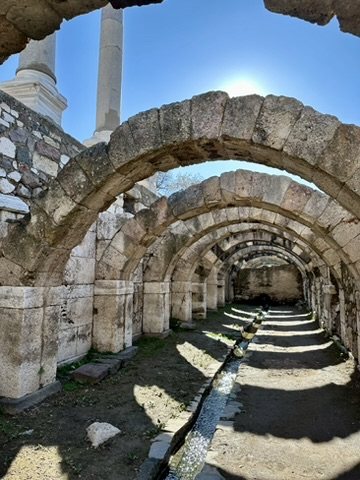 The vaulted basement of the Agora of Smyrna, with water still running along its floor.
Hierapolis grew into a spa town under Rome. Its springs deposit calcium carbonate down the hillside, and over thousands of years they have built the white terraces of Pamukkale, the “cotton castle.” Hotels once stood on the terraces; they were torn down after the site became a UNESCO World Heritage Site in 1988, and one hotel’s pool, full of fallen Roman columns, survives as the Antique Pool, which local legend says Mark Antony gave to Cleopatra. The city also had a Plutonium, a gate to the underworld, where carbon dioxide seeping from the ground killed the animals that priests led into it.
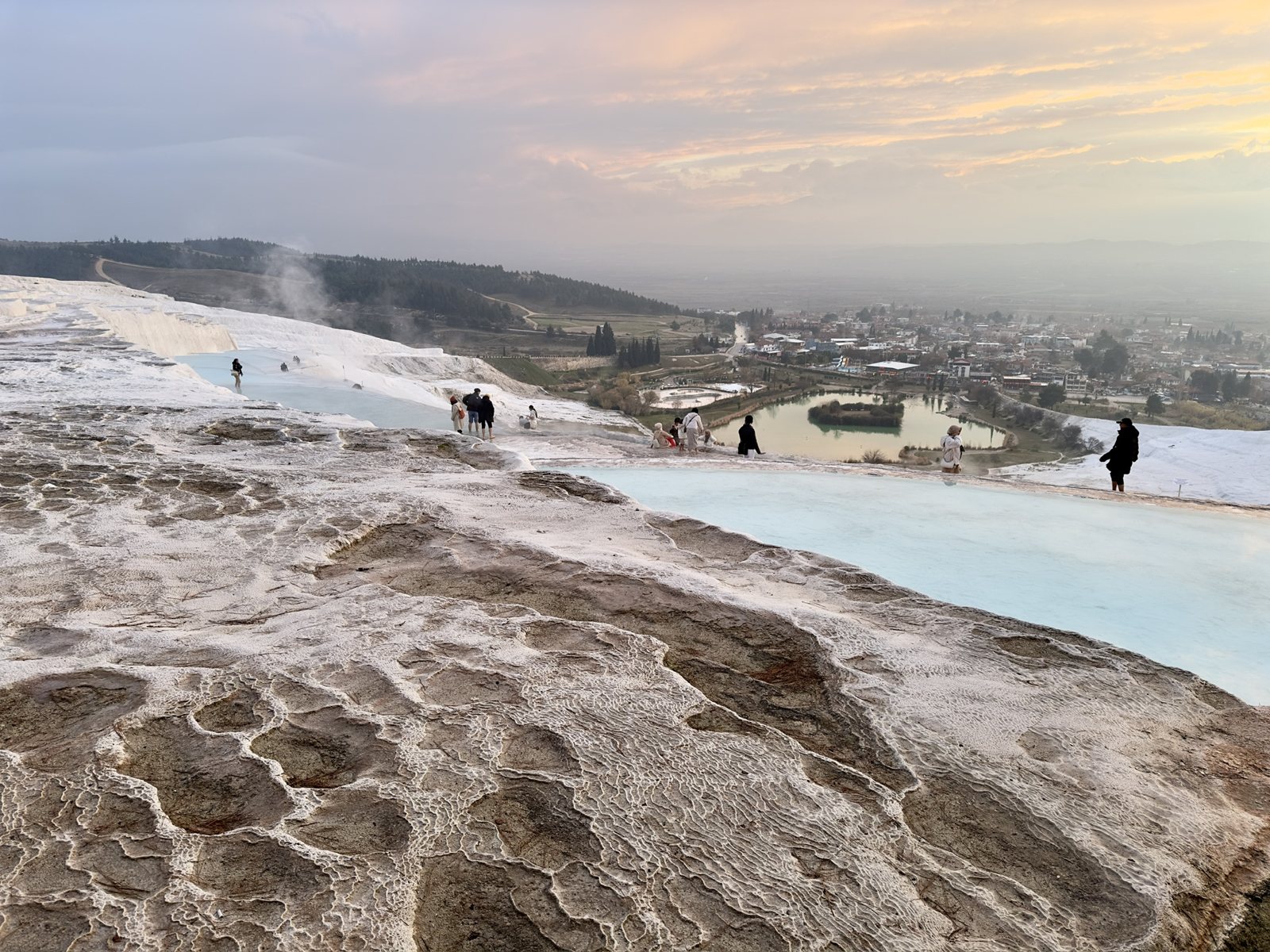 The travertines of Pamukkale, with the modern village below.
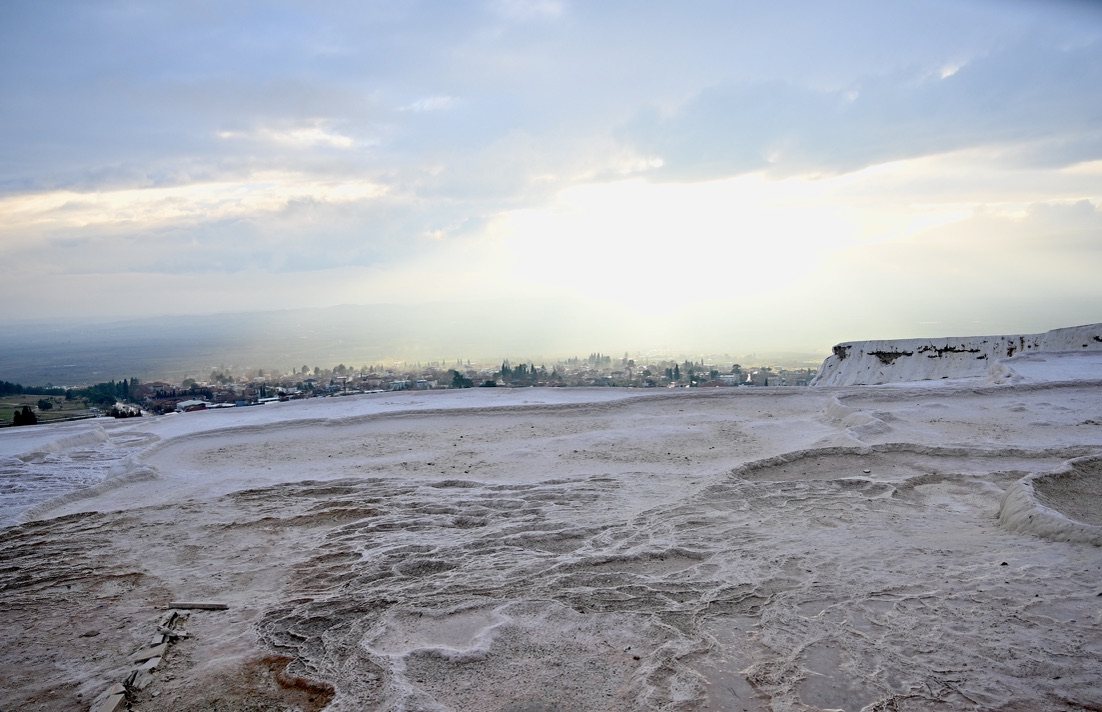 Calcium carbonate, laid down by the springs one thin layer at a time.
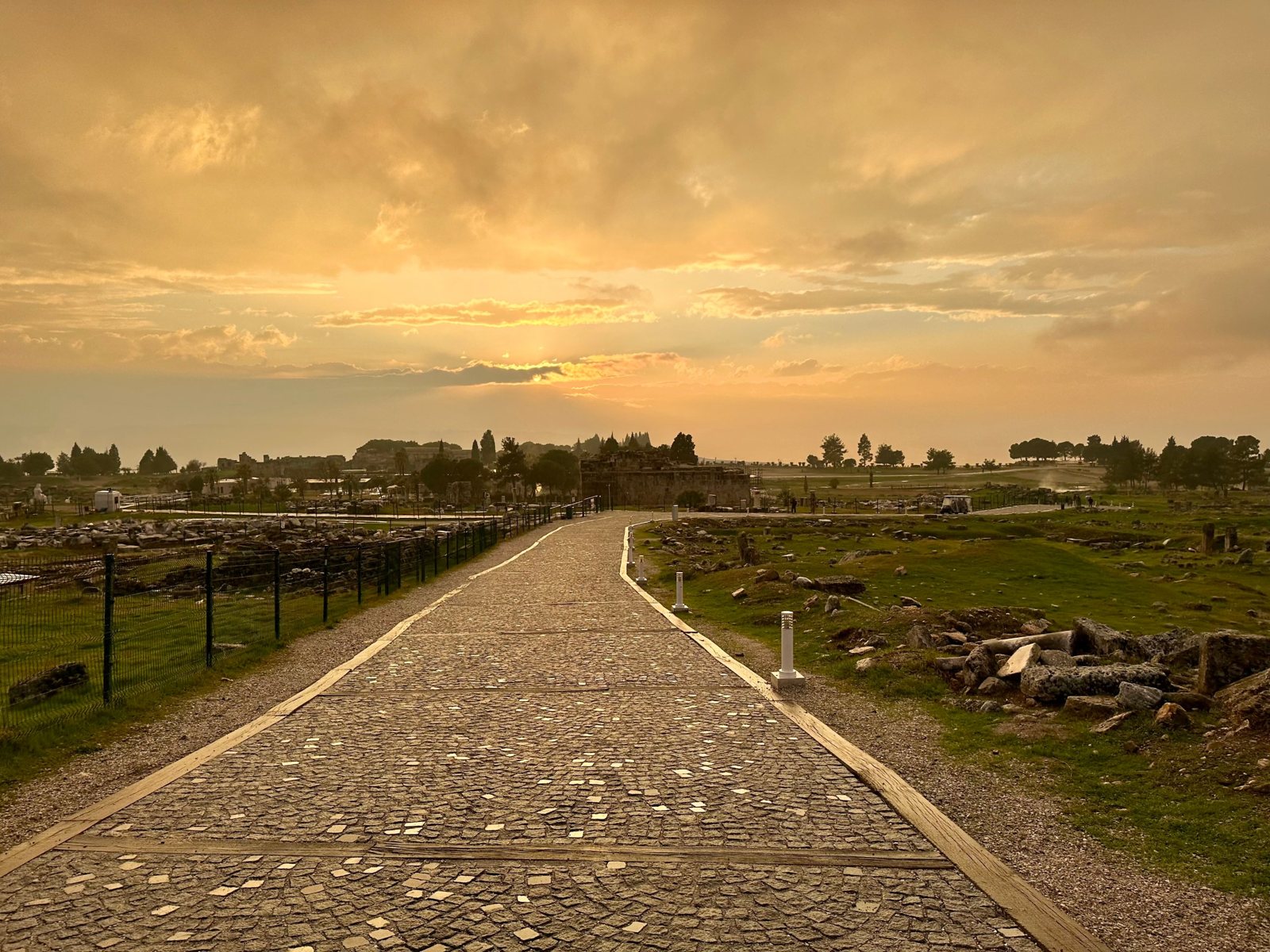 The main street of Hierapolis at dusk.
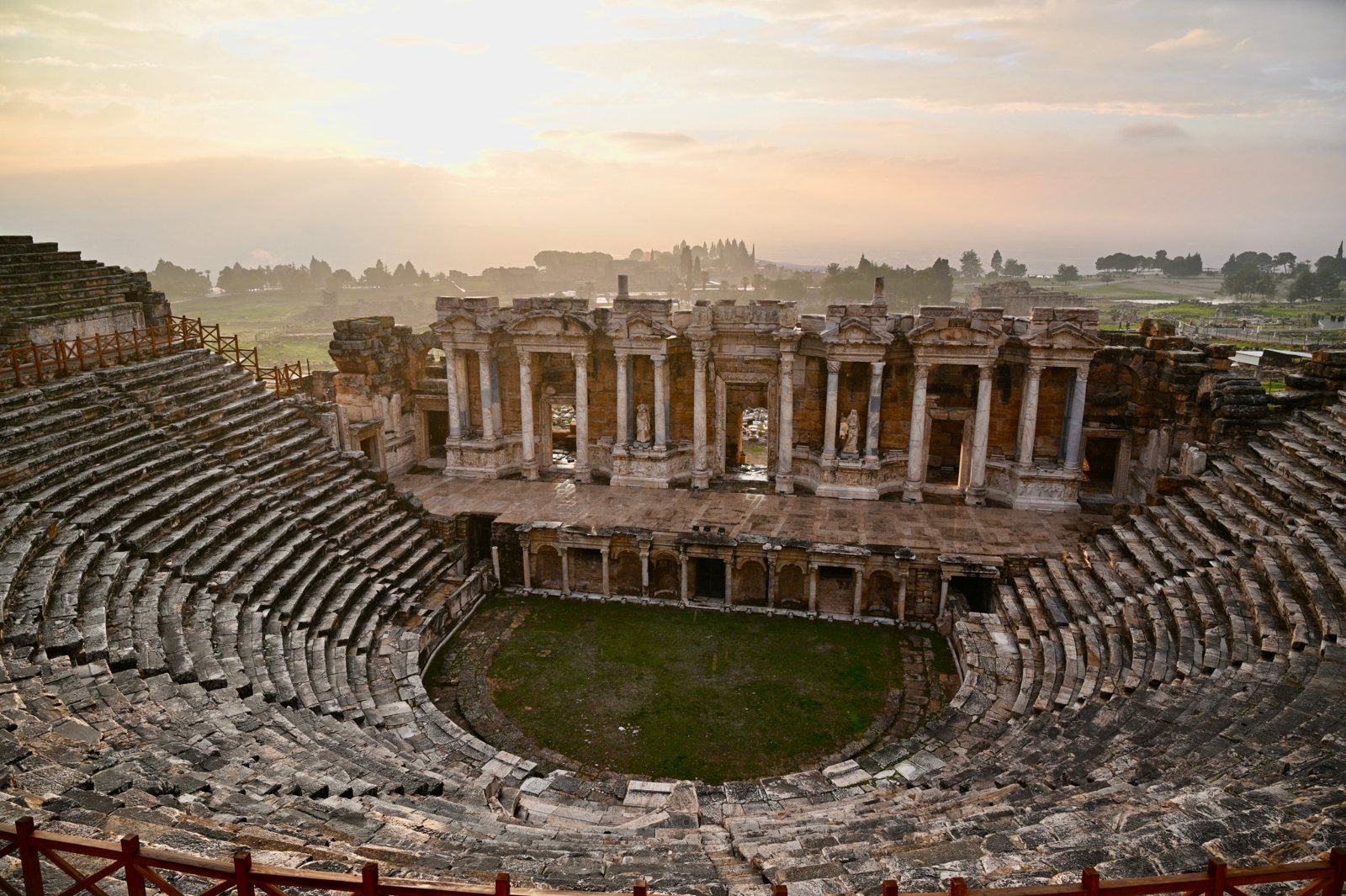 The Roman theater at Hierapolis, on the hillside above the city.
Hierapolis also produced one of the best-known Stoics of the Roman era. Epictetus was born here around AD 50, was taken to Rome as a slave, and after he was freed taught philosophy in Greece. His student Arrian, the historian whose account of Alexander includes the visit to Achilles’ tomb, wrote down his lectures. The Stoics held that virtue is a kind of knowledge, the same idea carved into the façade of the Library of Celsus, and they named four virtues:
- Wisdom: knowing what is good and what is bad.
- Courage: knowing what is to be feared and what is not.
- Moderation: knowing what to pursue and what to avoid.
- Justice: knowing what to give others and what not to.
They also named four passions, each resting on a mistaken judgment: fear of an apparent bad to come, desire for an apparent good to come, pleasure in a good we believe we have, and distress at a bad we believe we have. A sage, who holds no false beliefs, feels none of them. He does feel three “good feelings,” the eupatheiai: wish, the rational pursuit of something; caution, its rational avoidance; and joy, rational elation. Each has gentler forms: goodwill and kindness under wish, modesty and reverence under caution, and delight and cheerfulness under joy. The Plutonium, a short walk away, is a good place to practice caution.
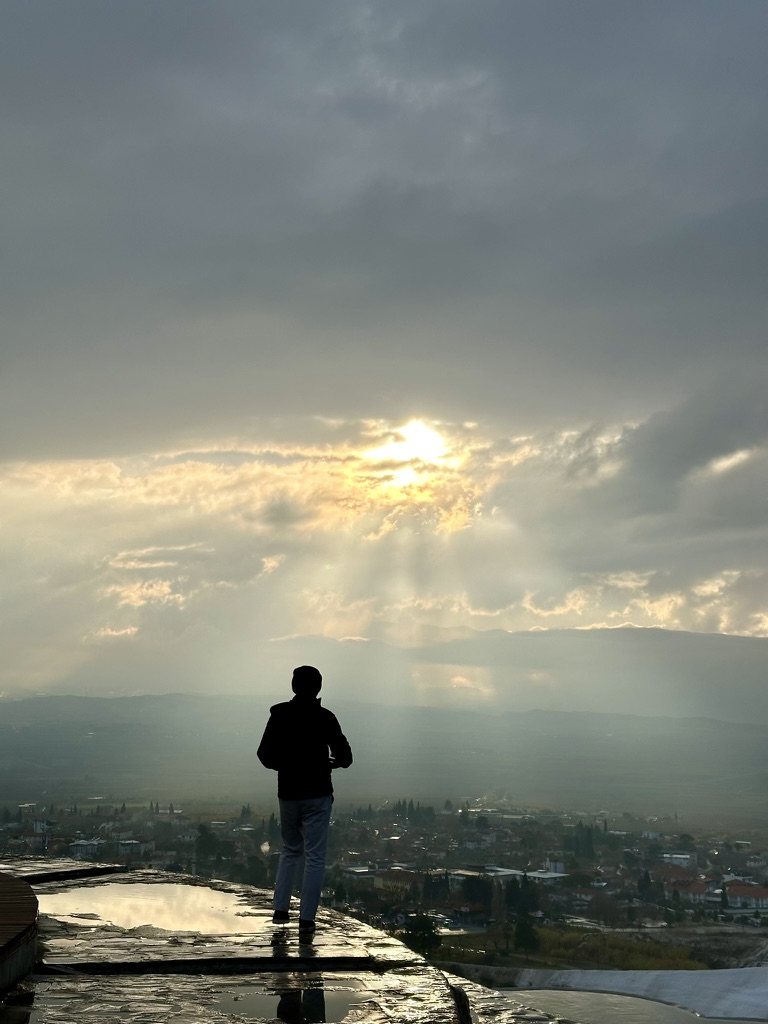 Sunset over the Lycus valley from the edge of the travertines.
Across the valley, Laodicea was a rich banking and textile city. It is one of the seven churches of Asia addressed in the Book of Revelation, alongside Ephesus and Smyrna, and it is the one rebuked for being “lukewarm, and neither cold nor hot.” A common reading links the line to its water, which arrived by aqueduct neither as hot as the springs at Hierapolis nor as cold as the water at nearby Colossae.
The Eastern Roman Empire: New Rome
330–1453 · Istanbul, Selçuk · Days 2–4 and 7
Constantine dedicated Constantinople as his new capital on 11 May 330. He chose Byzantion for the reason the Persian general had seen: it commanded the straits, it had the best harbor on the Bosphorus, and it was close to the frontiers that mattered. When the western half of the empire fell in the 5th century, the eastern half carried on from here for another thousand years.
Hagia Sophia
The church Constantine’s successors built on this site burned twice. The second time was in 532, during the Nika riots, when chariot-racing factions nearly overthrew Justinian. He rebuilt it in under six years. His architects, Anthemius of Tralles and Isidore of Miletus, were both from the Ionian coast, and the church they finished in 537 has a dome more than 30 meters across that seems to float on a ring of windows. The historian Procopius wrote that it looked suspended from heaven by a golden chain. A later legend has Justinian saying, at the dedication, “Solomon, I have surpassed thee.” The first dome collapsed in 558, and the one that stands today was finished in 562.
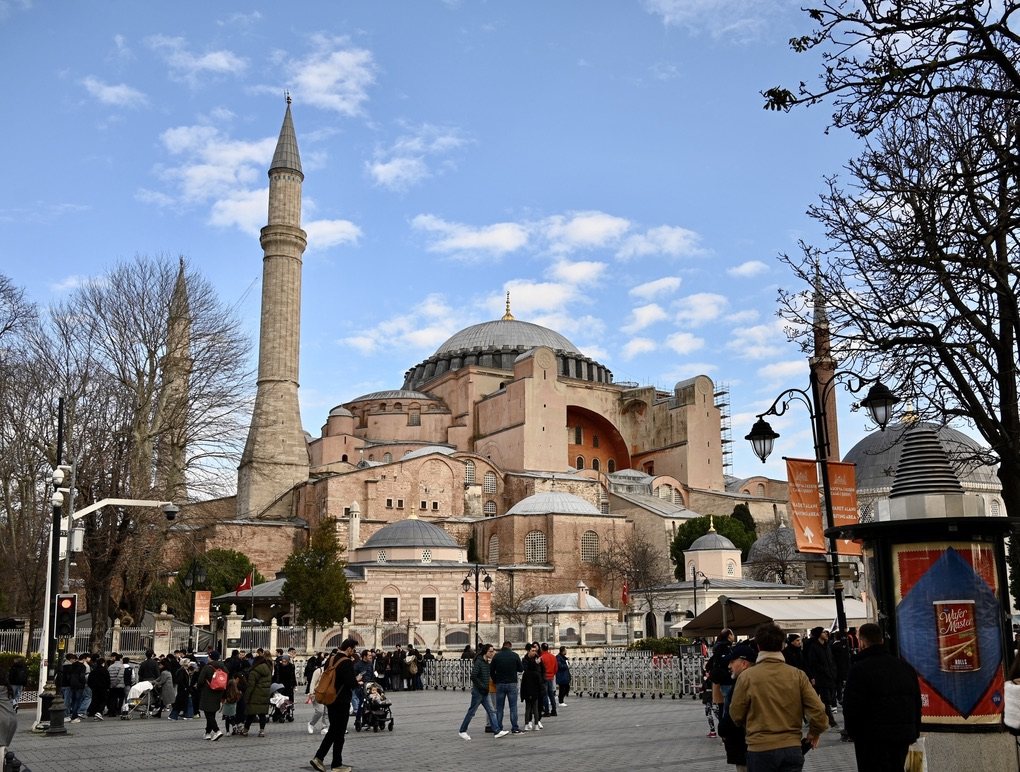 Hagia Sophia from the square. The buttresses and minarets were added over the centuries that followed.
Foreign visitors now see the interior from the upper gallery, which is where I stood. The great green roundels hanging from the piers are Ottoman, painted in the 1840s by the calligrapher Kazasker Mustafa İzzet Efendi, with the names of God, the Prophet Muhammad, the first four caliphs, and Muhammad’s grandsons Hasan and Husayn.
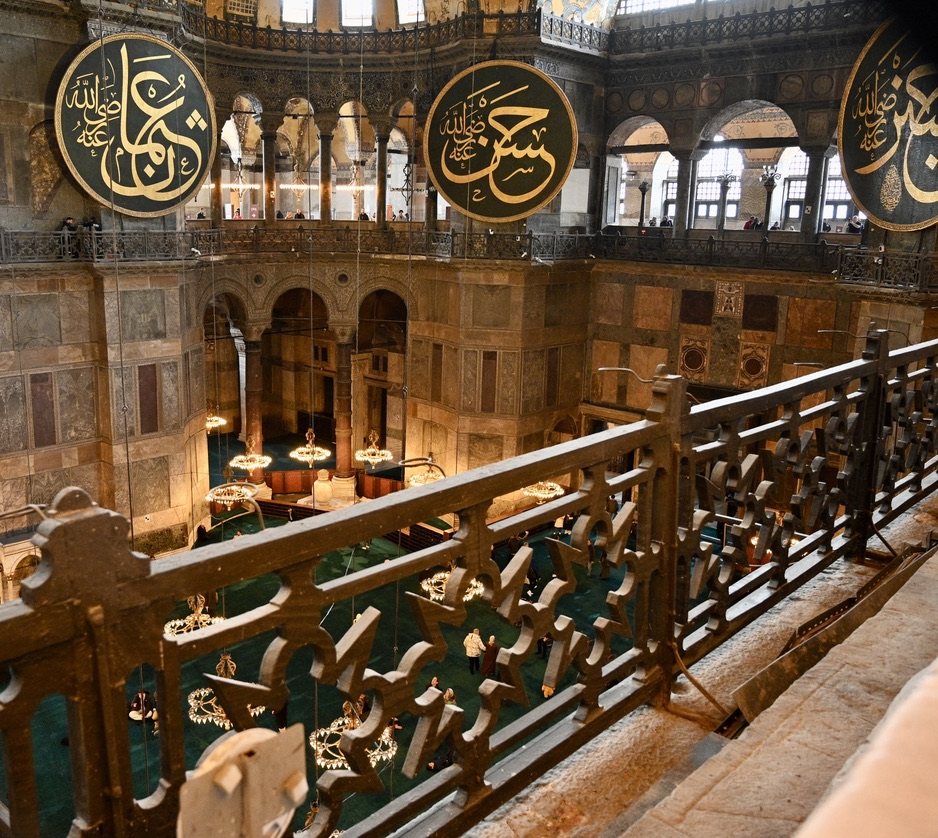 From the gallery: the roundels for the caliph Uthman, left, and Hasan, center.
Next door, Hagia Irene is the city’s other great early church, and the simplest to read. Justinian rebuilt it after the same riots, and the Second Ecumenical Council met here in 381 in the church that came before. Its apse holds a plain black cross on a gold ground instead of a figure. It dates from Iconoclasm, the 8th and 9th centuries, when emperors banned religious images, and it survived because the Ottomans never turned this church into a mosque; they used it as an armory.
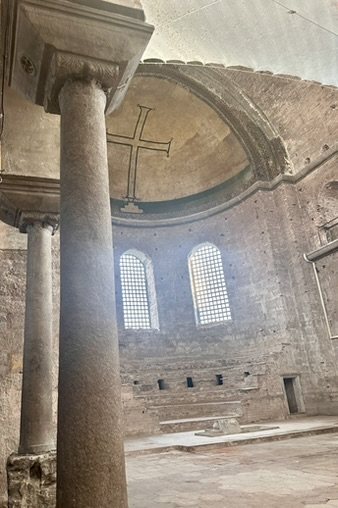 The Iconoclast cross in the apse of Hagia Irene.
Justinian also built the Basilica Cistern, under the square, in 532. It is a forest of 336 columns, each about 9 meters tall, and it could hold up to 80,000 cubic meters of water piped in from outside the city. The builders reused whatever stone came to hand: two of its columns stand on Roman heads of Medusa, one on its side and one upside down. James Bond rowed through it in From Russia with Love in 1963, and Robert Langdon came back for Dan Brown’s Inferno in 2016.
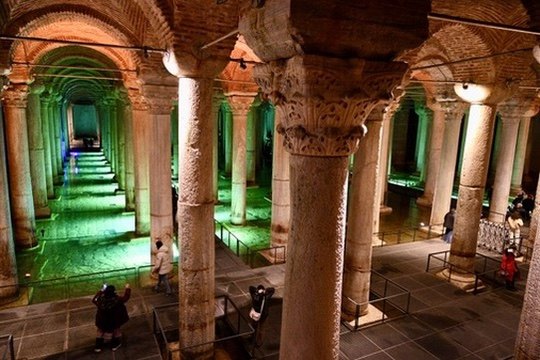 The Basilica Cistern, built under Justinian in 532.
Ephesus Again
On the coast, the Christian layer sits directly on top of the Roman one. In 431, the Council of Ephesus declared that Mary should be called Theotokos, “Mother of God,” which is why she carries that title, abbreviated ΜΡ ΘΥ, in the mosaic over the door in Hagia Sophia. On the hill above Selçuk, Justinian built the Basilica of St John over the apostle’s traditional tomb, and its ruins look down on the single column left of the Temple of Artemis.
The Walls, Galata, and 1453
The land walls of Theodosius II, finished around 413 and doubled after an earthquake in 447, kept Constantinople safe for a thousand years. The city outlasted sieges by Avars, Arabs, and Bulgars, and fell to a foreign army only once before 1453, to the Fourth Crusade in 1204. In the 14th century, the Byzantine nobleman Theodore Metochites rebuilt the Chora monastery near the walls and filled it with mosaics and frescoes often counted among the finest late Byzantine art; it reopened as a mosque in May 2024.
Across the Golden Horn, Galata was a Genoese trading colony, and the Genoese built Galata Tower in 1348. A legend recorded by the travel writer Evliya Çelebi says that in the 1630s a man named Hezarfen Ahmed Çelebi strapped on wings, jumped from the top, and glided across the Bosphorus to Üsküdar.
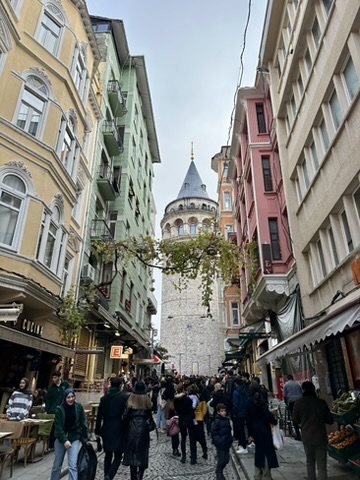 The street up to Galata Tower.
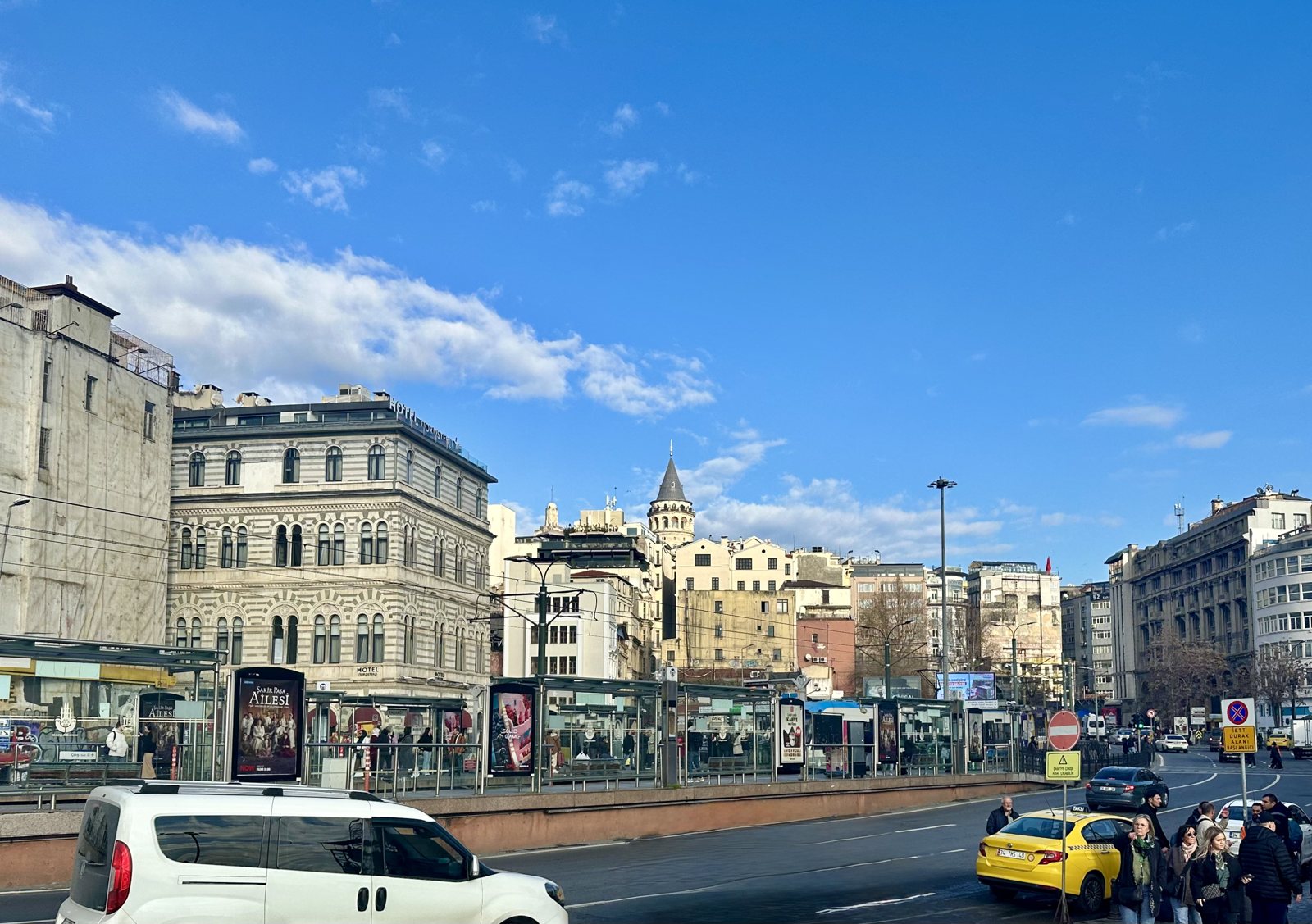 Galata Tower over Karaköy, the old Genoese harbor.
The end came in the spring of 1453. Mehmed II, 21 years old, besieged the city with an army many times the size of its garrison. A chain across the Golden Horn kept his fleet out, so he had ships dragged overland behind Galata and launched them into the Horn. On 29 May his troops broke through the land walls, and the last emperor, Constantine XI, died in the fighting.
Ottoman Istanbul: Caesar of Rome
1453–1922 · Istanbul, Çanakkale, Ayvalık, İzmir · Days 2–6
Mehmed made the city his capital and set out to fill it again. He turned Hagia Sophia into a mosque, began the Grand Bazaar, and built a new palace on the point of the old city, where the Byzantine acropolis had stood. He also built the castle at Çanakkale, in 1462, to close the Dardanelles.
Topkapı
Topkapı was the seat of Ottoman government for about four centuries, and it is a series of courtyards, each more private than the last. The Gate of Salutation leads from the public first court into the second, where the business of the empire was done.
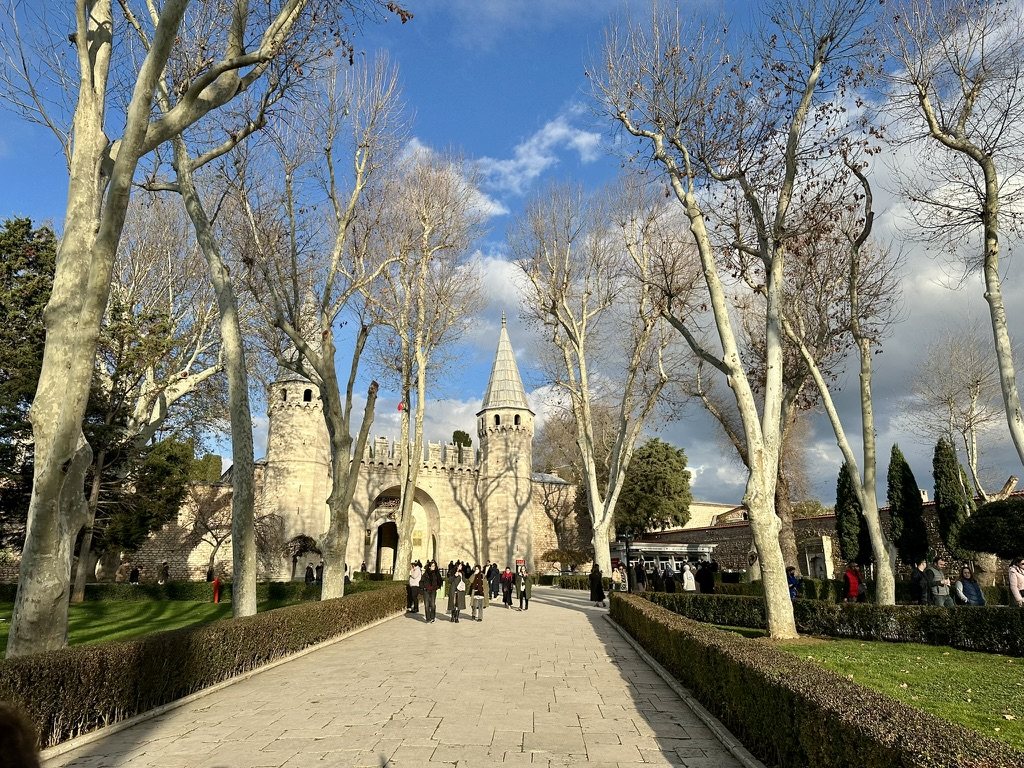 The Gate of Salutation, the entrance to Topkapı’s second court.
In the second court, the Imperial Council met in a domed hall under the Tower of Justice. The grand vizier ran the meetings; the sultan could listen unseen from behind a grilled window above them, and no one in the room could be sure whether he was there.
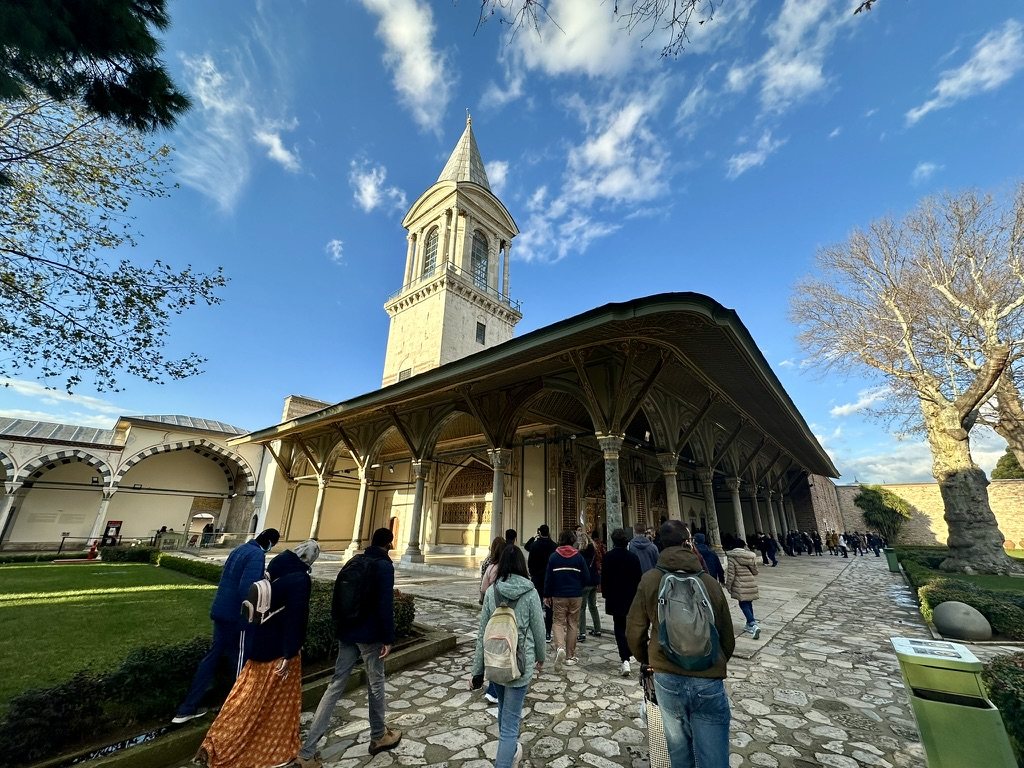 The Imperial Council hall and the Tower of Justice.
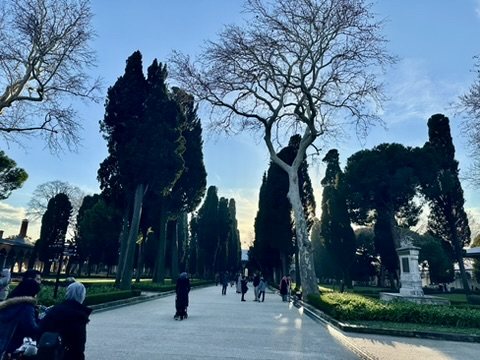 Cypresses in the palace grounds.
From the terraces at the far end, the view explains why every ruler of the city wanted this spot. On one side, the Bosphorus opens toward the Black Sea, with the Byzantine sea walls still running along the shore below. On the other lie the Golden Horn and Galata Tower.
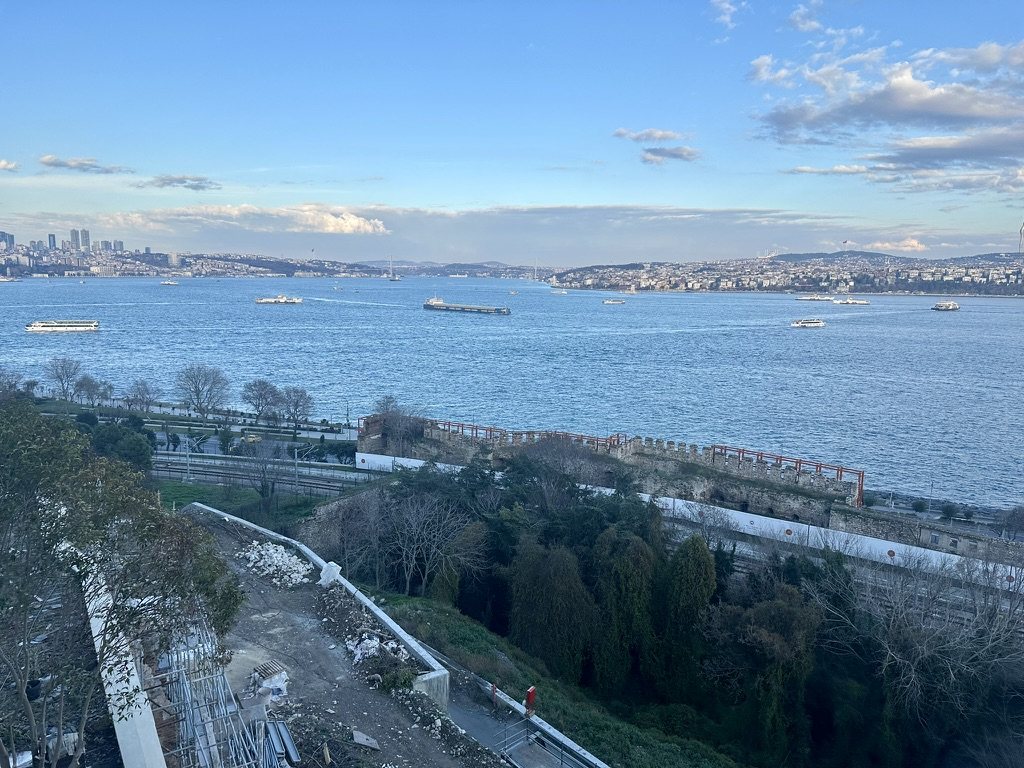 The Bosphorus from Topkapı. The crenellated wall along the shore is part of the old sea walls.
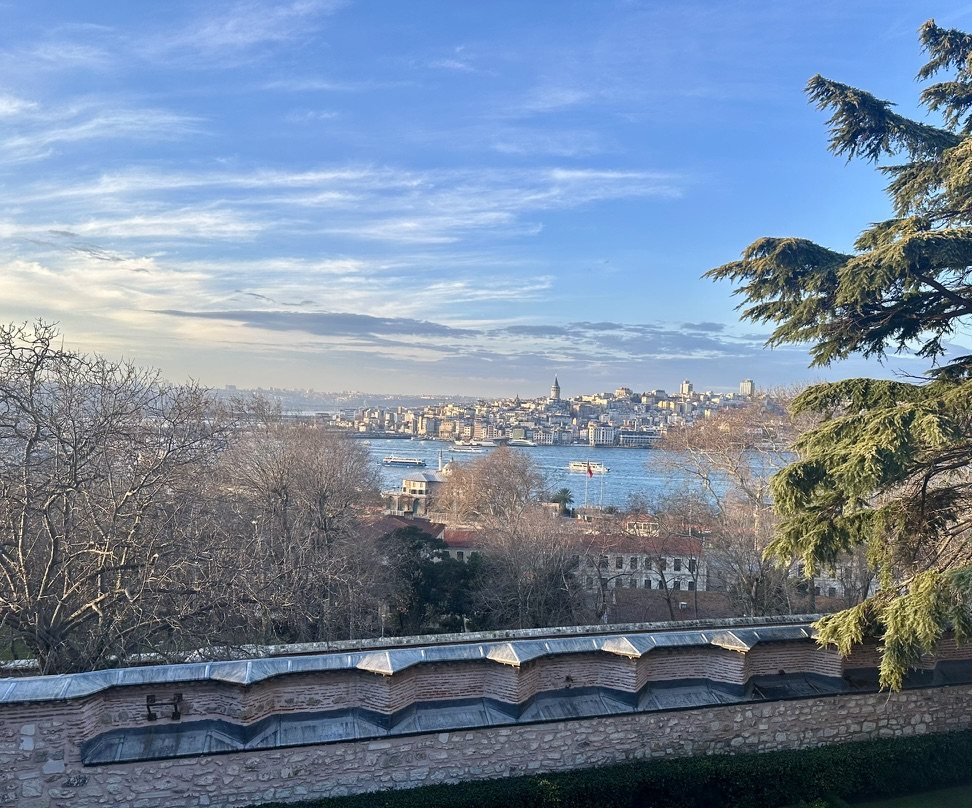 Across the Golden Horn to Galata, from the palace.
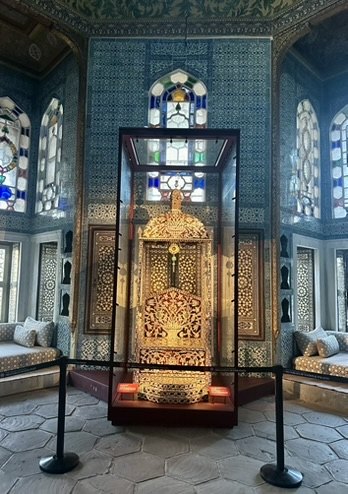 A gilded throne on display in one of the tiled pavilions of the palace’s innermost court.
Mosques and Bazaars
The Ottomans answered Hagia Sophia rather than replacing it. Mimar Sinan, the empire’s great architect, built the Süleymaniye for Süleyman the Magnificent between 1550 and 1557 on the city’s third hill, and Sultan Ahmed I built the Blue Mosque, with its six minarets, directly facing Hagia Sophia between 1609 and 1616.
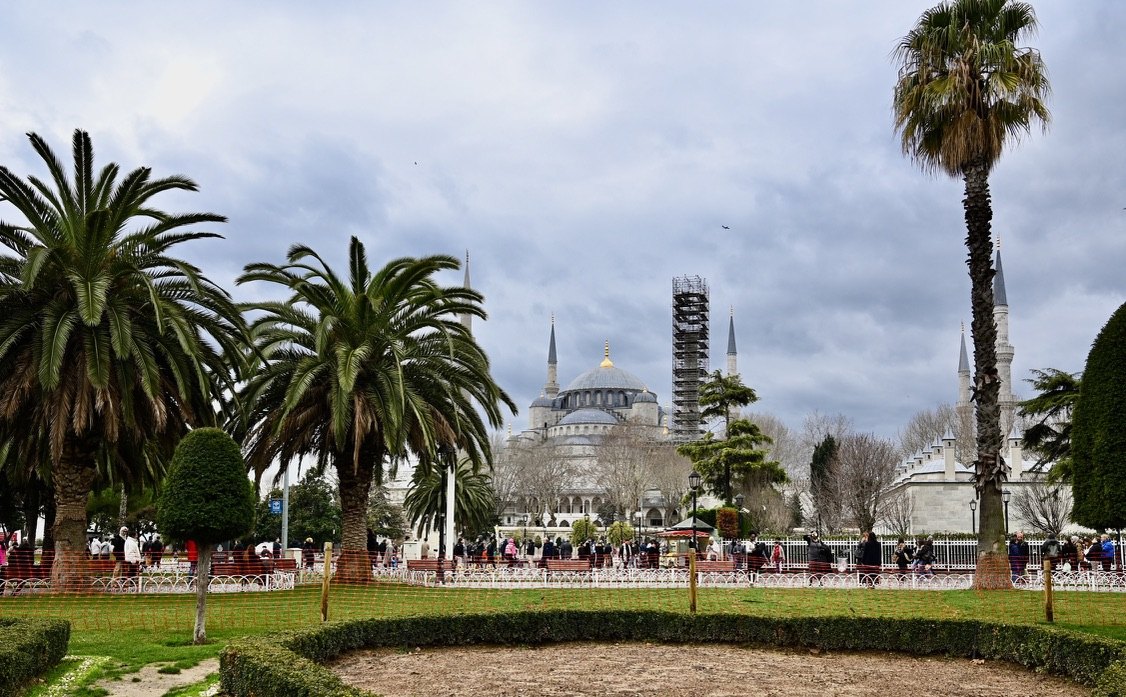 The Blue Mosque from Sultanahmet Square, with one minaret under repair.
Down by the water, the Spice Bazaar was finished in the 1660s as part of the New Mosque complex and is still called the Mısır Çarşısı, the “Egyptian Bazaar,” because revenues from the Ottoman province of Egypt paid for it.
The fishermen on the Galata Bridge are a newer tradition: the first bridge here opened in 1845, and the current one in 1994. They line both rails in all weather, and the grilled-fish sandwiches sold at the foot of the bridge are the other half of the scene.
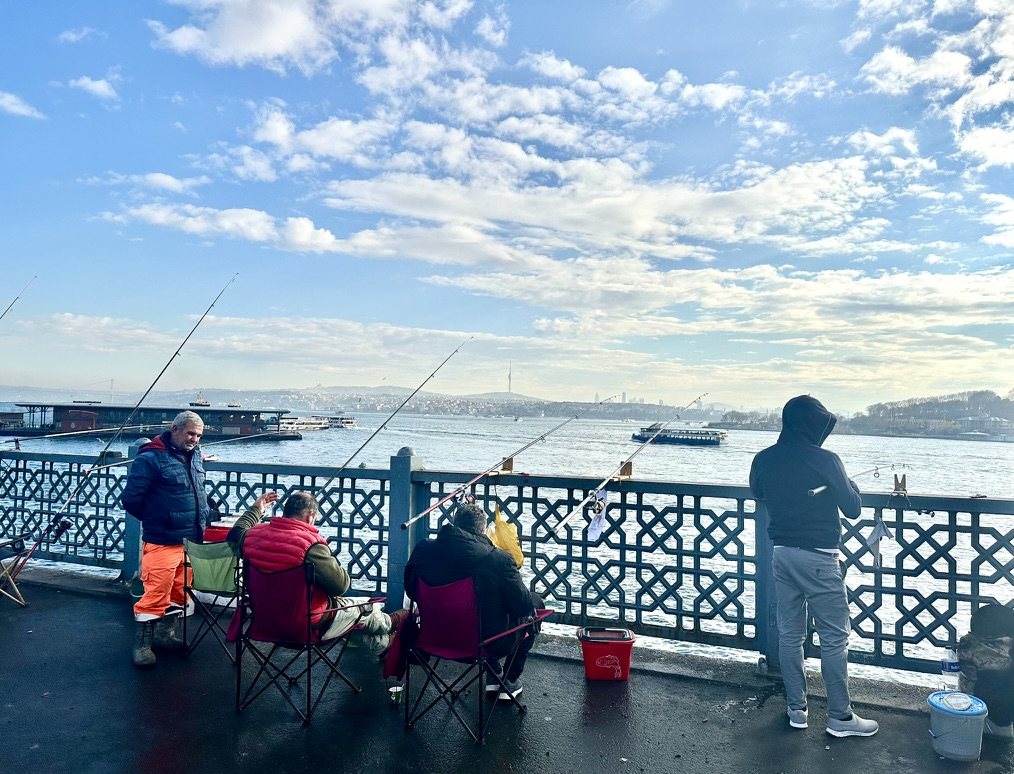 Fishermen on the Galata Bridge, looking toward the Bosphorus.
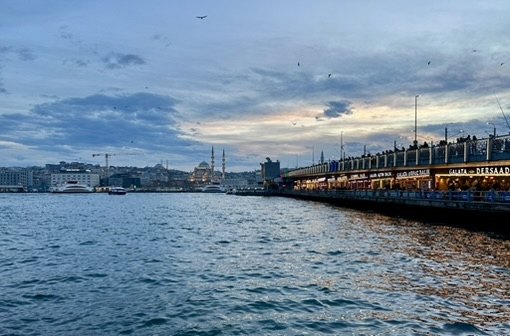 The Galata Bridge at dusk, with the New Mosque and the Spice Bazaar on the far shore.
Pera
In the 19th century, the European quarter across the Golden Horn, Pera, became the modern face of the empire. Its main street, the Grande Rue de Péra, was lined with embassies, churches, and apartment buildings for the city’s Greek, Armenian, Levantine, and Jewish families. The Tünel, a short underground funicular from the waterfront up to Pera, opened in 1875, which makes it the second-oldest underground railway in the world after London’s. The street is now İstiklal Avenue, and a restored red tram, brought back in 1990, still runs its length.
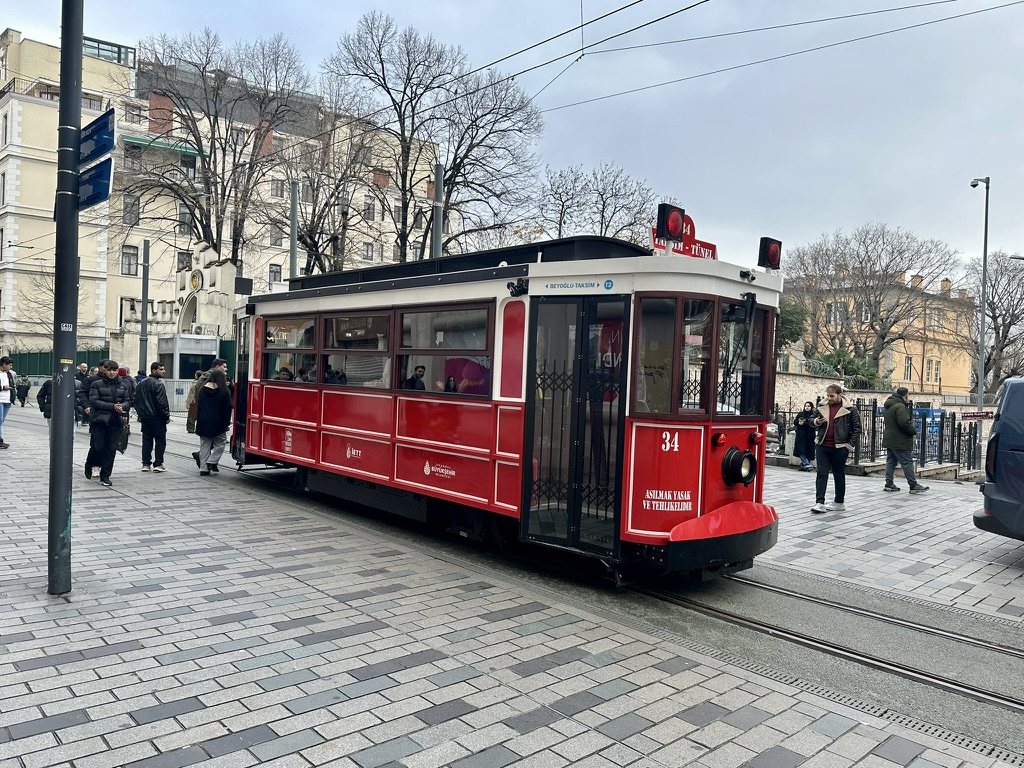 The nostalgic tram, which runs from Taksim to Tünel.
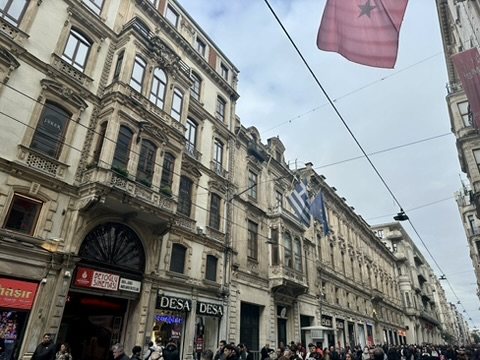 İstiklal Avenue, once the Grande Rue de Péra.
I walked İstiklal three days before Christmas, and St. Anthony of Padua, the largest Catholic church in the city, was decorated for it. It was built between 1906 and 1912 in Venetian neo-Gothic, and in the 1930s and 1940s the Vatican’s envoy to Turkey, Angelo Roncalli, preached here; he later became Pope John XXIII.
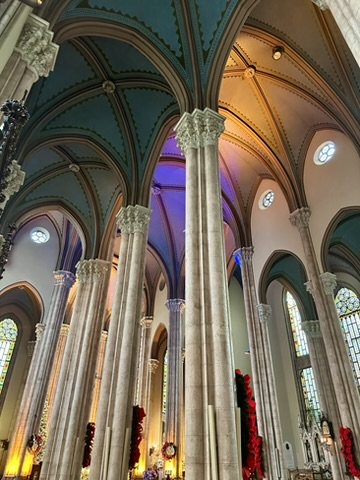 St. Anthony of Padua on İstiklal, decorated for Christmas.
On the Bosphorus shore below, Sultan Abdülmecid I moved the court out of Topkapı and into Dolmabahçe Palace, finished in 1856, a European-style palace for an empire trying to modernize. One clock there is still stopped at 9:05, in the bedroom where Mustafa Kemal Atatürk, the Republic’s founder, died on the morning of 10 November 1938.
The End of the Empire
The empire’s last decade ran through the places on my route. At the Dardanelles in 1915, the minelayer Nusret laid the mines that sank three Allied battleships on 18 March, and the campaign on the Gallipoli peninsula that followed made the name of a young officer, Mustafa Kemal, the future Atatürk. A replica of Nusret sits by the naval museum in Çanakkale. In İzmir, the clock tower on Konak Square was built in 1901 for Sultan Abdülhamid II’s jubilee, with a clock given by Kaiser Wilhelm II. Twenty-one years later, in September 1922, at the end of the Greco-Turkish War, Turkish forces entered the city, and a fire destroyed most of its Greek and Armenian quarters. The population exchange between Greece and Turkey followed in 1923, and the Greek world on this coast, nearly 3,000 years old, came to an end.
On the drive south from Troy, I stopped at Ayvalık, a town that was mostly Greek Orthodox until 1922. Most of its Christians left for Lesbos, just across the water, and Muslims from Lesbos and Crete arrived in their place; some of their descendants still speak Greek at home.
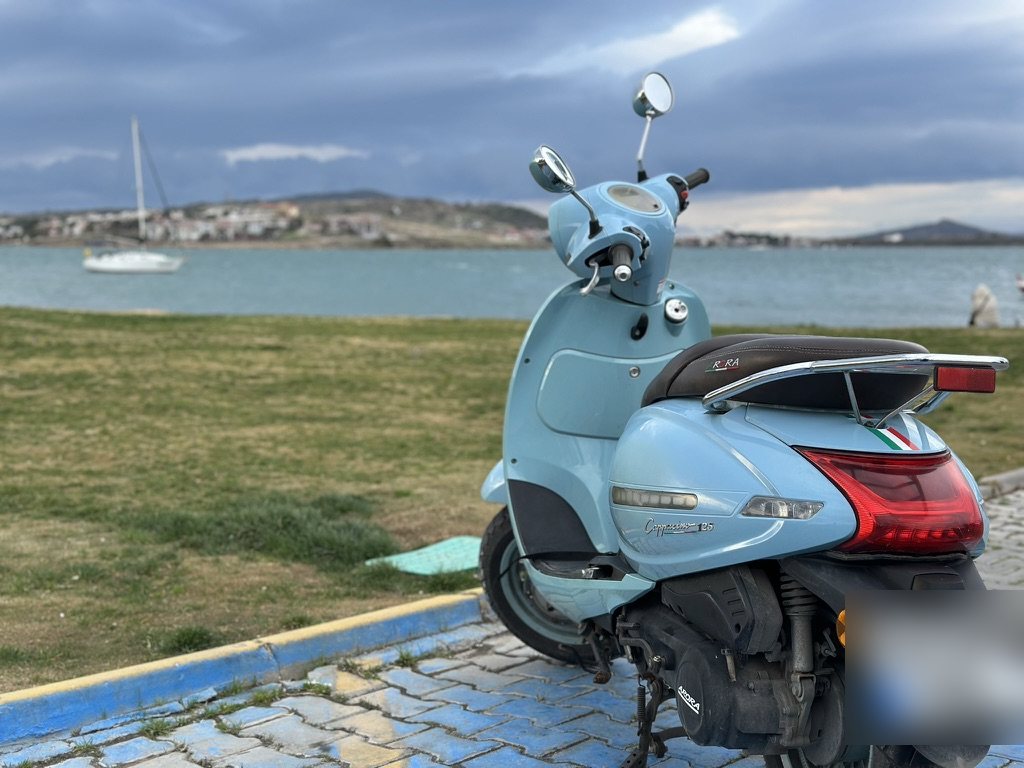 Ayvalık, on the Aegean, looking across the bay.
Istanbul’s street cats, estimated at well over 100,000, belong to no period and to every one of them.
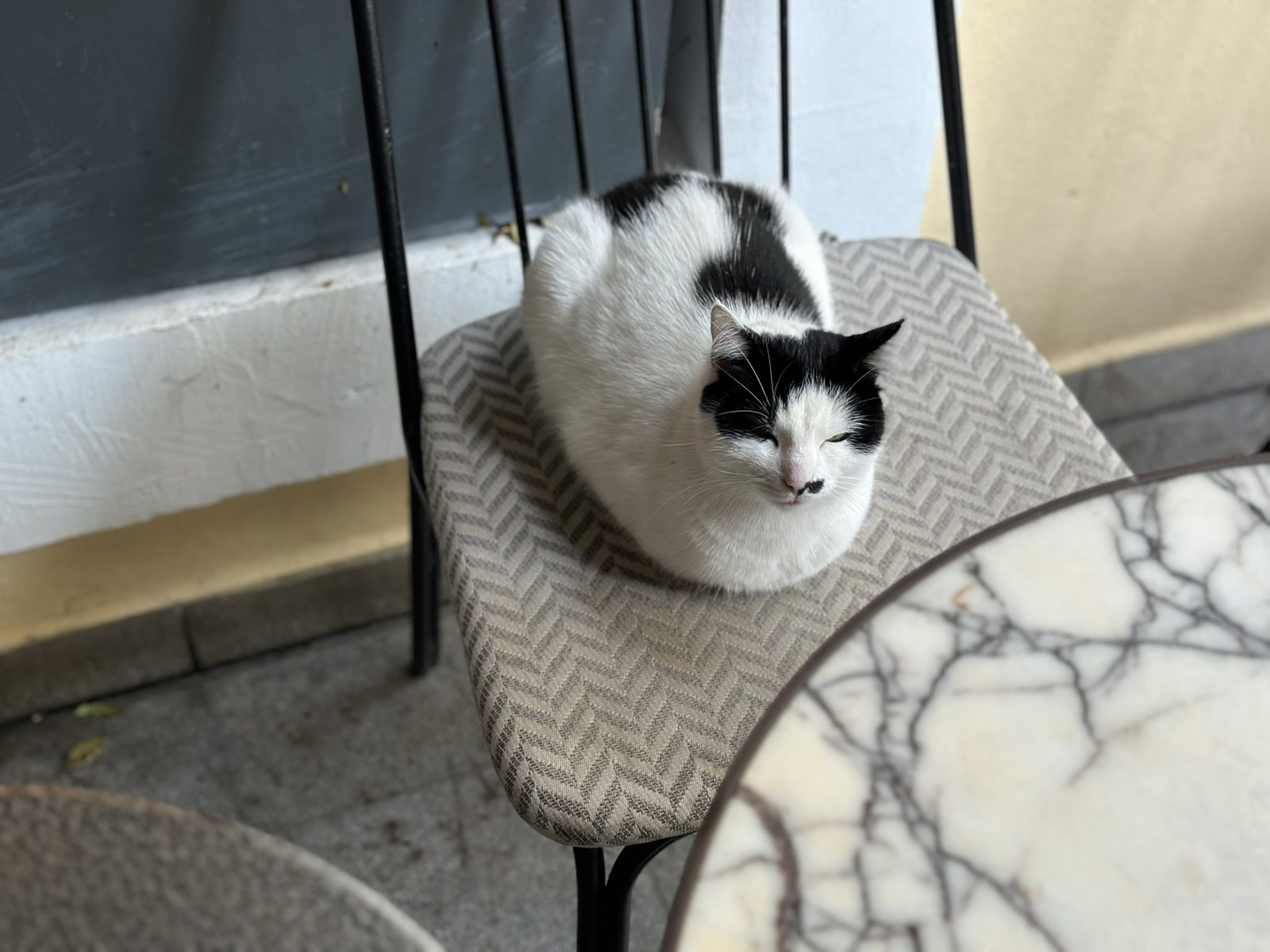 A local, off duty.
The Republic: The Gift Above the Door
1923– · Istanbul · Days 2–4
The Republic of Turkey was declared in 1923, with its capital in Ankara, and for the first time in 1,600 years Istanbul was not the seat of an empire. Hagia Sophia has changed status with the country. It was a church for more than 900 years and a mosque for nearly 500. A cabinet decree in 1934 made it a museum, and in July 2020 it became a mosque again. Its Christian mosaics remain, and the vestibule mosaic is still above its door.
The city and the church have changed hands, names, and faiths since the 10th century, but in that mosaic Constantine and Justinian are still holding them out.
The Route
| Day | Date | Where | What I did |
|---|---|---|---|
| 1 | Sat 21 Dec | Istanbul | Arrival |
| 2–4 | Sun 22–Tue 24 Dec | Istanbul | Galata, Karaköy, and İstiklal; Hagia Sophia, Hagia Irene, Topkapı, the Basilica Cistern, the Blue Mosque, Süleymaniye, Chora, and the land walls; the bazaars; Kadıköy by ferry; Dolmabahçe |
| 5 | Wed 25 Dec | Çanakkale | Drive to the Dardanelles; the Trojan horse, the naval museum, and Çimenlik Castle; Troy and the Troy Museum; Alexandria Troas |
| 6 | Thu 26 Dec | İzmir | Drive south by way of Ayvalık; the Clock Tower, Kadifekale, the Asansör, and Hisar Mosque |
| 7 | Fri 27 Dec | Pamukkale | The Agora of Smyrna; Ephesus, the Temple of Artemis, Teos, and the Basilica of St John; drive inland |
| 8 | Sat 28 Dec | Pamukkale | Laodicea; the travertines, Hierapolis, the Antique Pool, and the theater |
| 9 | Sun 29 Dec | — | Flight from Denizli |
Appendix: Reading a Byzantine Mosaic
Byzantine mosaics label their figures in Greek, and the labels use a few standard abbreviations. The letters look unfamiliar mainly because the C-shaped “lunate” sigma, Ϲ, stands in for Σ, and a bar over a pair of letters marks a sacred name written in short form.
| On the mosaic | Greek in full | Meaning |
|---|---|---|
| ΜΡ ΘΥ | Μήτηρ Θεοῦ | Mother of God (the title from the Council of Ephesus) |
| ΙϹ ΧϹ | Ἰησοῦς Χριστός | Jesus Christ |
| ΚΩΝϹΤΑΝΤΙΝΟϹ Ο ΕΝ ΑΓΙΟΙϹ ΜΕΓΑϹ ΒΑϹΙΛΕΥϹ | Κωνσταντῖνος ὁ ἐν ἁγίοις μέγας βασιλεύς | Constantine, the great emperor among the saints |
| ΙΟΥϹΤΙΝΙΑΝΟϹ Ο ΑΟΙΔΙΜΟϹ ΒΑϹΙΛΕΥϹ | Ἰουστινιανὸς ὁ ἀοίδιμος βασιλεύς | Justinian, the emperor of glorious memory |