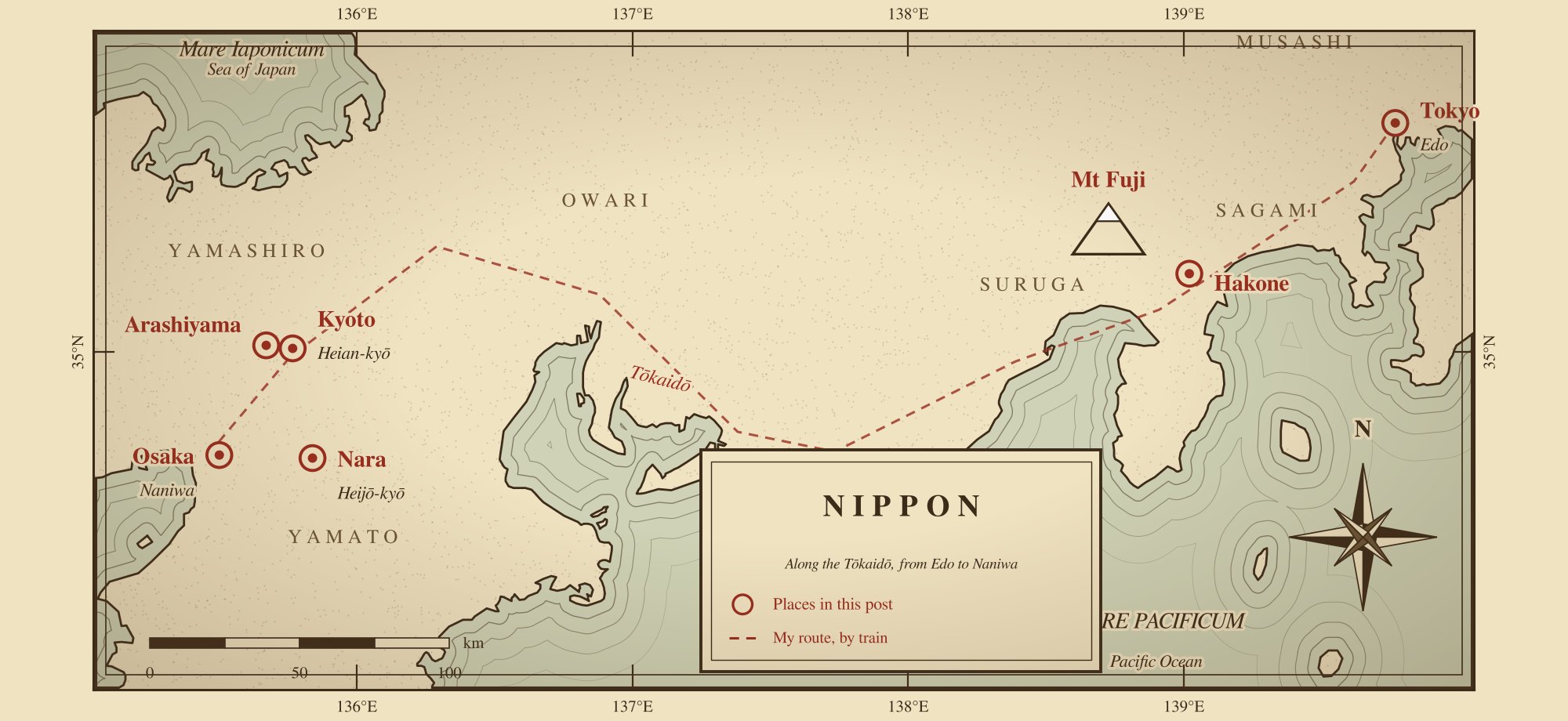
 Central Japan, drawn for this post in the style of an old map. The dashed line follows the Tōkaidō Shinkansen; old names and provinces are in italics.
This trip was not an escape. It was about resetting my orientation. I arrived in Japan in December 2025 with more open questions than answers, but I was no longer panicking about that uncertainty; I was learning to stand inside it. My planning notes called the trip Project Samurai, for the discipline more than the swords, and the plan was really a hypothesis: that a country where solitude is not loneliness, where restraint is a form of strength, and where beauty often lives in what is left unsaid might be the right place for that. I did not need answers. I wanted clarity of mind, steadiness of body, and a little quiet.
The route followed the Tōkaidō, the old “Eastern Sea Road” between the shogun’s city of Edo and the emperor’s city of Kyoto, and on to the merchants’ city of Osaka. Each turned out to have something to teach: Tokyo independence, Kyoto restraint, and Osaka ease. Along the way, the trip also ran backward through Japanese history, from the Tokyo of today to Edo, the courts of Kyoto and Nara, and the wars that decided who would rule. So I have written it up by city, with the history and the food folded in where I met them.
The Periods, and Where I Saw Them
Historians name most of Japan’s periods after the seat of power. The dates below are approximate.
| Period | Dates | Where I saw it |
|---|---|---|
| Nara | 710–794 | Tōdai-ji and Kasuga Taisha, Nara |
| Heian | 794–1185 | Kyoto; Fushimi Inari |
| Kamakura and Muromachi | 1185–1573 | Zen, tea, and ink painting in Kyoto and Arashiyama |
| Sengoku and unification | 1467–1603 | Osaka Castle |
| Edo | 1603–1868 | The Imperial Palace (Edo Castle), Nihonbashi, Zōjō-ji, Hakone, Mt Fuji, Hokusai |
| Meiji to today | 1868– | Meiji Jingu, Tokyo Station, Odaiba, Shibuya, Dōtonbori |
Kami and Buddha, Emperor and Shogun
Two ideas help with almost everything a visitor sees in Japan.
The first is that Japan has two main religions, and most people practice both. Shinto is the older one. It has no founder and no single scripture; it holds that kami, gods or spirits, live in the natural world, in mountains, rivers, trees, rocks, even earthquakes and volcanoes. In that sense it resembles other nature religions, such as the old Norse one. Shinto sites are shrines, marked by a torii gate. Buddhism arrived in the 6th century, by tradition in 538 or 552, from India by way of China and the Korean kingdom of Baekje, bringing ideas of impermanence and enlightenment, monks, and scripture. It did not replace Shinto. It layered onto it, and for most of Japanese history the two were practiced together, often on the same grounds. Buddhist sites are temples. The habit continues: the government’s religious yearbook counts about 87 million Shinto adherents and 83 million Buddhists in a country of about 125 million, because so many people are counted by both. A common description is that Japanese life begins at the shrine and ends at the temple, which handles most funerals.
Zen, the school of Buddhism best known abroad, came later. The monk Eisai brought Rinzai Zen back from China in 1191, along with a taste for powdered green tea, which he promoted in a book on the health benefits of drinking it. Dōgen founded the Sōtō school after returning in 1227. Zen’s emphasis on discipline and direct experience appealed to the warrior class, and it shaped ink painting, rock gardens, and the tea ceremony.
The second idea is the difference between the emperor and the shogun. The imperial house is often called the oldest continuous hereditary monarchy in the world; by legend it descends from the sun goddess Amaterasu, and the current emperor, Naruhito, who acceded in 2019, is counted as the 126th. For most of the last thousand years, though, the emperor reigned while someone else ruled. From the late 12th century, real power lay with the shogun, the military ruler at the head of the samurai. Japan’s history is largely the story of how those two roles were divided, fought over, and in 1868 put back together.
Tokyo: Motion, Scale, and Independence
Fri 19–Tue 23 Dec · Tokyo, Mt Fuji, Hakone · Days 1–5
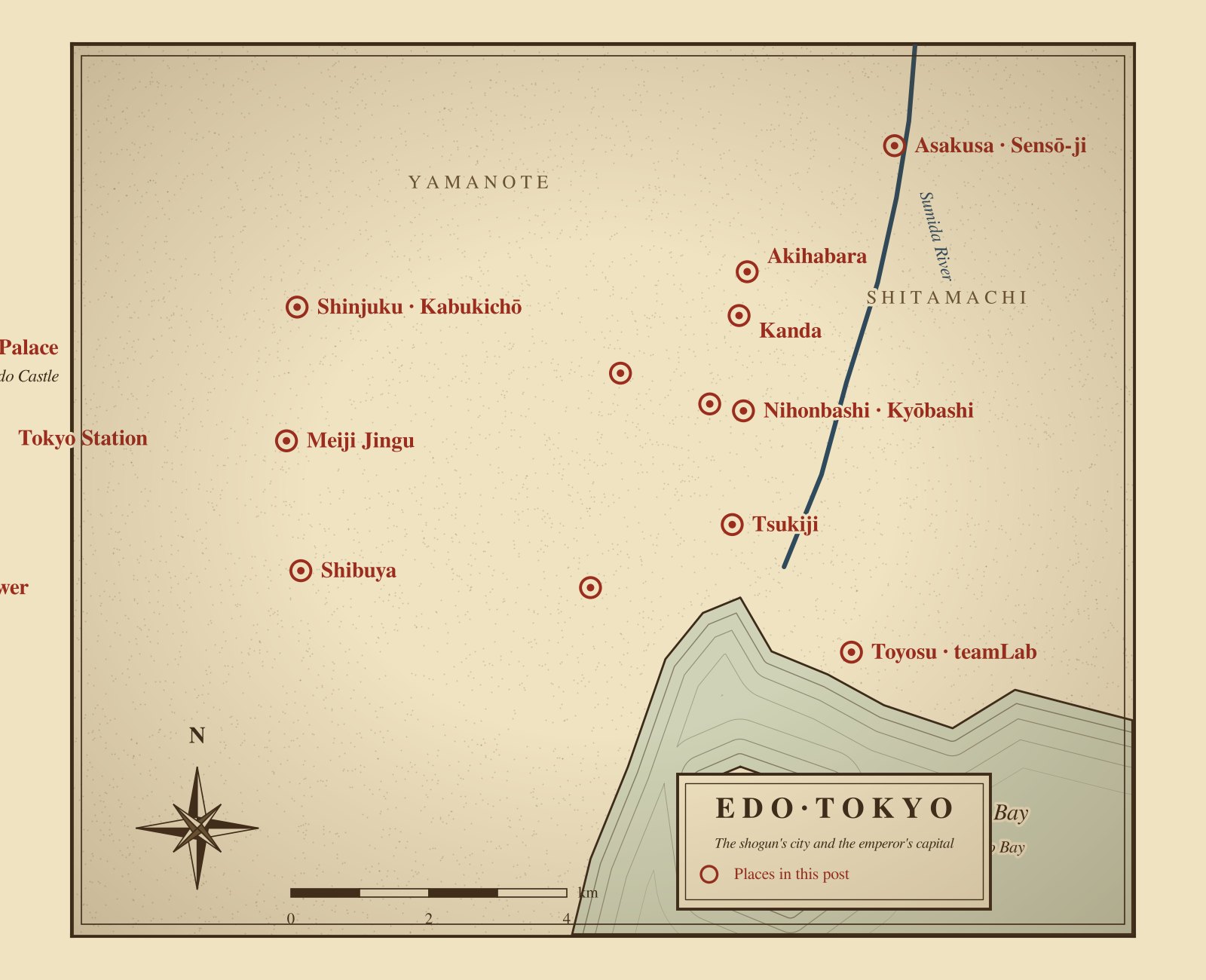 Tokyo, drawn for this post in the style of an old map, with the places I visited. The bay shore is approximate.
Tokyo was where I landed back into the world. The city did not wait for me. It moved immediately, trains, people, and lights, all with precision. I was anonymous, and that felt good: no one was watching, and no one expected anything. I walked without a destination, and the city absorbed me. On my first night I ate at Ichiran, a tonkotsu ramen chain from Fukuoka where each diner sits in a booth with partitions on either side, which may be the most Tokyo way possible to eat alone without explanation. (At home, my own attempt is a double-soup shoyu ramen, topped with ajitama.)
Edo
Tokyo is a young capital by Japanese standards. It began as Edo, a castle town that the warrior Ōta Dōkan fortified in 1457. Ten years later, the Ōnin War broke out in Kyoto and began more than a century of civil war among regional lords, the Sengoku or “Warring States” period. It ended with three unifiers in turn: Oda Nobunaga, Toyotomi Hideyoshi, and Tokugawa Ieyasu. Ieyasu, who had made Edo his base in 1590, won the decisive battle of Sekigahara in 1600 and became shogun in 1603. For the next 265 years, the Edo period, his family ruled from here in peace, with the emperor in Kyoto and foreign contact restricted, from the 1630s, mainly to the Dutch and Chinese at Nagasaki.
What is left of Edo Castle is now the Imperial Palace, next to Tokyo Station. Most of its grounds are closed, but its moats and walls run through the business district, and the Tatsumi Yagura, a two-story corner turret, is one of only three that survive. The office towers behind it make the point about scale. In the late-1980s bubble, the palace’s land was said to be worth more than all the real estate in California.
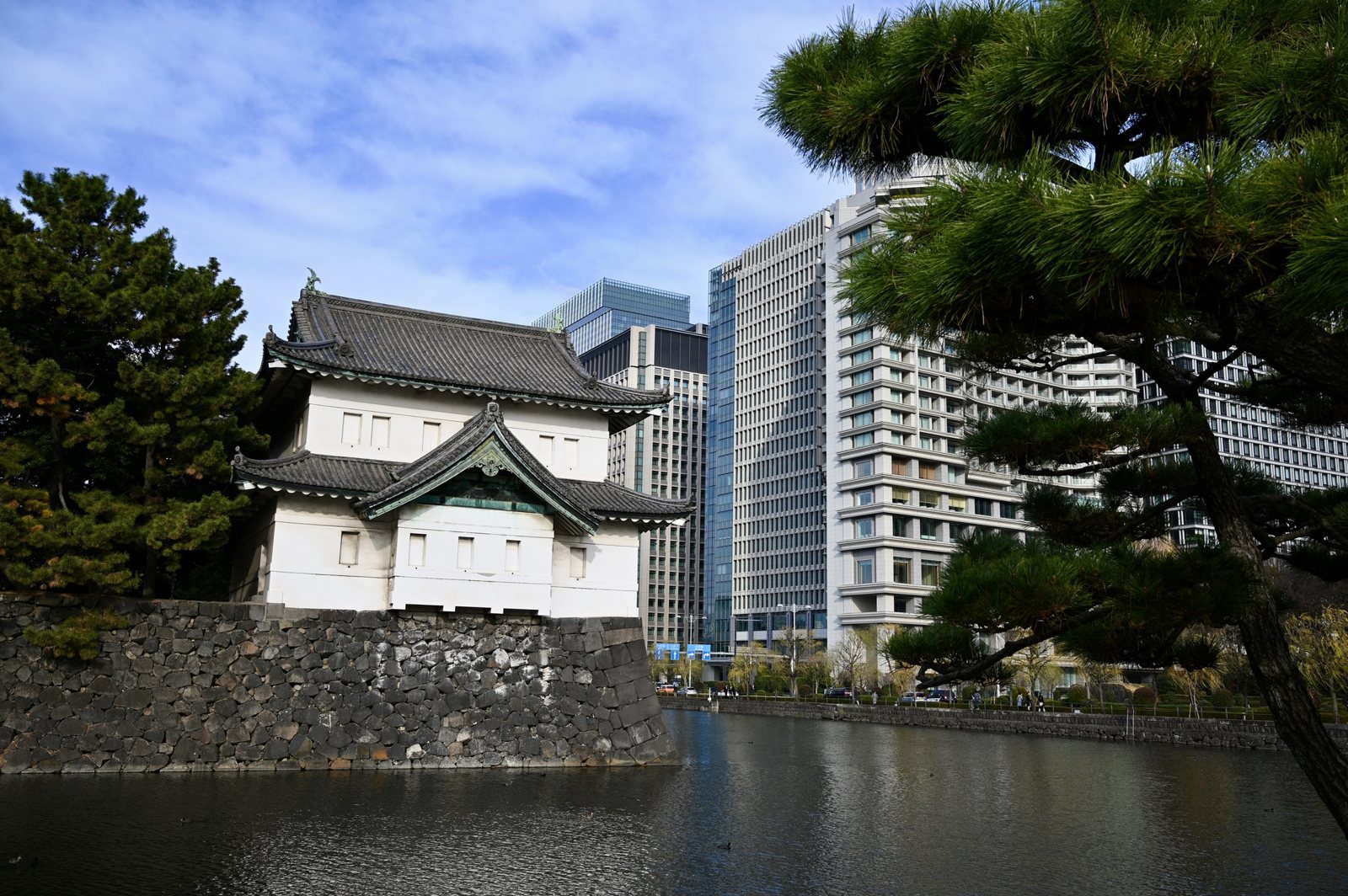 The Tatsumi Yagura, one of three surviving turrets of Edo Castle.
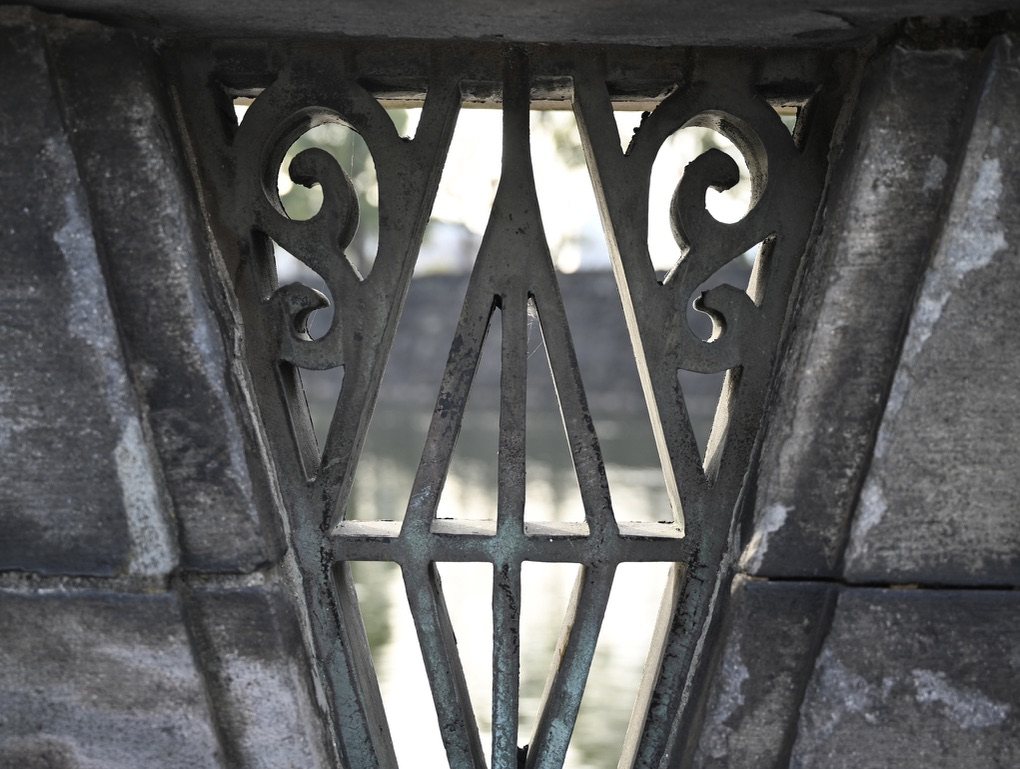 Ironwork on a bridge over the palace moat.
The shogun’s roads began a few blocks away. In 1603 Ieyasu had a bridge put across the river at Nihonbashi, and the next year it became the starting point of the five great roads out of Edo, the Tōkaidō to Kyoto among them. Distances in Japan are still measured from a marker in its road. The current stone bridge opened in 1911, with bronze kirin on its lamp posts whose wings are said to stand for journeys out across the country. In 1963, in the rush to prepare for the Tokyo Olympics, an expressway was built directly over it; it is now being moved underground, with the overhead section due to come down by 2040. One bridge south, a stone post carved 京橋, “the bridge toward the capital,” survives from the Kyōbashi bridge of 1875.
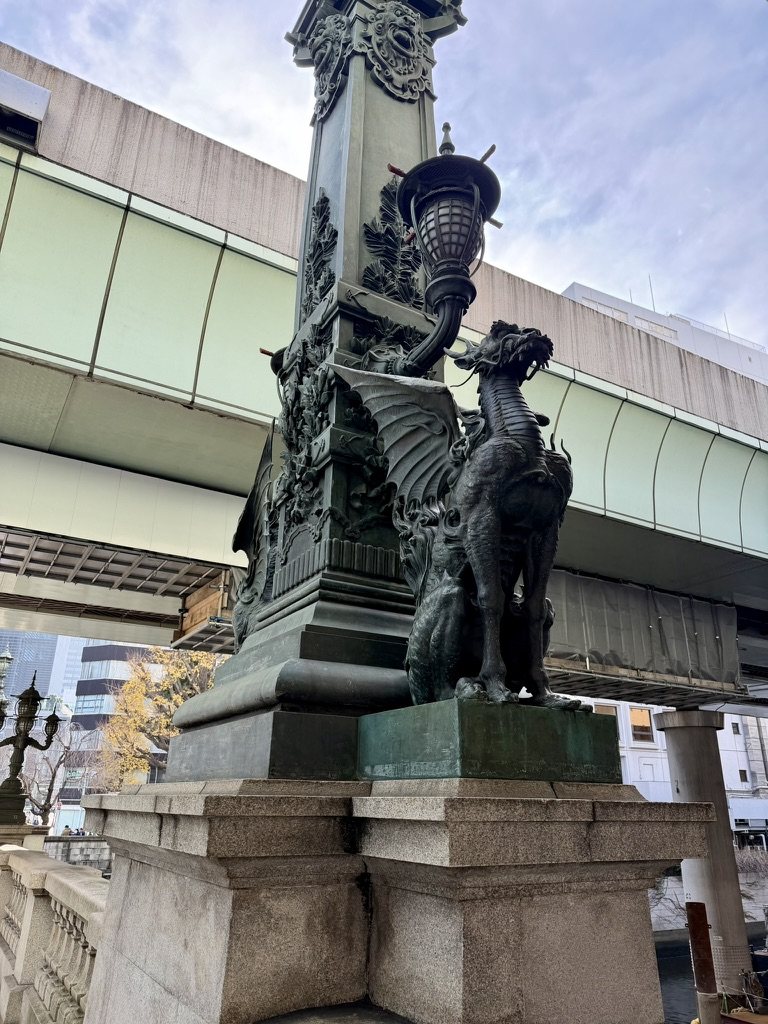 A winged kirin on Nihonbashi, under the expressway built over it in 1963.
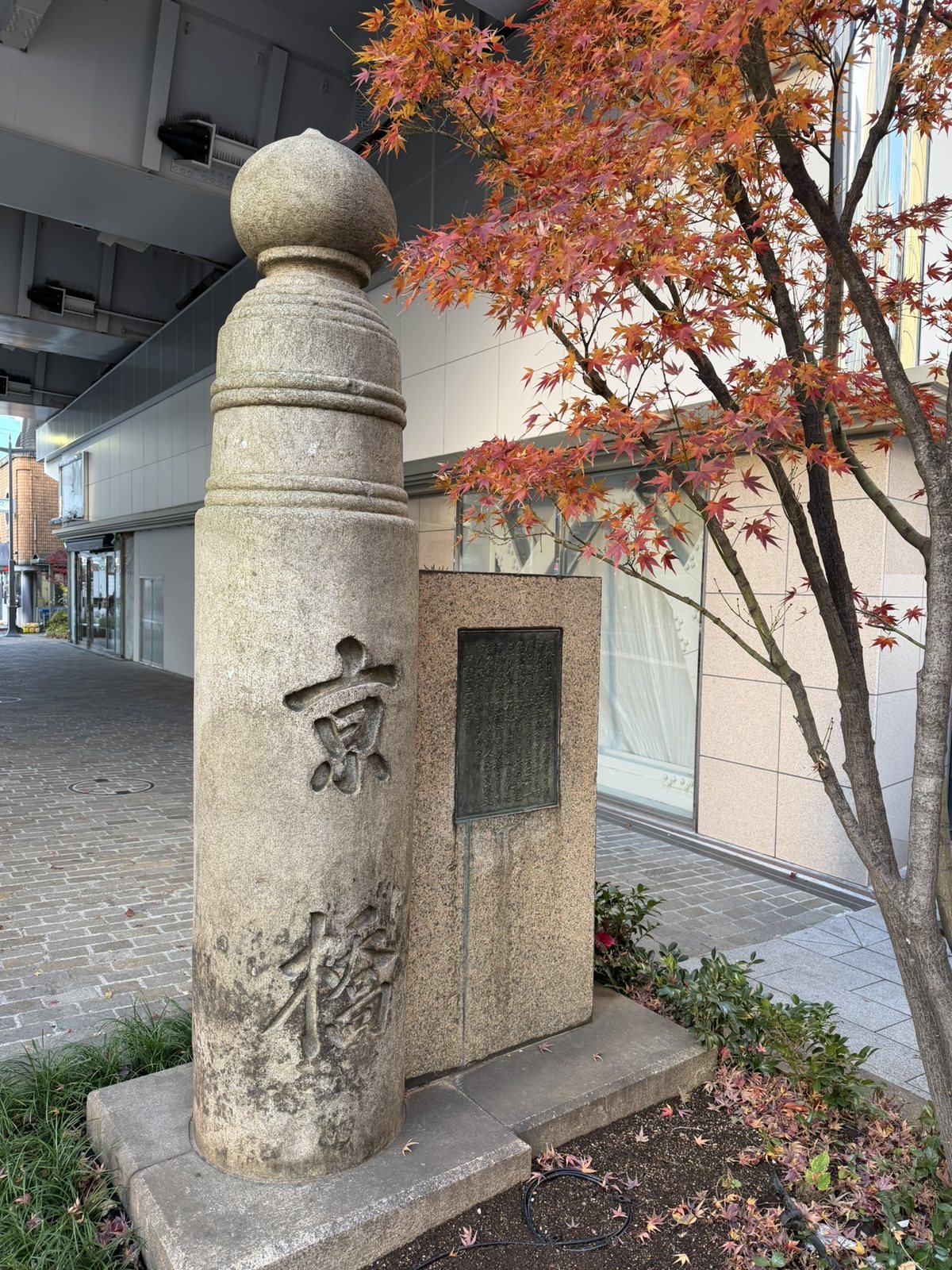 A post from the 1875 Kyōbashi bridge, the next bridge down the Tōkaidō.
Edo was also where much of what the world now calls Japanese food took shape, as fast food for a crowded city of working men. Nigiri sushi, a slice of fish pressed onto vinegared rice, is credited to a vendor named Hanaya Yohei in the 1820s. Tempura had arrived earlier with Portuguese traders in Nagasaki and became an Edo street snack. Eel grilled in a sweet soy glaze, kabayaki, was another. Near Kanda I had it over rice for lunch, with karaage on the side. Next door, Akihabara grew from a postwar black market in radio parts into the city’s district of electronics, anime, and arcades.
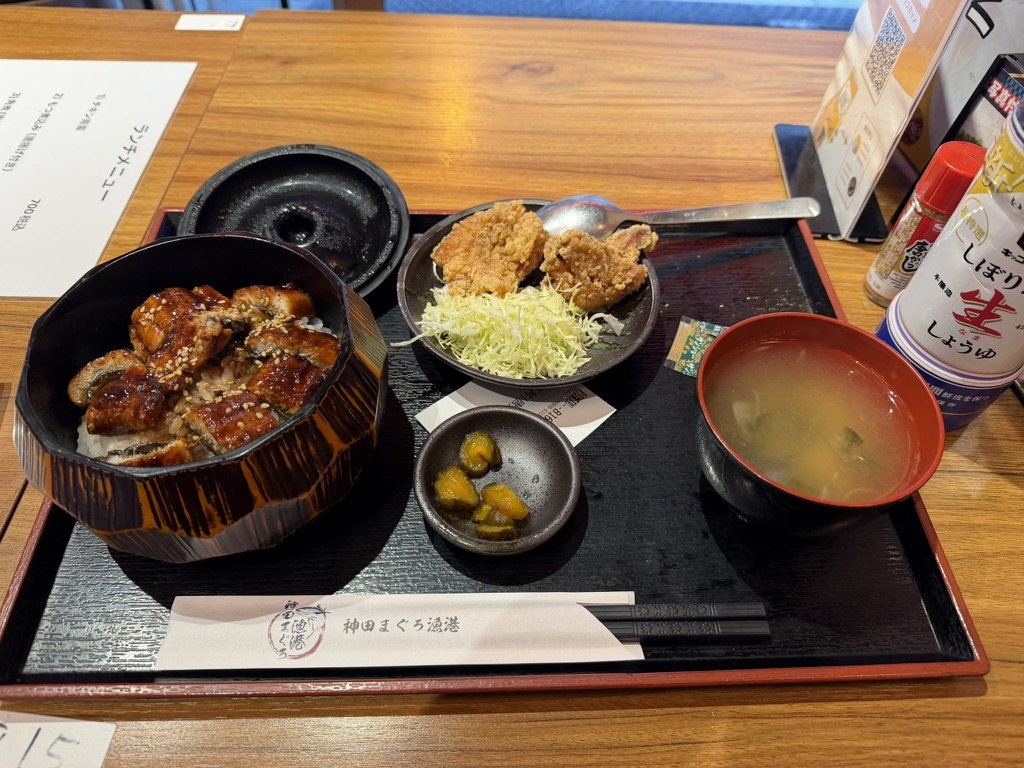 Unagi over rice in Kanda, an Edo dish.
Edo grew up around older places. Sensō-ji in Asakusa, on the Sumida River, is traditionally dated to 628, when two fishermen found a statue of Kannon in their net, which makes it older than Edo by eight centuries. Its inner gate, the Hōzōmon, hangs a red lantern marked 小舟町, for the neighborhood that donated it. Behind the main hall, koi drift under a stone bridge, and the noise of the shopping street disappears within a few steps.
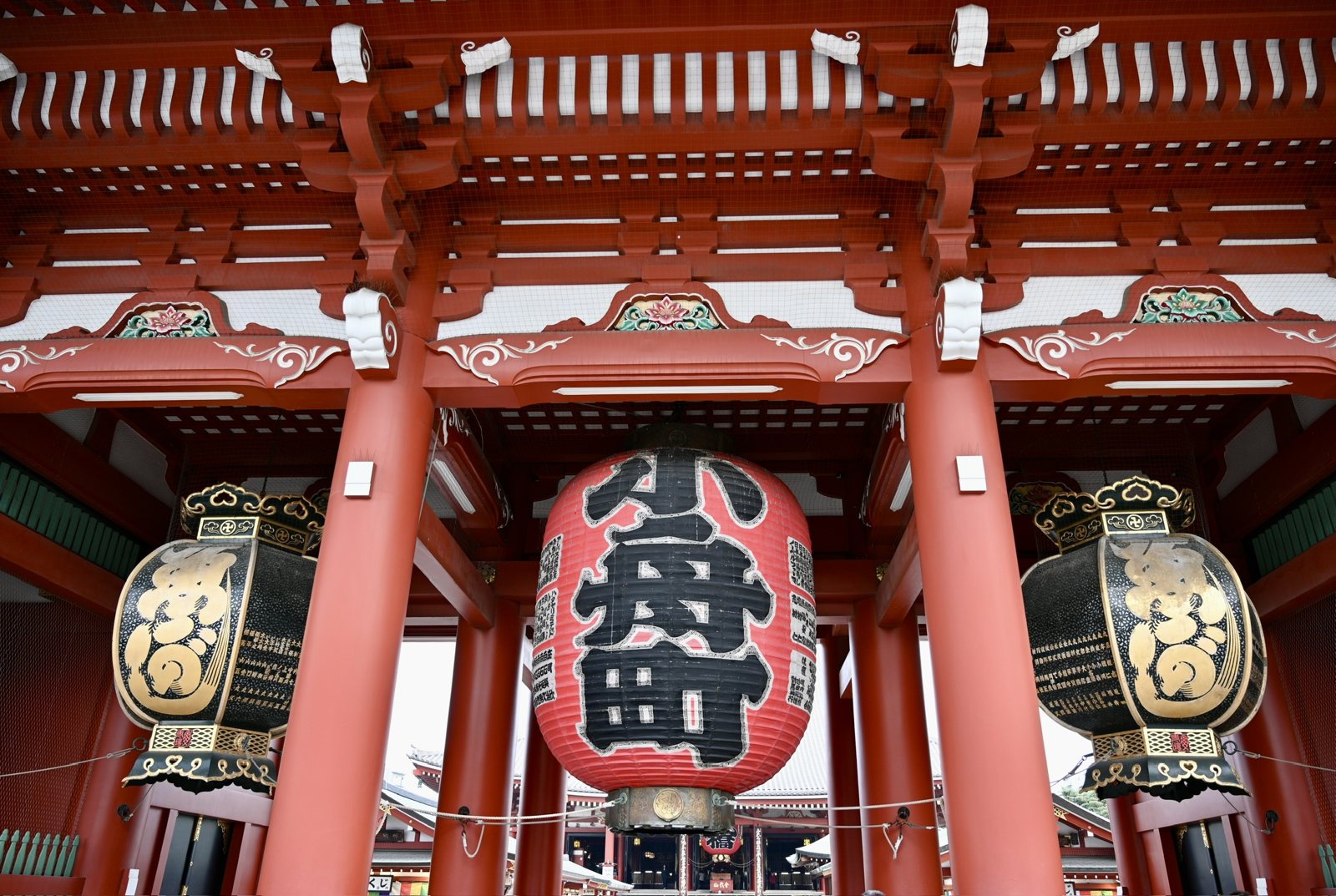 The Hōzōmon at Sensō-ji. The red lantern names the Kobunachō neighborhood that gave it.
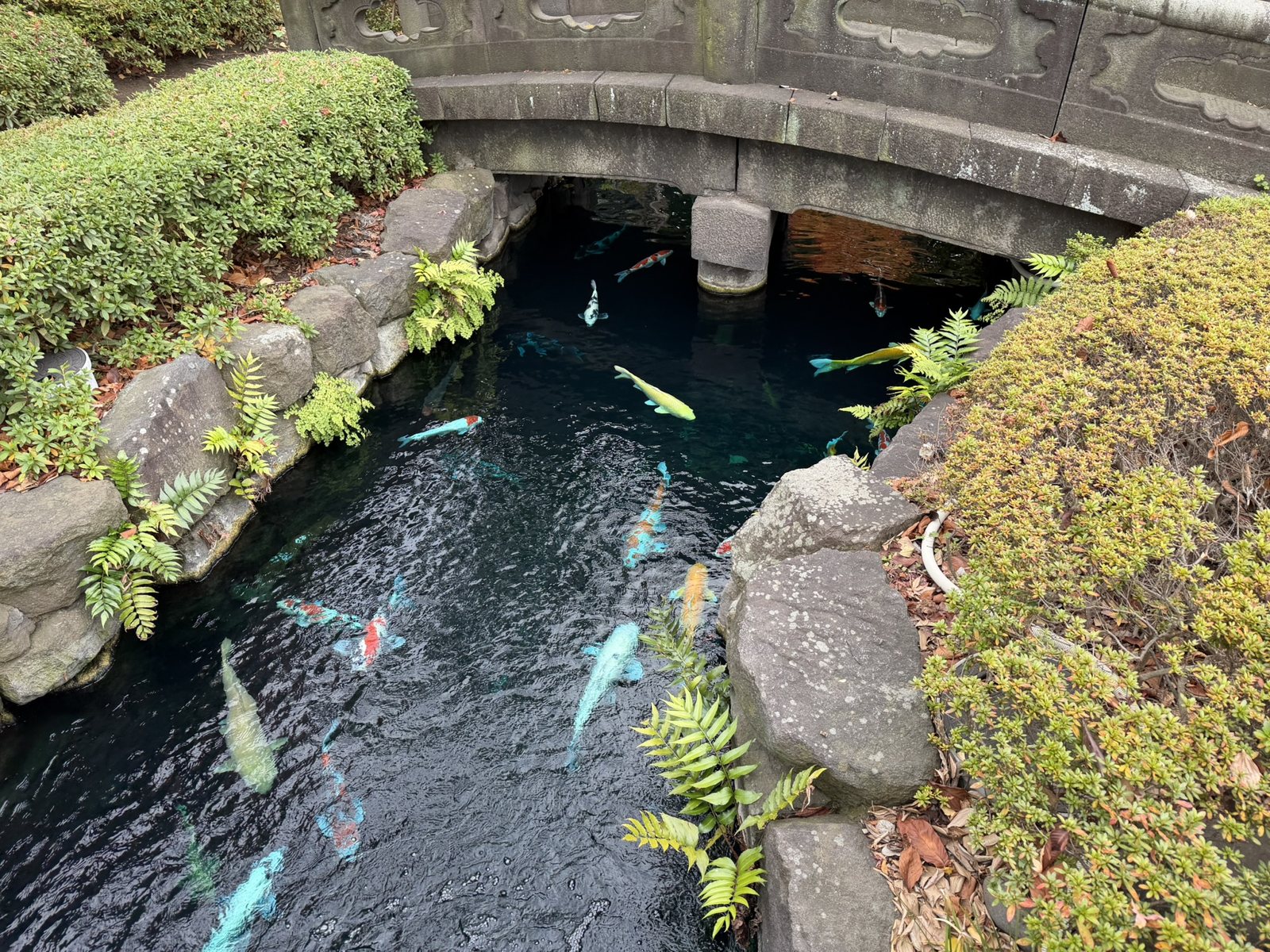 Koi in the garden at Sensō-ji.
The Tokugawa family temple, Zōjō-ji, holds the graves of six of the fifteen shoguns. It now sits at the foot of Tokyo Tower, a 1958 steel tower painted orange and white for air safety, which is a fair summary of what happened to Edo next.
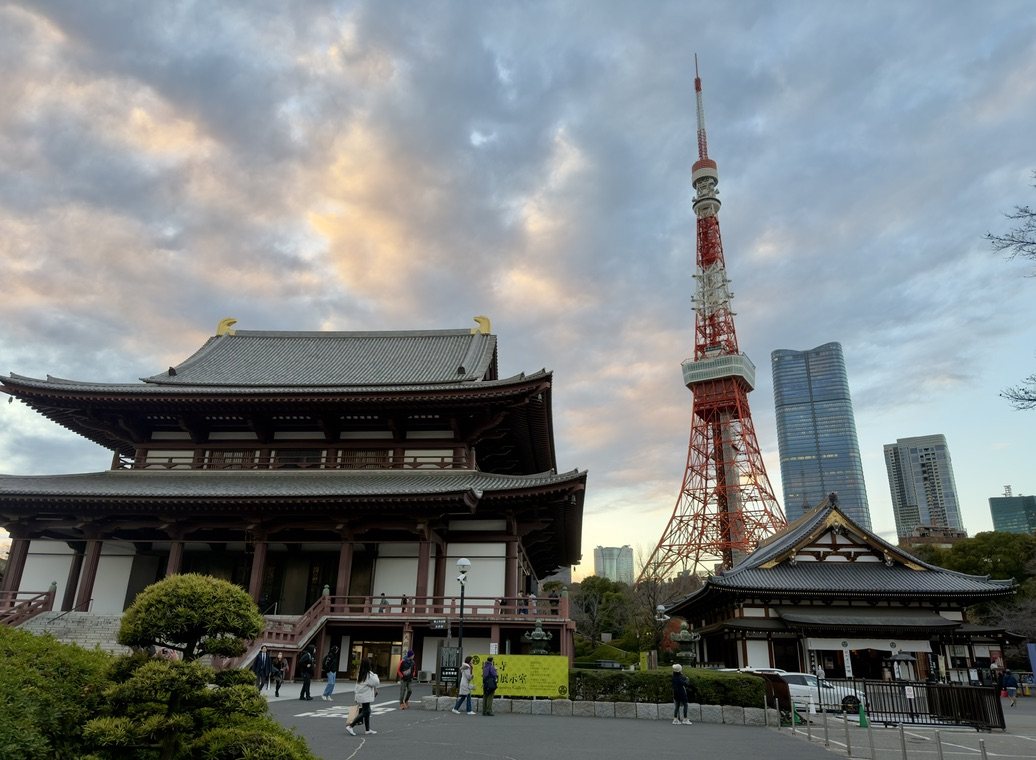 Zōjō-ji, the Tokugawa family temple, and Tokyo Tower.
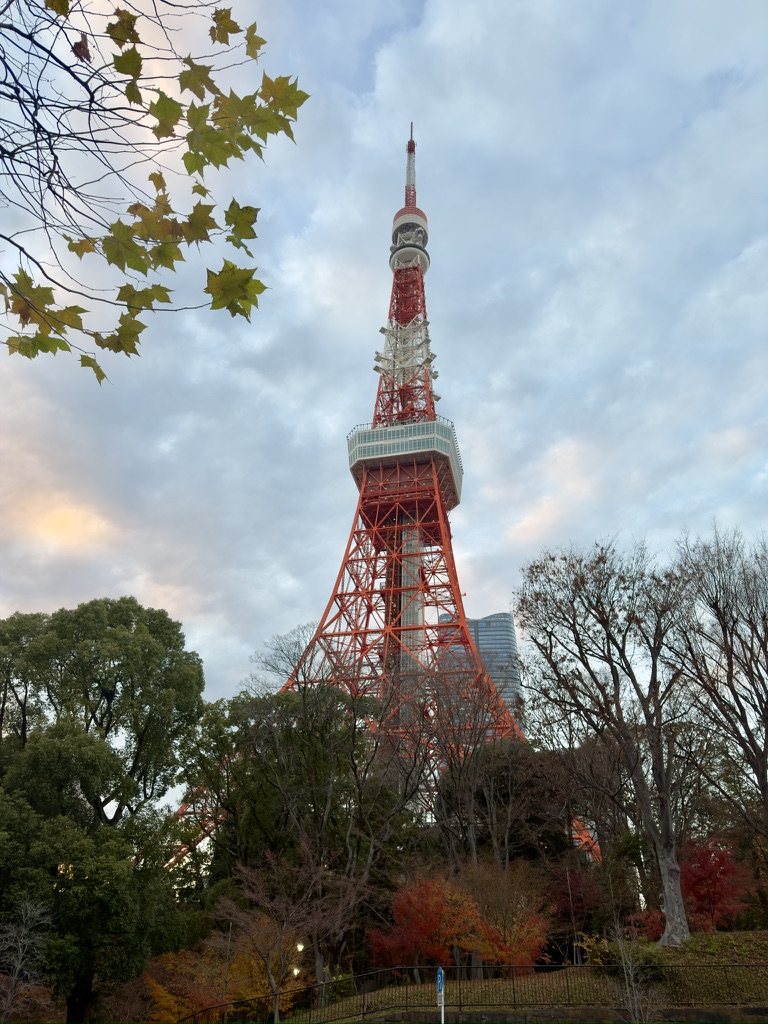 Tokyo Tower from Shiba Park.
Meiji: The Emperor Comes to Edo
In 1853 Commodore Perry’s American warships anchored in Edo Bay and demanded that Japan open its ports. The shogunate built cannon batteries, daiba, on artificial islands in the bay; two survive, and the district around them is still called Odaiba. The shogunate could not hold off the pressure, and in 1868 a coalition of domains overthrew it in the name of the emperor. The Meiji Restoration renamed Edo as Tokyo, the “eastern capital,” moved the teenage emperor into the castle, and set out to industrialize the country within a generation.
Meiji Jingu, dedicated in 1920 to that emperor and his empress, is Shinto’s answer to the modern city. It lies between Harajuku and Shinjuku, and its forest feels ancient, but it was planted: about 100,000 trees were donated from across Japan and beyond, and they have grown into a 70-hectare wood. The great torii on the approach, about 12 meters tall, is made of Taiwanese cypress more than 1,500 years old, and its crossbeam carries the imperial chrysanthemum. Along the path, sake brewers have stacked barrels as offerings; across from them, so have winemakers from Burgundy, a nod to the emperor’s taste for French wine.
Meiji Jingu was the first shrine of the trip, so it is where I learned how to pray at one. Bow once before passing under the torii, and walk to the side of the path, since the center is said to belong to the kami. At the water basin, the temizuya, take the ladle in your right hand and rinse your left hand, then your right; pour a little water into your cupped left hand to rinse your mouth, spit it to the side, and rinse the ladle’s handle before putting it back. At the hall, drop a coin in the offering box, ring the bell if there is one, then bow twice, clap twice, pray, and bow once more. At a Buddhist temple the gestures are quieter: a bow, a coin, and palms pressed together, with no clapping.
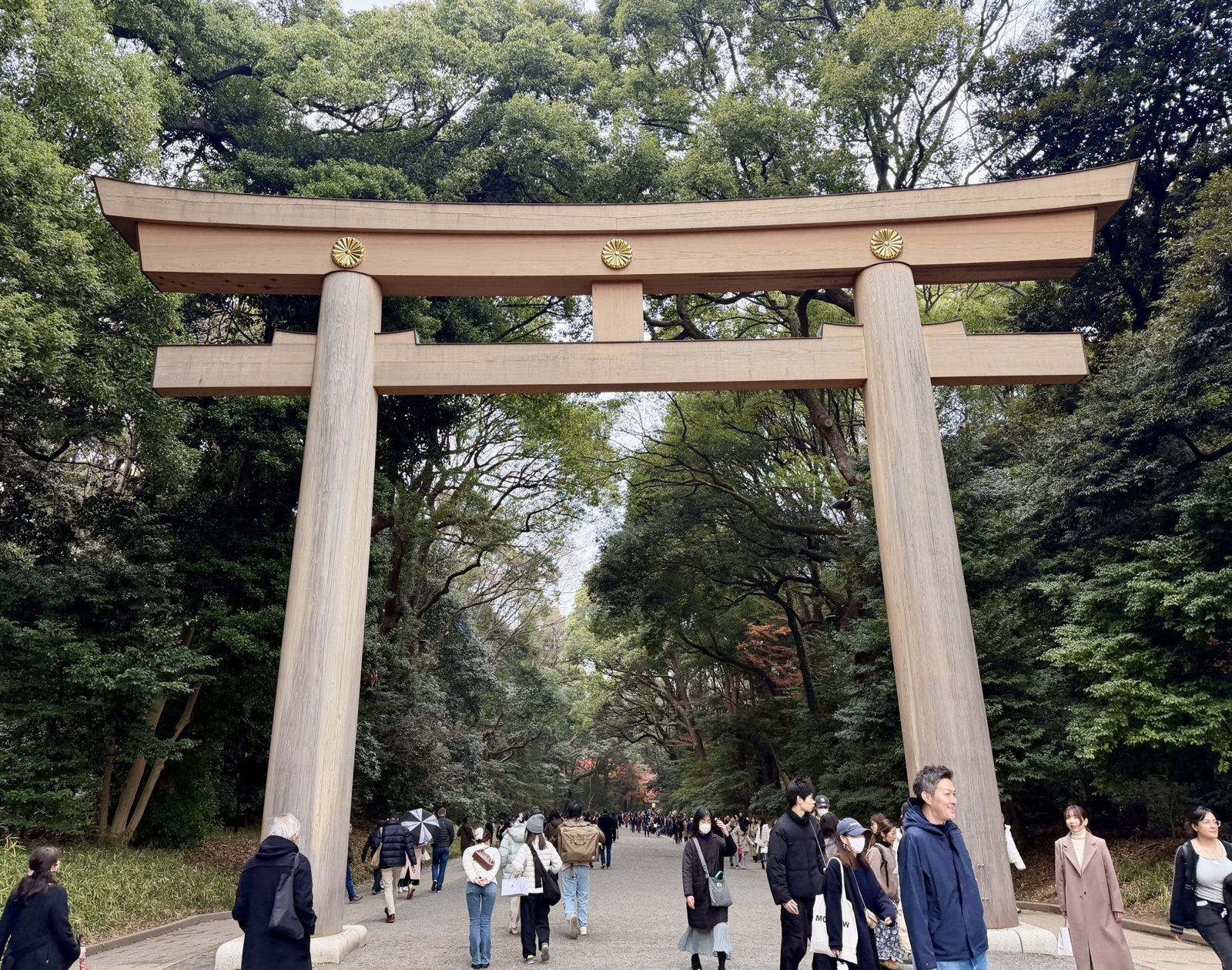 The Ōtorii at Meiji Jingu.
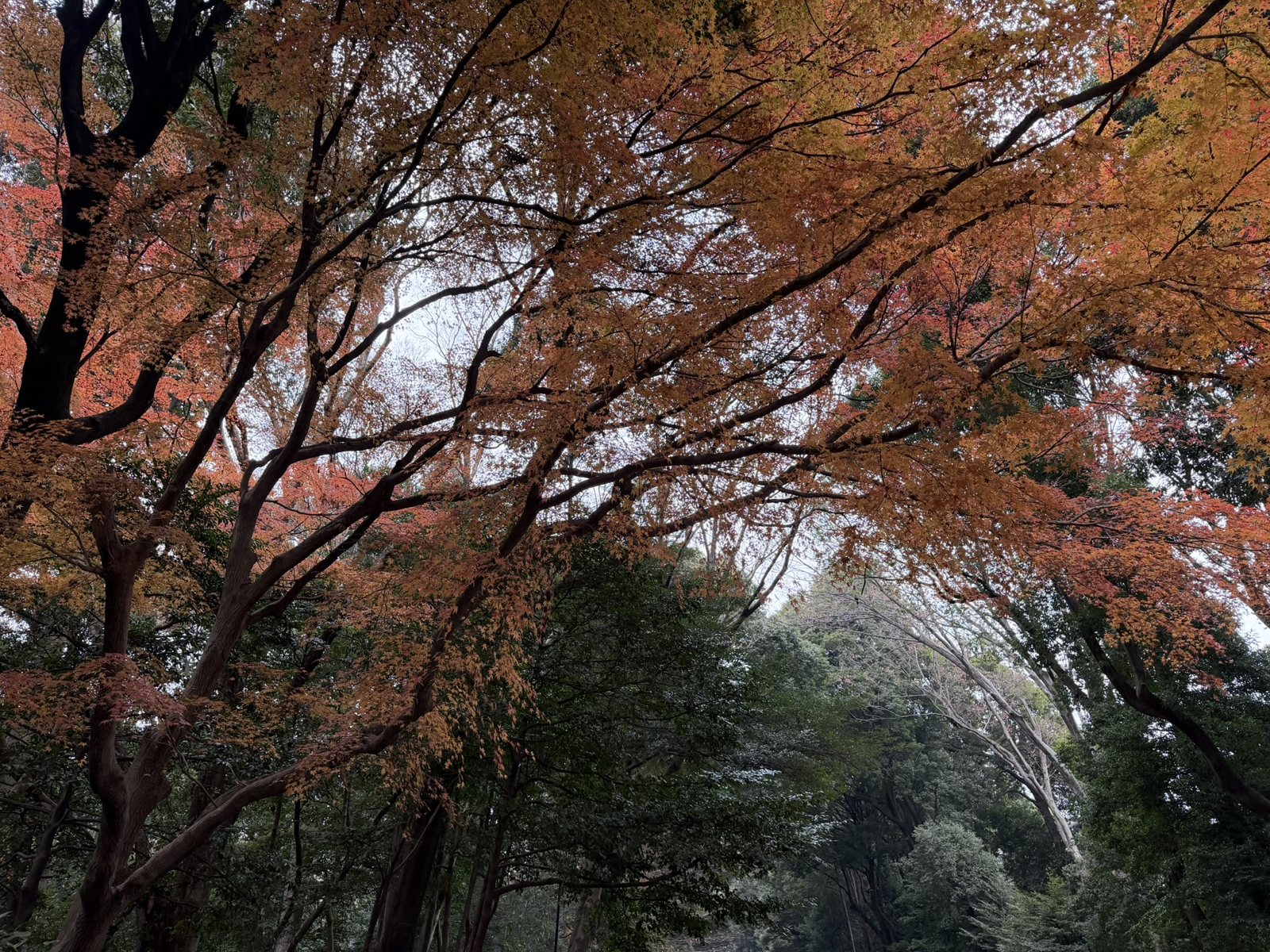 Late maples in a forest planted a century ago.
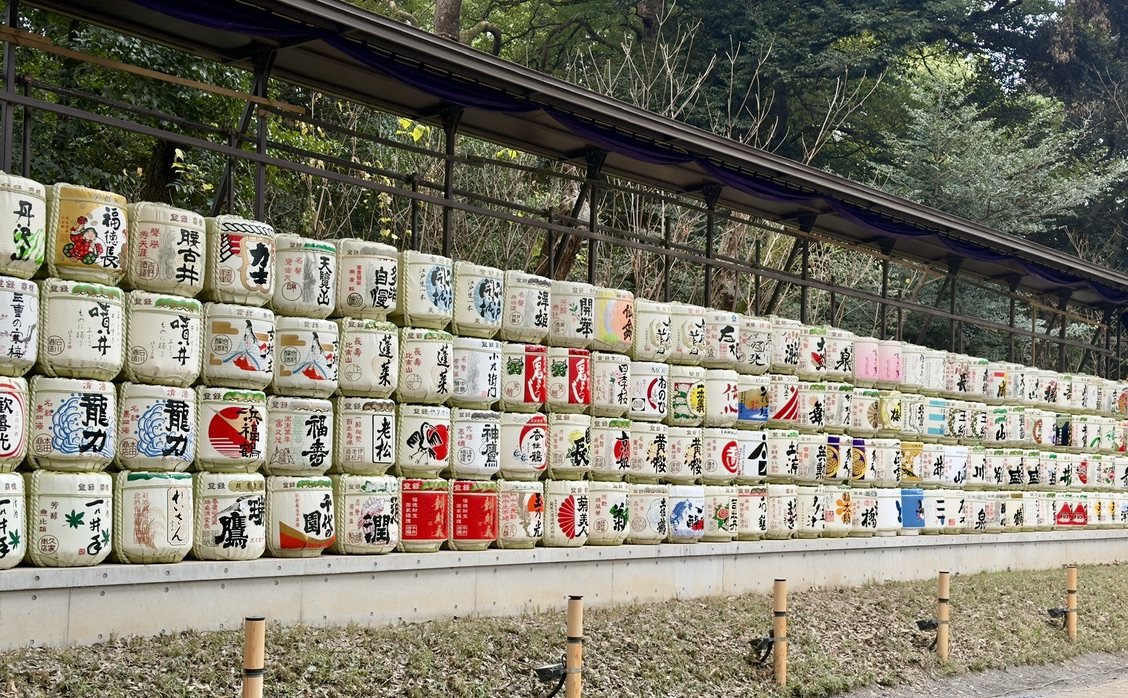 Sake barrels donated by brewers from across Japan.
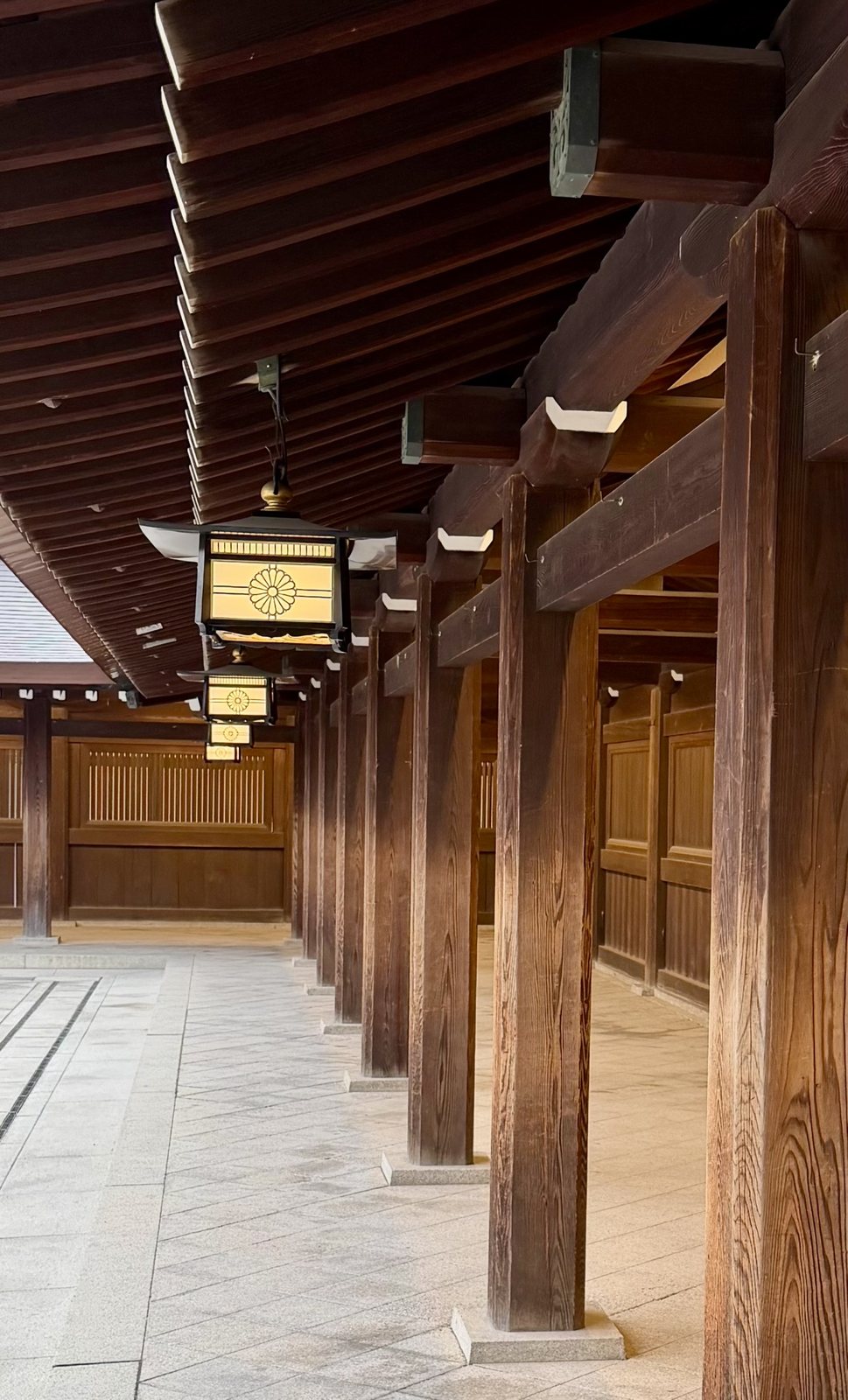 The colonnade around the main courtyard.
Meiji changed the menu too. Buddhist teaching had discouraged eating meat for centuries, and in 1872 the emperor ate beef in public to show the country that modern people did. Beef hot pots, the ancestor of sukiyaki and of the gyūdon beef bowl, spread through the port cities. Western-style dishes, yōshoku, followed, among them curry rice and the breaded pork cutlet that became tonkatsu. Chinese cooks in Yokohama’s Chinatown brought the noodle soup that became ramen; the first dedicated ramen shop opened in Asakusa in 1910.
Tokyo Station faces the palace on purpose. Tatsuno Kingo’s red-brick building opened in 1914, lost its domes to the air raids of 1945, made do with octagonal roofs for decades, and was restored to its original design in 2012.
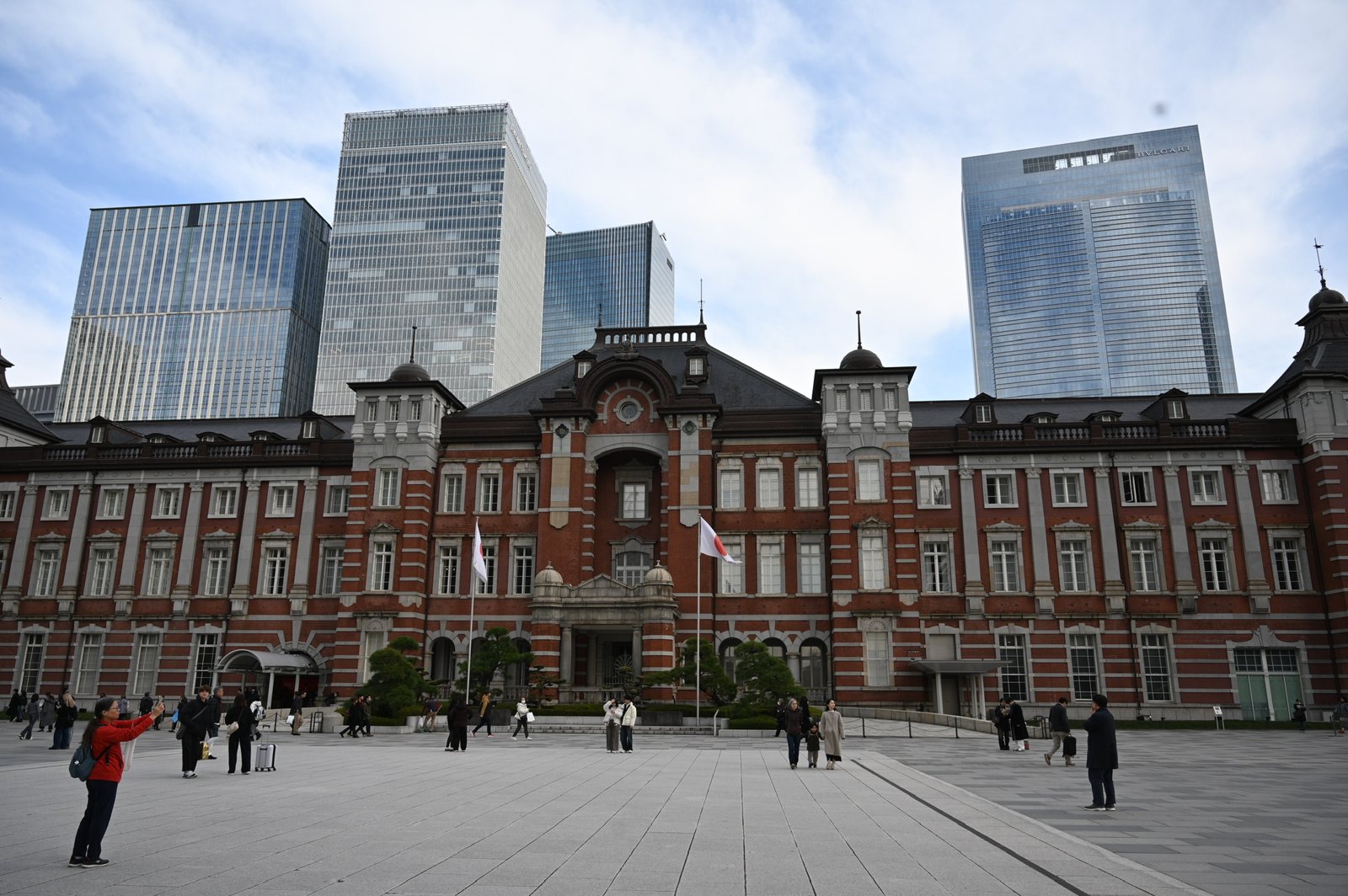 Tokyo Station, restored in 2012 to its 1914 design.
After the war, the 1946 “Humanity Declaration” set aside the emperor’s divine status, and the 1947 constitution made him “the symbol of the State and of the unity of the people.” Shinto and the imperial house remain, as Meiji Jingu shows, but as heritage and ritual rather than as instruments of the state.
Shibuya, Shinjuku, and the Tokyo of Today
From Meiji Jingu I walked down through Harajuku and Omotesando to Shibuya, where the famous crossing takes up to about 3,000 people on a single light change. One moment I had been in quiet greenery; the next I was watching thousands of people flow past one another in near silence. It was crowded but not chaotic. Everyone had somewhere to be, and no one was in anyone else’s way. That was when I understood something about Tokyo: here, independence is not defiance. It is normal.
From the roof of Shibuya Sky, about 230 meters up, the day’s route lay in a single view: the dark forest of Meiji Jingu, the shrine to the emperor in whose name Japan remade itself after 1868; in front of it, Kenzō Tange’s sweeping gymnasium for the 1964 Olympics, the event that announced Japan’s postwar recovery; and behind it, the towers of Shinjuku. It is about a century and a half of modern Japan in one frame.
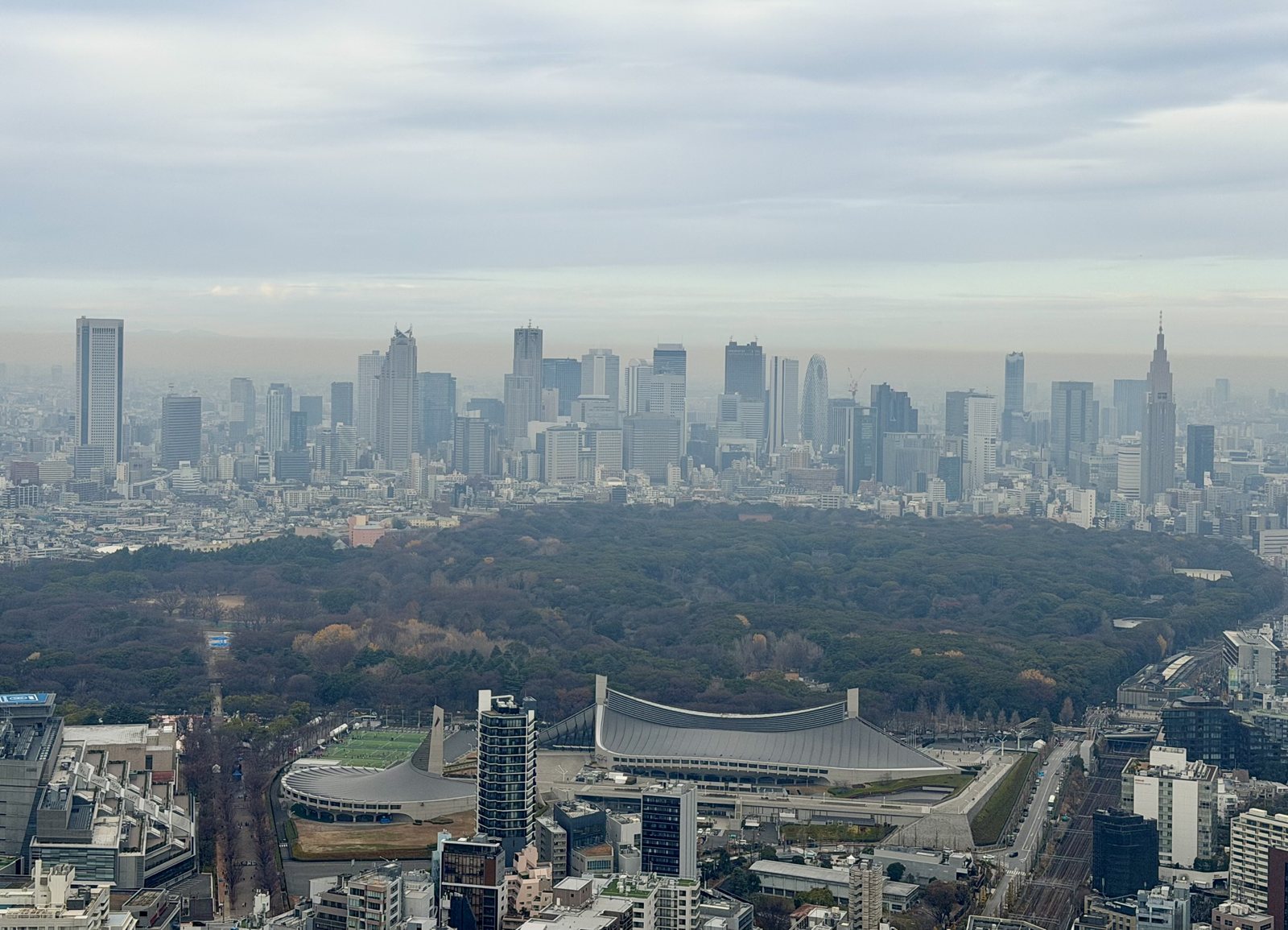 From Shibuya Sky: the Meiji Jingu forest, the 1964 Olympic gymnasium in front of it, and Shinjuku beyond.
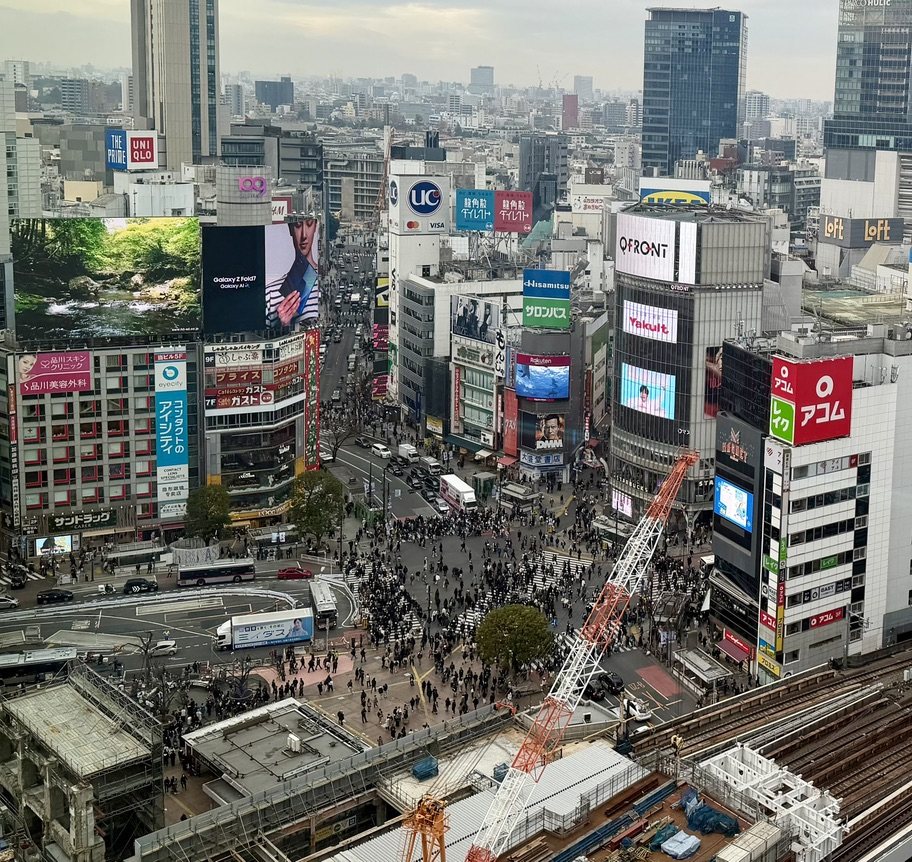 The Shibuya crossing, mid-scramble.
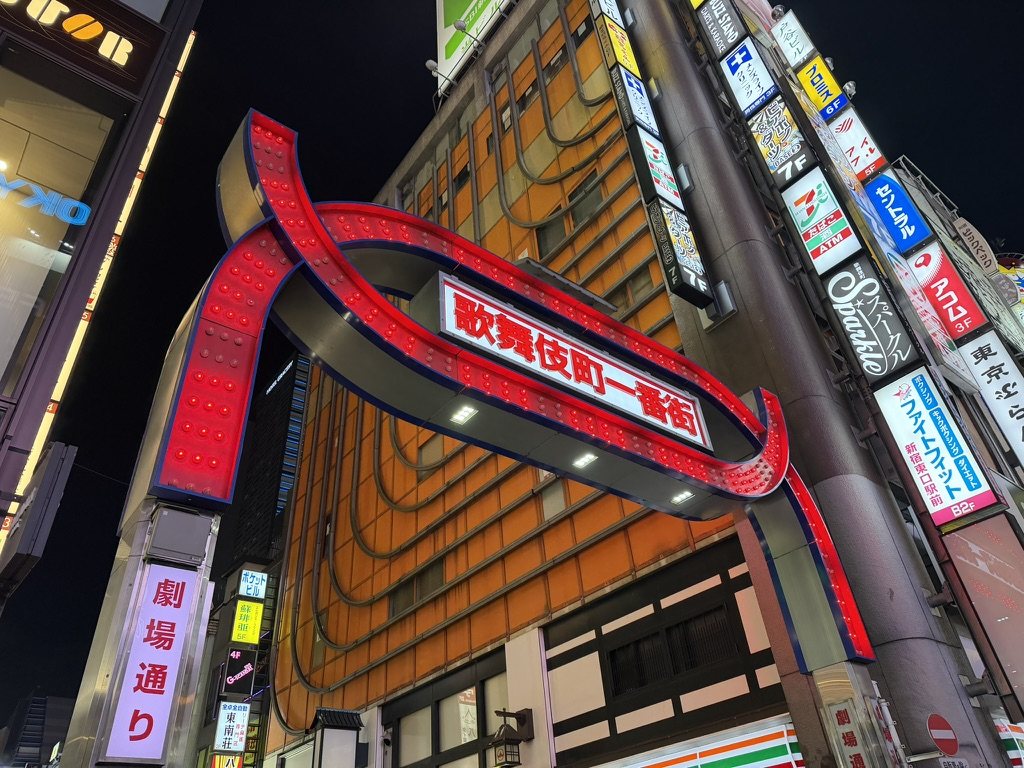
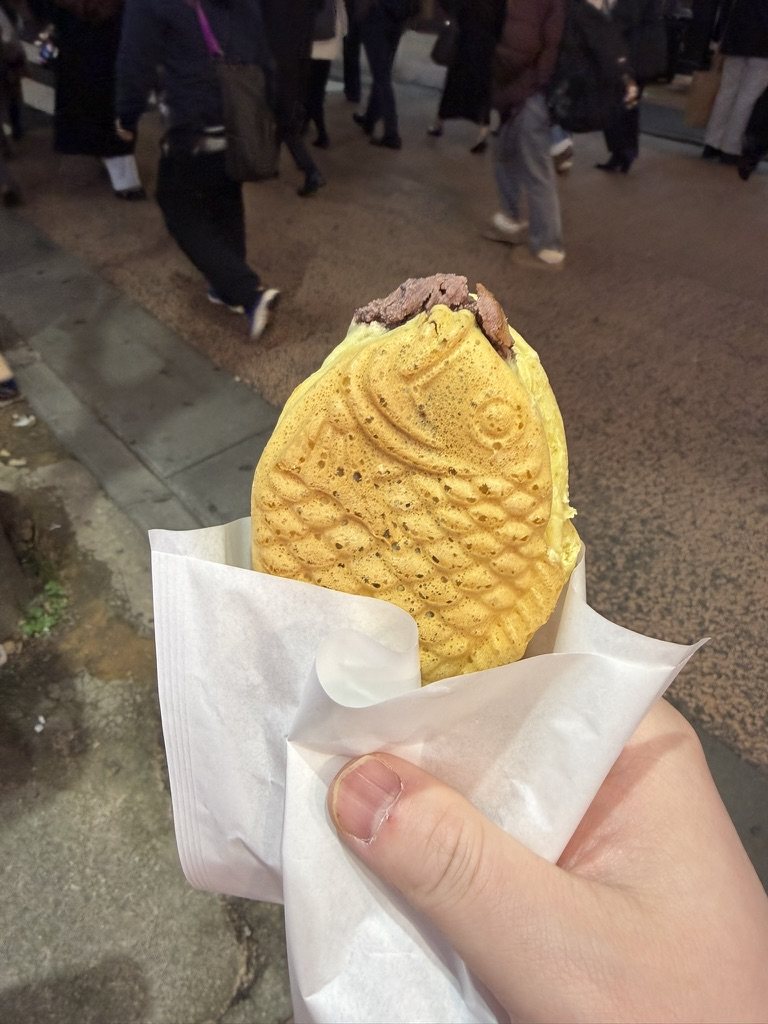
Tokyo is less one city than a set of them. Shibuya is youth, fashion, and energy; Shinjuku is offices, the metropolitan government, and nightlife. Shinjuku’s narrow alleys, and the tiny bars of Golden Gai, were Tokyo at its most playful and slightly absurd. I watched people more than I took part, and that was enough; it was enough to be present. Kabukichō, under its red neon arch, is named for a kabuki theater planned there after the war that was never built. Taiyaki, the fish-shaped cake filled with sweet bean paste that I ate on the street nearby, is said to date from 1909, late in the Meiji era. At night the city glows without trying to impress, and there is comfort in that.
The Japan I visited was also in the middle of a change that I follow for work. Sanae Takaichi had become its first woman prime minister two months earlier. A record 42.7 million foreign visitors came in 2025, and on some streets it felt like it. After decades of near-zero interest rates, the Bank of Japan has been raising rates and shrinking its holdings of government bonds, which it had bought until it owned about half the market. Japan’s government debt is close to 200 percent of GDP, and the country is the largest foreign holder of US Treasuries, so what happens to yields in Tokyo travels. I track all of this in the Japan section of my Macro Monitor. Standing in Shibuya, it was a useful reminder that the charts are about a place.
Mt Fuji and Hakone
Leaving the city made Tokyo feel even sharper in hindsight. Mt Fuji, 3,776 meters high, is an active volcano that last erupted in 1707, and in Shinto it is a kami. The goddess of the mountain is Konohanasakuya-hime, “the princess who makes the trees blossom,” often linked with the cherry blossom, and she is worshipped at some 1,300 Sengen shrines, headed by Fujisan Hongū Sengen Taisha at the mountain’s foot. Fear of the volcano and reverence for it grew together, and worship is often described as partly a way to calm it.
At the fifth station, the road ends beside Komitake Shrine, which honors her older sister, Iwanaga-hime, the goddess of rock. In the old chronicles, the heavenly prince Ninigi was offered both sisters and chose the beautiful Konohanasakuya-hime over the enduring Iwanaga-hime, and so, the story goes, human lives became as brief as blossoms rather than as lasting as stone. It is the Japanese idea of impermanence in a single myth.
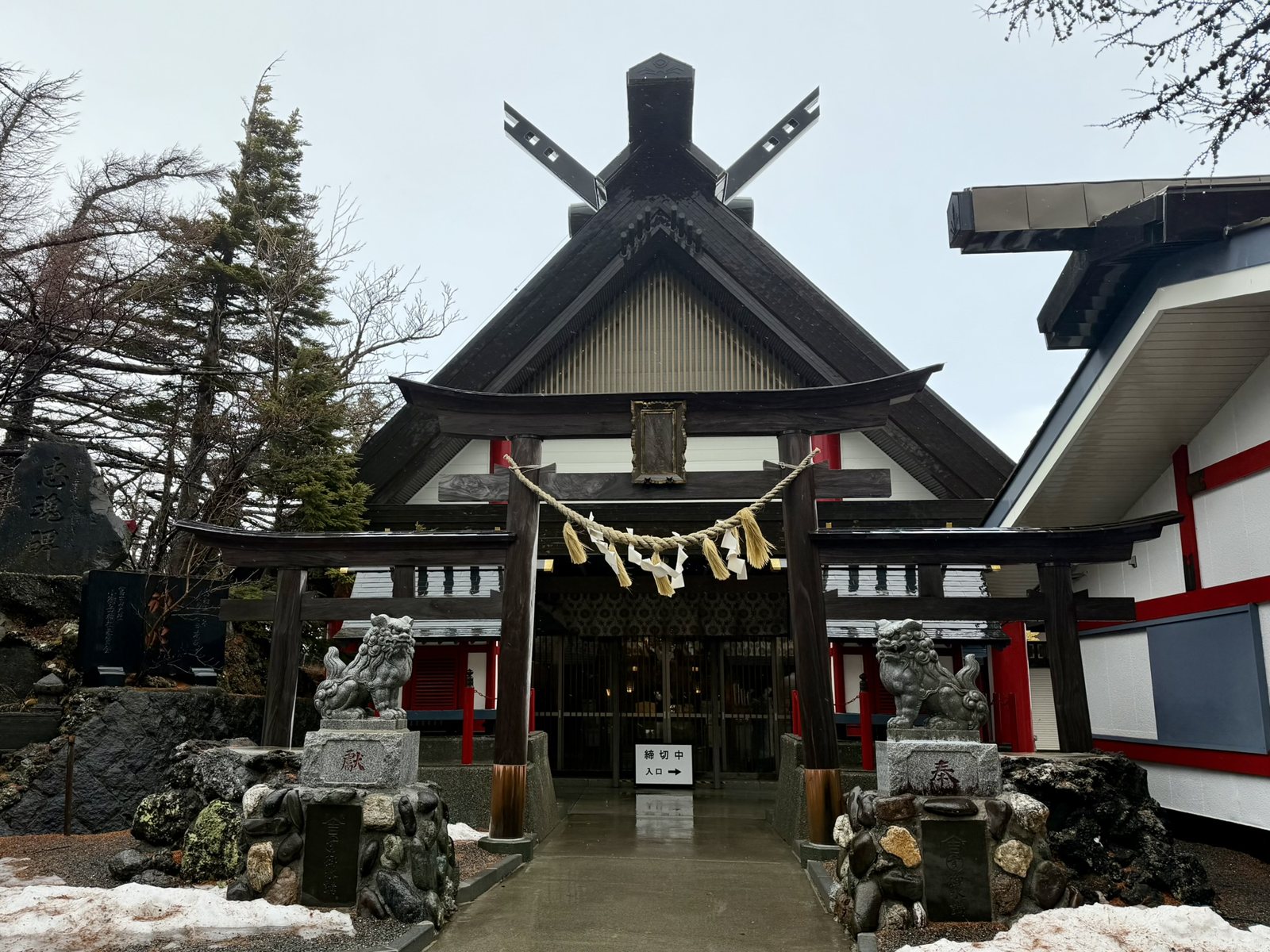 Komitake Shrine at the fifth station, for Iwanaga-hime, the goddess of rock.
Climbing Fuji was historically a pilgrimage rather than a sport. In the Edo period, confraternities called Fuji-kō saved up to send members to the summit for purification, and women were barred from climbing the mountain until 1872. The mountain did not demand attention when I saw it. It sat in its own cloud, immovable and indifferent, and put scale back into perspective. My problems shrank without disappearing, which seemed like the right balance.
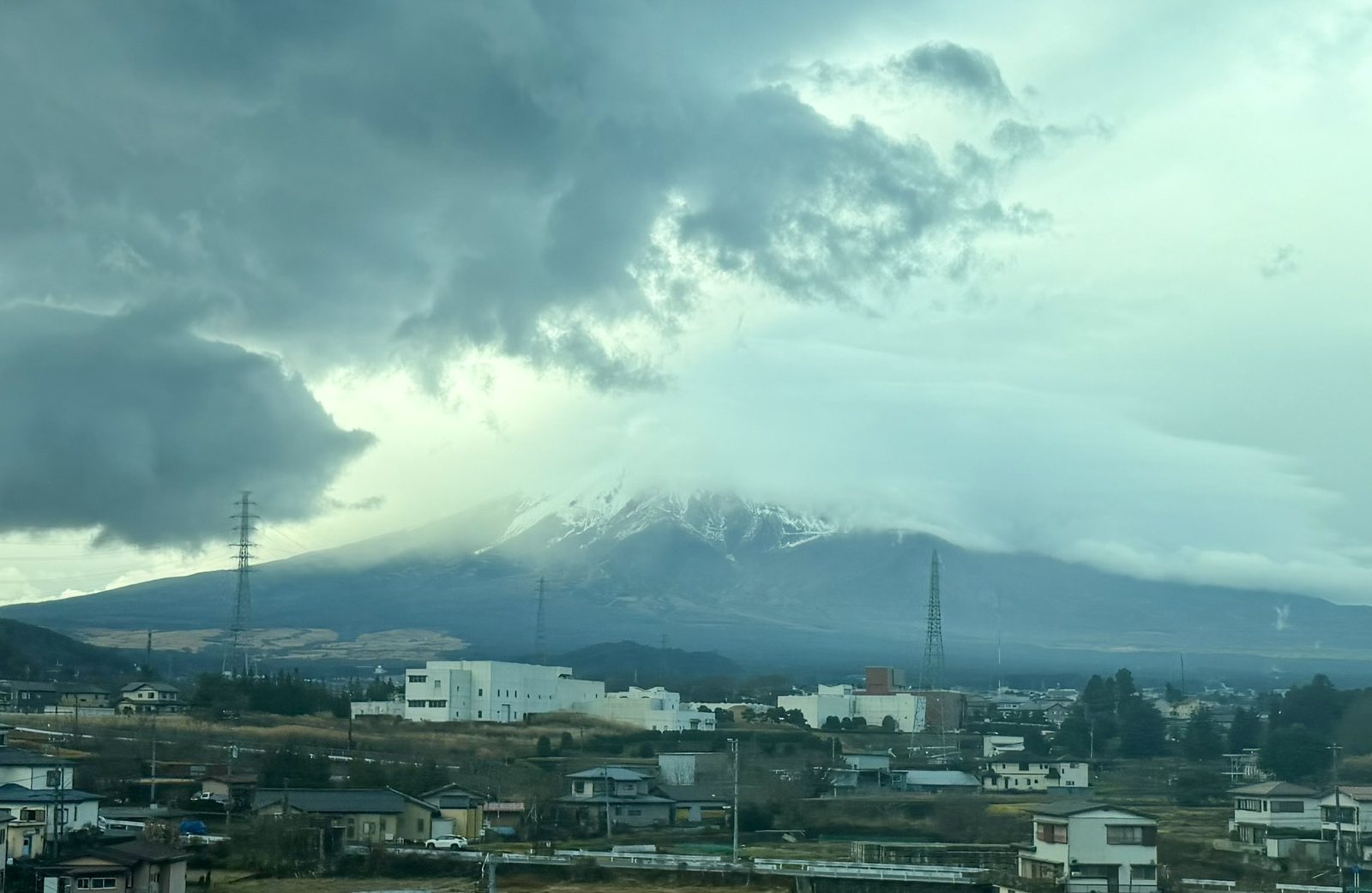 Fuji, mostly in its own weather.
It is also perhaps the most painted mountain in Japan, and the story of how it came to be painted is the story of Japanese painting in brief. Court painters of the Heian period developed yamato-e, a native style of bright color and gentle landscapes. Zen monks brought ink painting from China, and the monk Sesshū made it Japanese in the 15th century. The Kanō school painted gold-leaf folding screens for warlords and shoguns. Then, in Edo, woodblock prints, ukiyo-e, “pictures of the floating world,” put art within reach of merchants and townspeople; printers even used techniques such as mokume-zuri, printing the grain of the wood itself for texture. In the Meiji era, the word nihonga was coined for painting in these traditions, to tell it apart from the Western-style painting arriving at the same time.
The mountain’s most famous image came from an artist who was already old. Katsushika Hokusai was born in Edo in 1760 in the district of Katsushika, which gave him the name he is known by. He was apprenticed to a woodcarver at 14 and joined the studio of the print designer Katsukawa Shunshō at 18. He used at least 30 names over his career, and he was about 70 when the publisher Nishimuraya Yohachi brought out his Thirty-Six Views of Mount Fuji. In the colophon to his later One Hundred Views of Mount Fuji, he wrote that nothing he drew before 70 was worth noticing, and that by 110 every dot and line would be alive. He died in 1849, at 88, reportedly wishing for a few more years to become a real painter. From 1834 he signed his work Gakyō Rōjin Manji, “the old man mad about art.”
The first print of the series, Under the Wave off Kanagawa, printed around 1830 to 1832, is often called the best-known Japanese image in the world. A wave the size of a cliff curls over three fishing boats, and Fuji sits small and calm in the distance, the one thing in the picture that will still be there afterward. Hokusai printed it with Prussian blue, a pigment newly imported from Europe, and the print later traveled back the other way: Debussy put it on the cover of the score of La Mer in 1905. Public-domain impressions are in the Metropolitan Museum of Art and the Art Institute of Chicago.
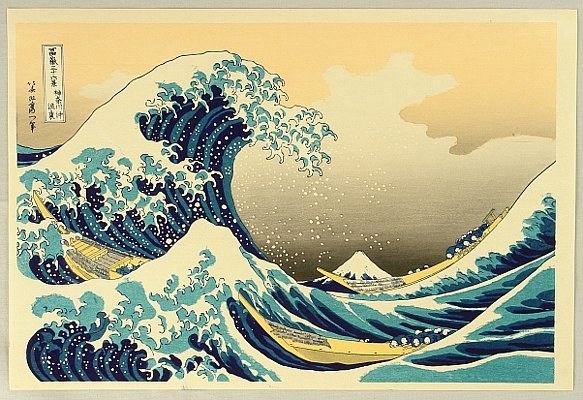 Katsushika Hokusai, Under the Wave off Kanagawa (c. 1830–32), from Thirty-Six Views of Mount Fuji; shown here in a later woodblock reproduction. Original impressions: Metropolitan Museum of Art and Art Institute of Chicago.
That afternoon, after the fifth station, I crossed into Hakone, the volcanic hot-spring district where the old Tōkaidō climbed over the mountains and the shogunate kept a checkpoint. Hakone sits inside the caldera of Mt Hakone, a volcano that is still alive. White plumes rise from its slopes: these are fumaroles, vents where volcanic gas, mostly water vapor laced with sulfur, escapes from the hot rock below. They are densest at Ōwakudani, the “Great Boiling Valley,” where the ground was last blown open by small steam-driven explosions, and the same heat feeds the town’s hot springs. A cable car hauls visitors up slopes the old travelers walked. I came back to Tokyo tired, but steadier.
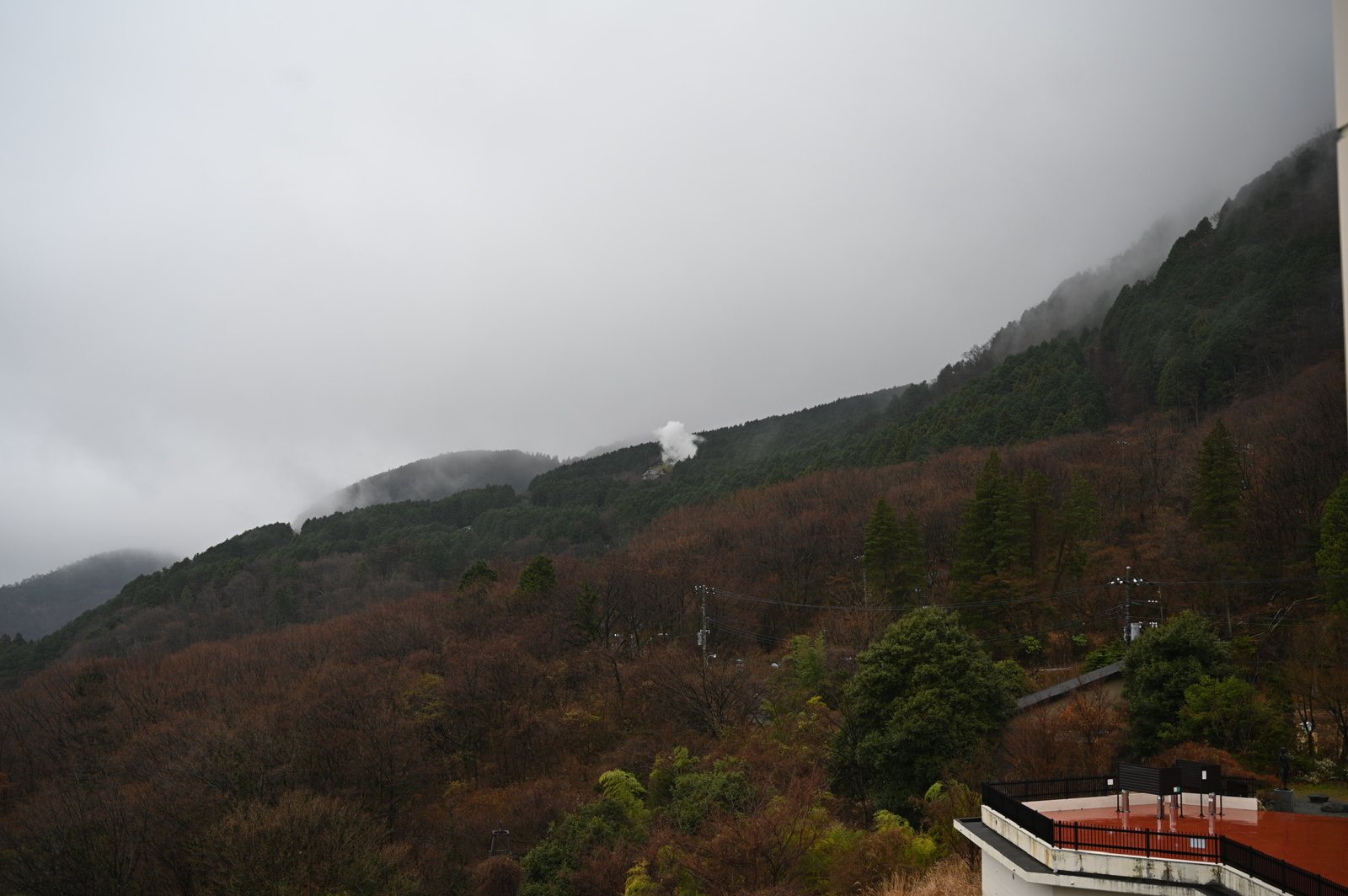 A fumarole on the slopes of Mt Hakone: volcanic gas venting from the hillside.
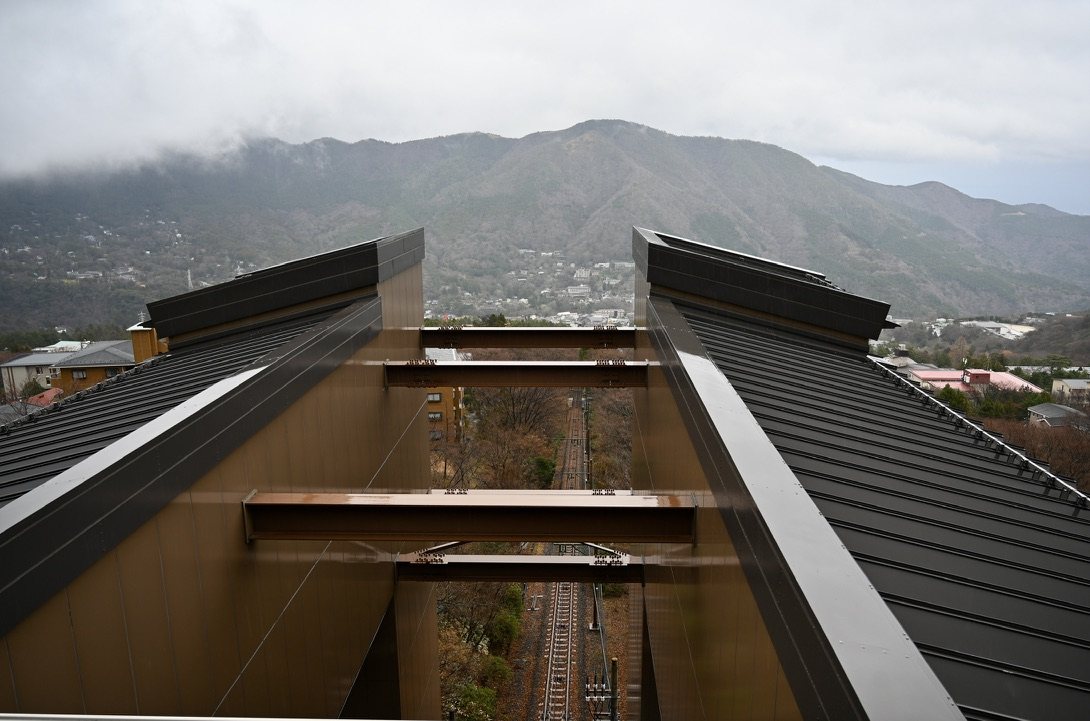 The Hakone cable car, looking down the mountain.
Odaiba: The Future’s Waiting Room
My last Tokyo day began with oysters at the Tsukiji outer market, which stayed put when the wholesale fish market left for Toyosu in 2018. From there I went out onto the reclaimed land of the bay. Odaiba felt like the future’s waiting room: wide, quiet, and slightly unreal, with a replica of the Statue of Liberty facing the Rainbow Bridge and, until 2026, a life-size Unicorn Gundam standing guard over a shopping mall.
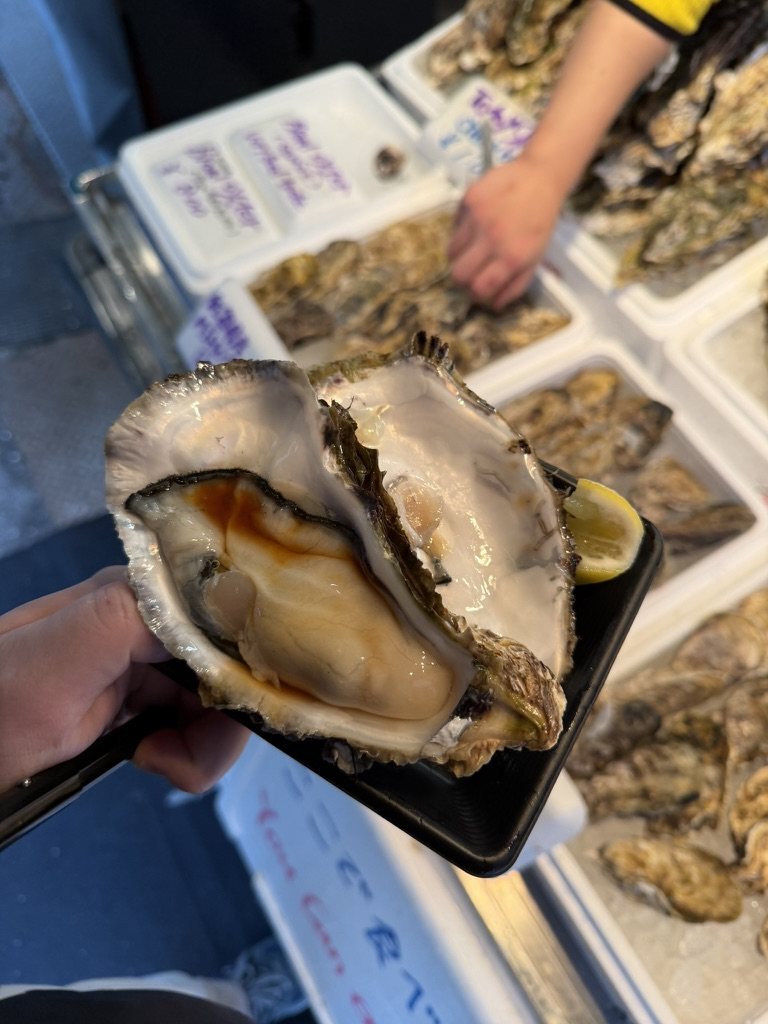 Breakfast at Tsukiji.
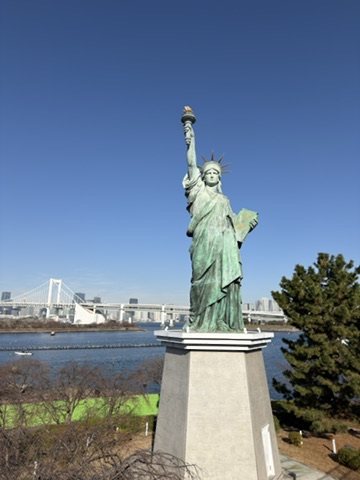 Odaiba’s Statue of Liberty, with the Rainbow Bridge behind.
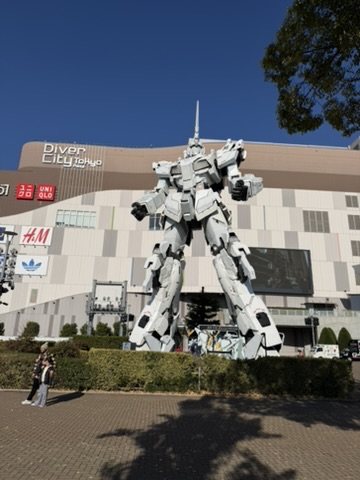 The Unicorn Gundam at DiverCity. Update, 2026: it was taken down at the end of August.
At teamLab Planets, in Toyosu, visitors take off their shoes and walk, partly through water, into rooms of digital art. It was impressive but strangely calming; the technology did not overwhelm, it invited a quiet curiosity. By the end of that day I felt complete with Tokyo. I did not need more.
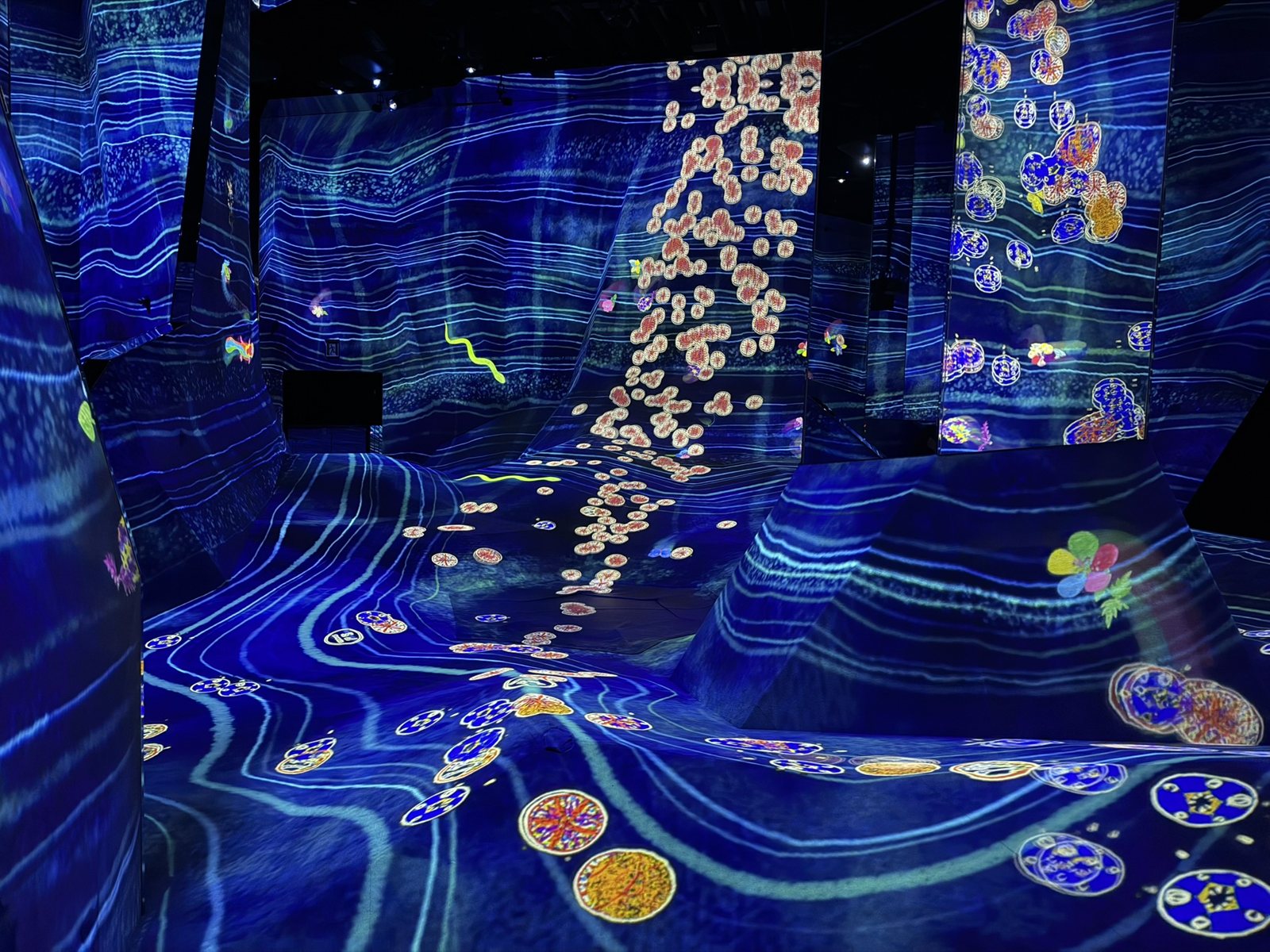 teamLab Planets, Toyosu.
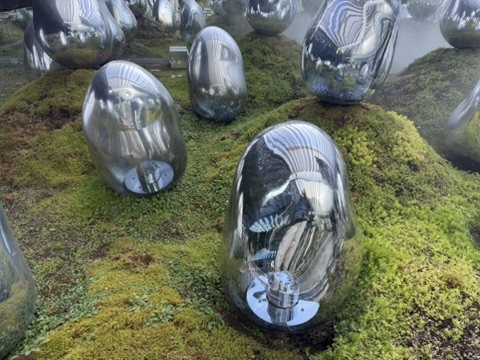
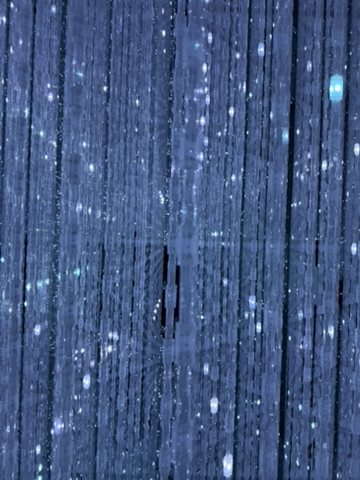
What stayed with me was how quiet the city actually is, how normal it feels to be alone, how efficiency can feel humane, and how the absence of eye contact comes with an absence of judgment. Tokyo taught me that self-containment is a kind of strength.
Kyoto and Nara: Stillness, History, and Inner Space
Wed 24–Fri 26 Dec · Kyoto, Nara, Arashiyama · Days 6–8
I took the Shinkansen down the corridor the Tōkaidō once followed. The line opened in 1964 as the world’s first high-speed railway, and covers in a little over two hours a road that took travelers on foot about two weeks.
Kyoto: The Emperor’s City
The court moved to Heian-kyō, modern Kyoto, in 794, and the emperors stayed for more than a thousand years, until 1869. Kyoto arrived softly. It does not announce itself; it reveals itself slowly, in wooden buildings, narrower streets, and warmer light. It is not a city for distraction.
At dusk I walked through Gion, past Yasaka Shrine and down Hanamikoji, and along the Shirakawa canal. Time stretched. Nothing was rushed, and even my thoughts slowed down. The light caught the five-story pagoda of Hōkan-ji, the “Yasaka pagoda,” above the tiled roofs.
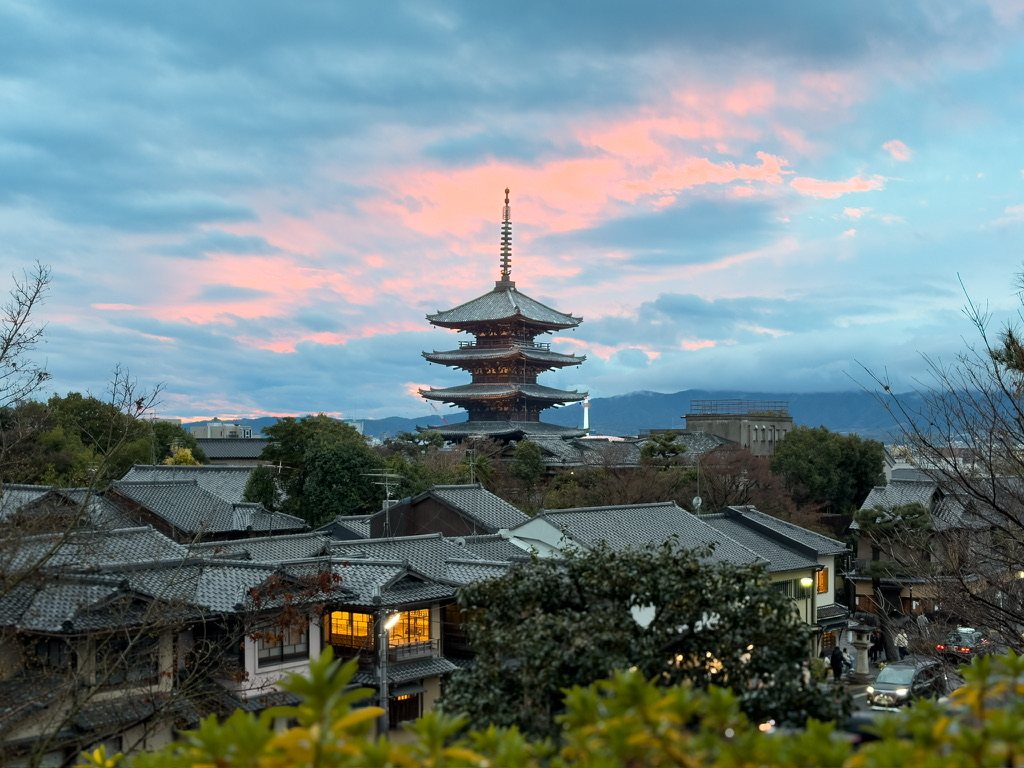 The Yasaka pagoda at dusk.
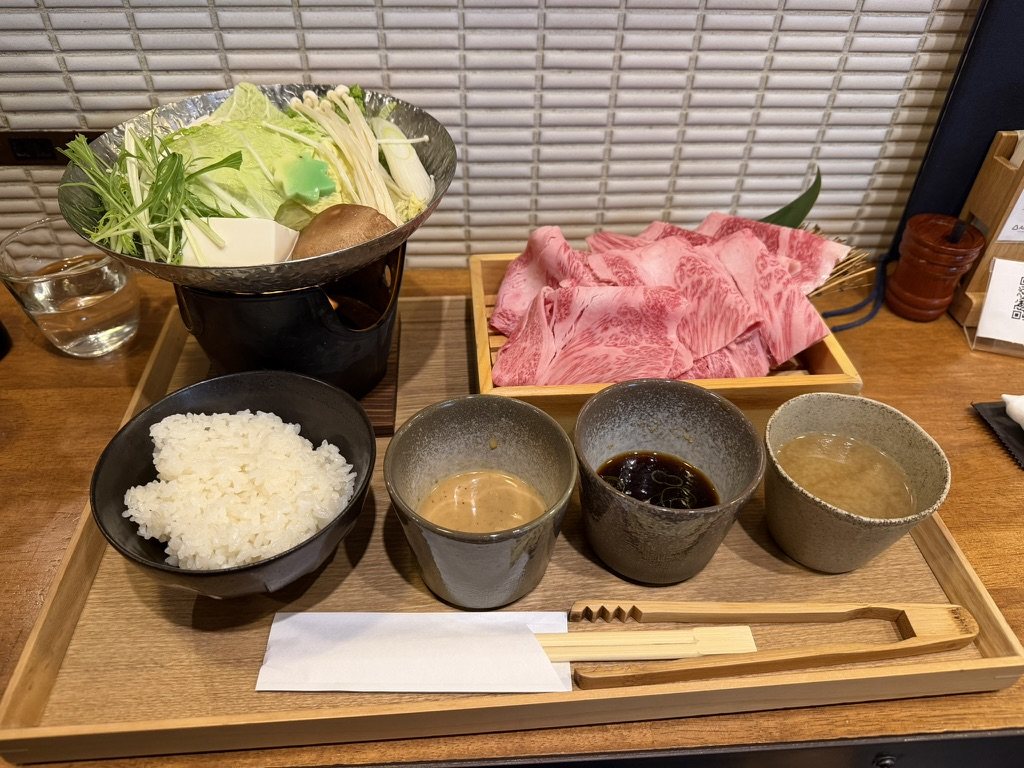 Wagyu hot pot in Kyoto, a meal that would have been unthinkable before 1872. At home I keep it simpler, with a seared wagyu steak.
Fushimi Inari
Fushimi Inari sits on the rail line from Kyoto to Nara, which makes it a natural first stop on the way. Founded in 711, it is the head of some 30,000 to 40,000 Inari shrines across Japan. Inari began as the kami of rice, and since rice was once how wealth, taxes, and power were measured, Inari became the kami of business and prosperity as well. That makes it one of the most practical gods in Shinto.
The shrine is less a building than a mountain, which suits a religion that places the divine in nature rather than in buildings: its paths climb Mount Inari under thousands of vermilion torii, each given by a business or a family, often in thanks after a wish came true, and inscribed with the donor’s name and the date. The vermilion is said to ward off misfortune and, practically, to help protect the wood from decay. The foxes that guard the paths are not gods but Inari’s messengers, chosen because foxes hunt the rodents that eat the rice; they often hold a key to the granary, a jewel, or a scroll in their mouths, for access to abundance, stored wealth, and knowledge.
Walking through the gates is an act of gratitude rather than petition, and the long climb turns that into a ritual. As the path rises, the crowds thin, the gates grow older, and the mountain grows quieter; the full walk to the summit and back takes two to three hours, and many visitors turn back early. The idea it expresses is reciprocity: effort comes first, and thanks follow success. It is easy to see why it suited Kyoto’s merchants, and why it still suits a country that values patience and long commitment.
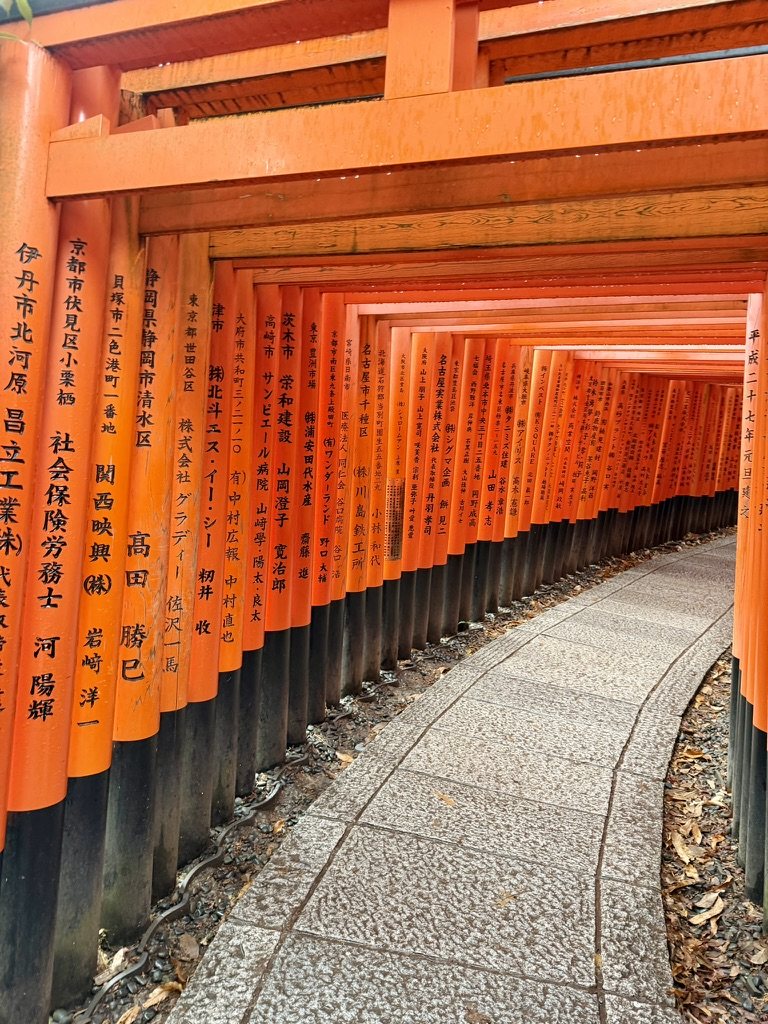 The torii at Fushimi Inari, each inscribed with its donor.
Nara: Where Buddhism Became the State’s
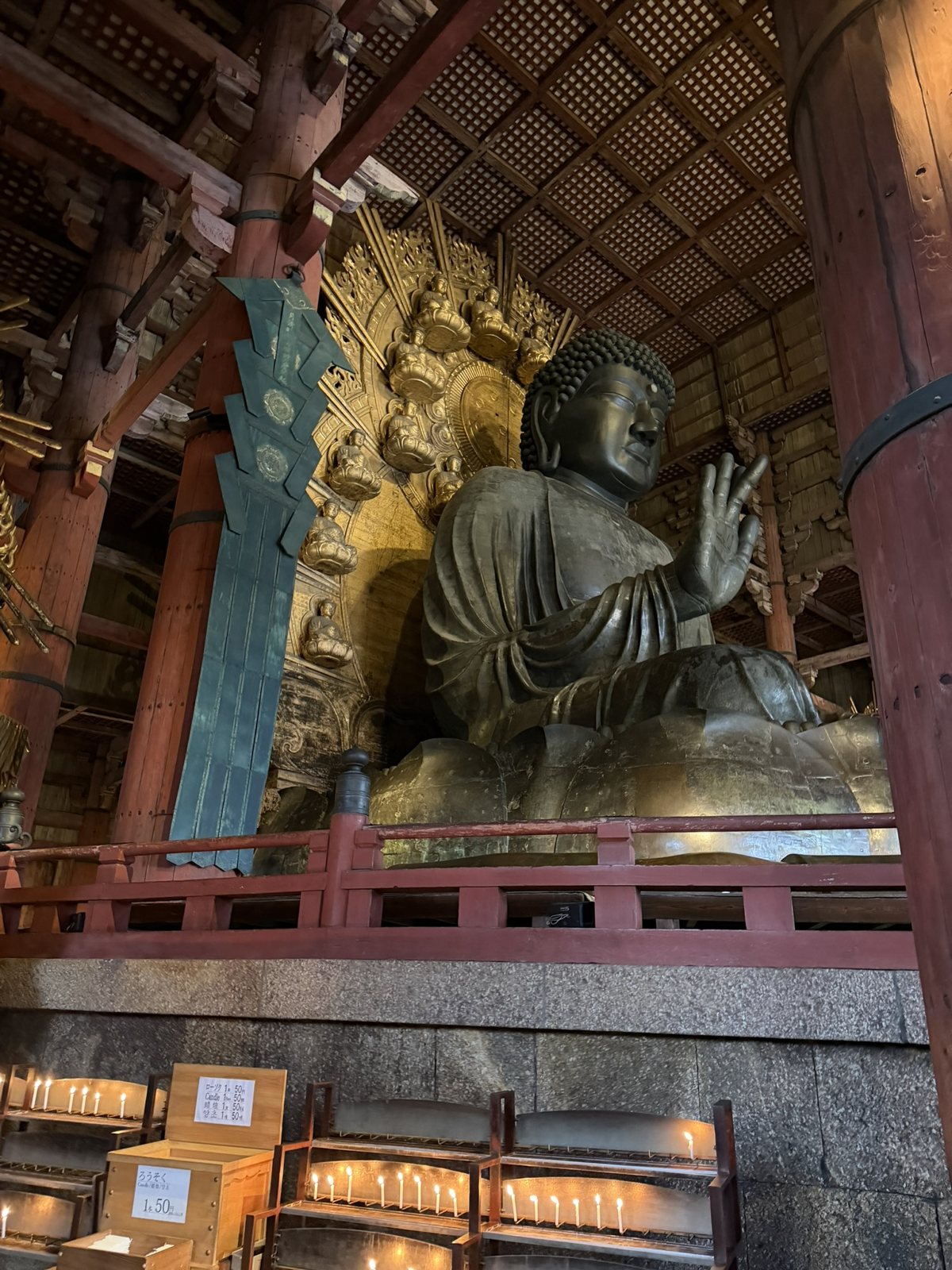
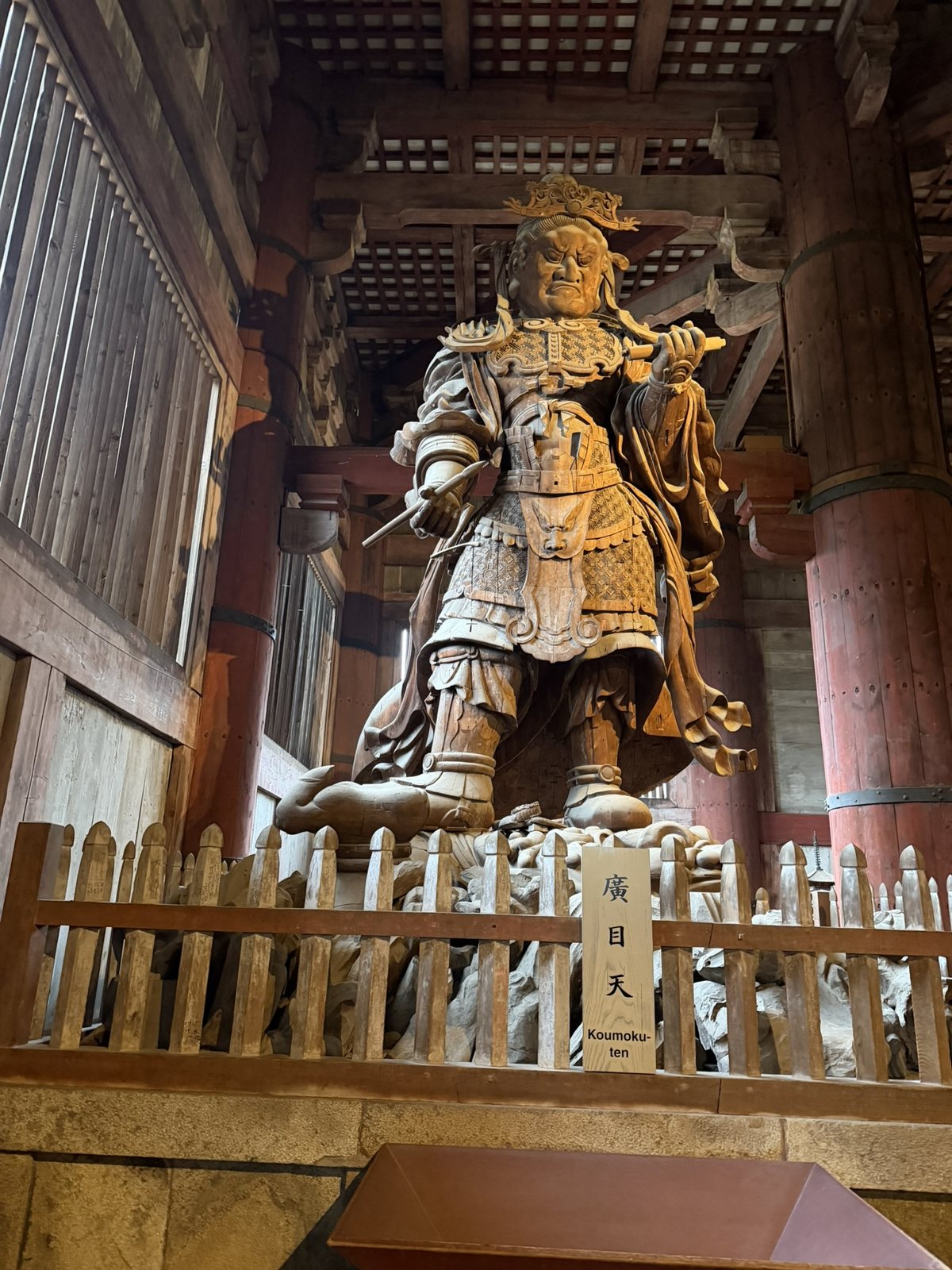
Nara was Japan’s first permanent capital, from 710 to 784, laid out on the grid of the Chinese capital at Chang’an. It is where Buddhism became an affair of state, and it feels ancient in a way that is not performative. Emperor Shōmu ordered a temple in every province and built Tōdai-ji at the head of them; its Great Buddha was dedicated in 752. The figure is about 15 meters tall, and the hall around it, rebuilt in 1709, is about a third smaller than the original and still among the largest wooden buildings in the world. The Buddha does not intimidate; it steadies. Beside it stands Kōmokuten, one of the Four Heavenly Kings who guard the directions, holding a brush and scroll to record what he sees. I felt small, but not insignificant. That distinction matters.
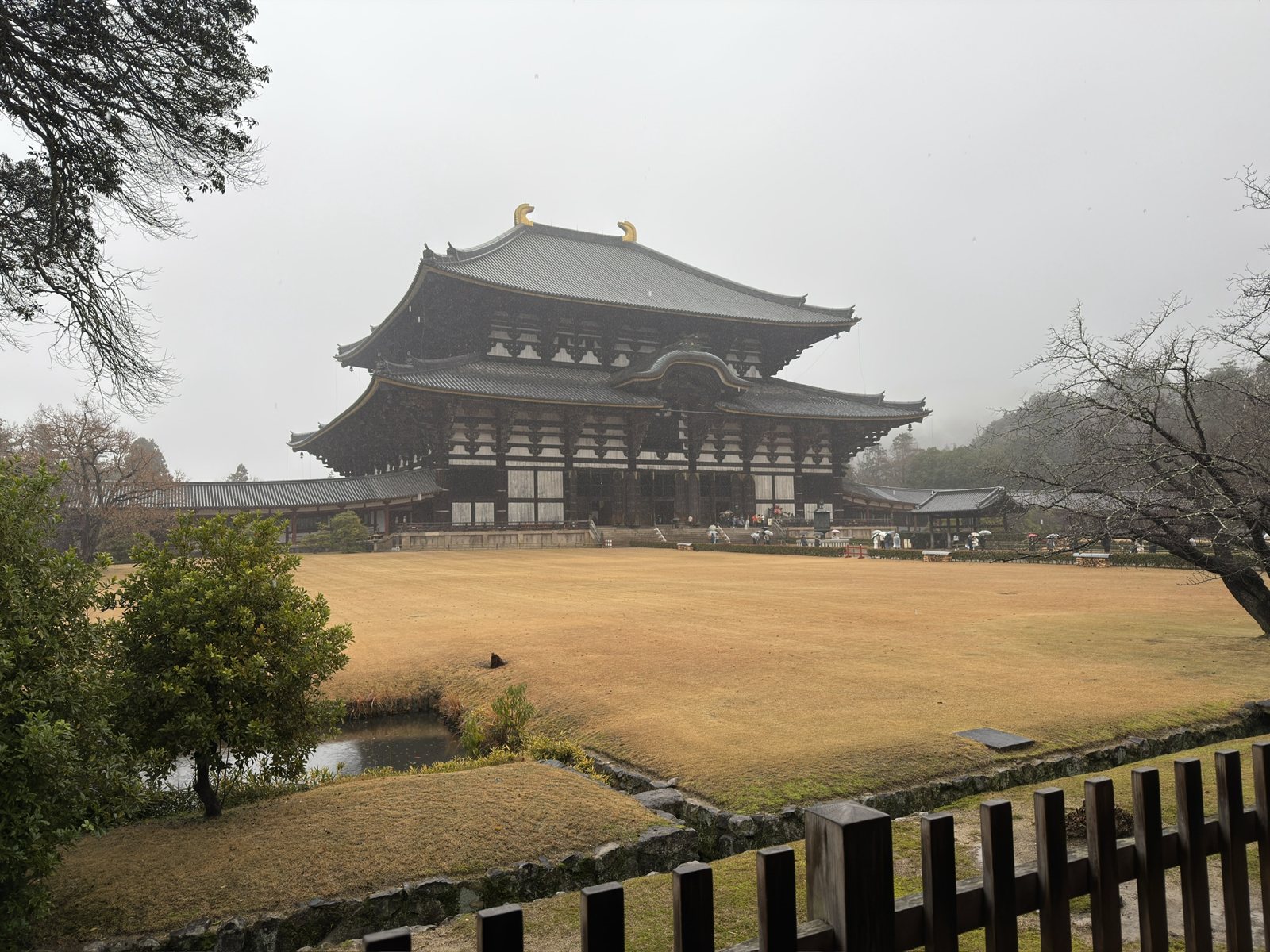 The Daibutsuden, rebuilt in 1709.
A short walk away, the two religions sit side by side. Kasuga Taisha, a Shinto shrine founded in 768 for the guardian kami of the powerful Fujiwara family, is reached by a path of some 3,000 stone and bronze lanterns, most of them furred with moss. Its gods are said to have arrived riding a white deer, which is why Nara’s deer, now about 1,465 of them, are treated as sacred messengers and protected as a national Natural Monument. They move freely, unconcerned with tourists or time, and they stood about in the rain at Tōdai-ji’s Great South Gate.
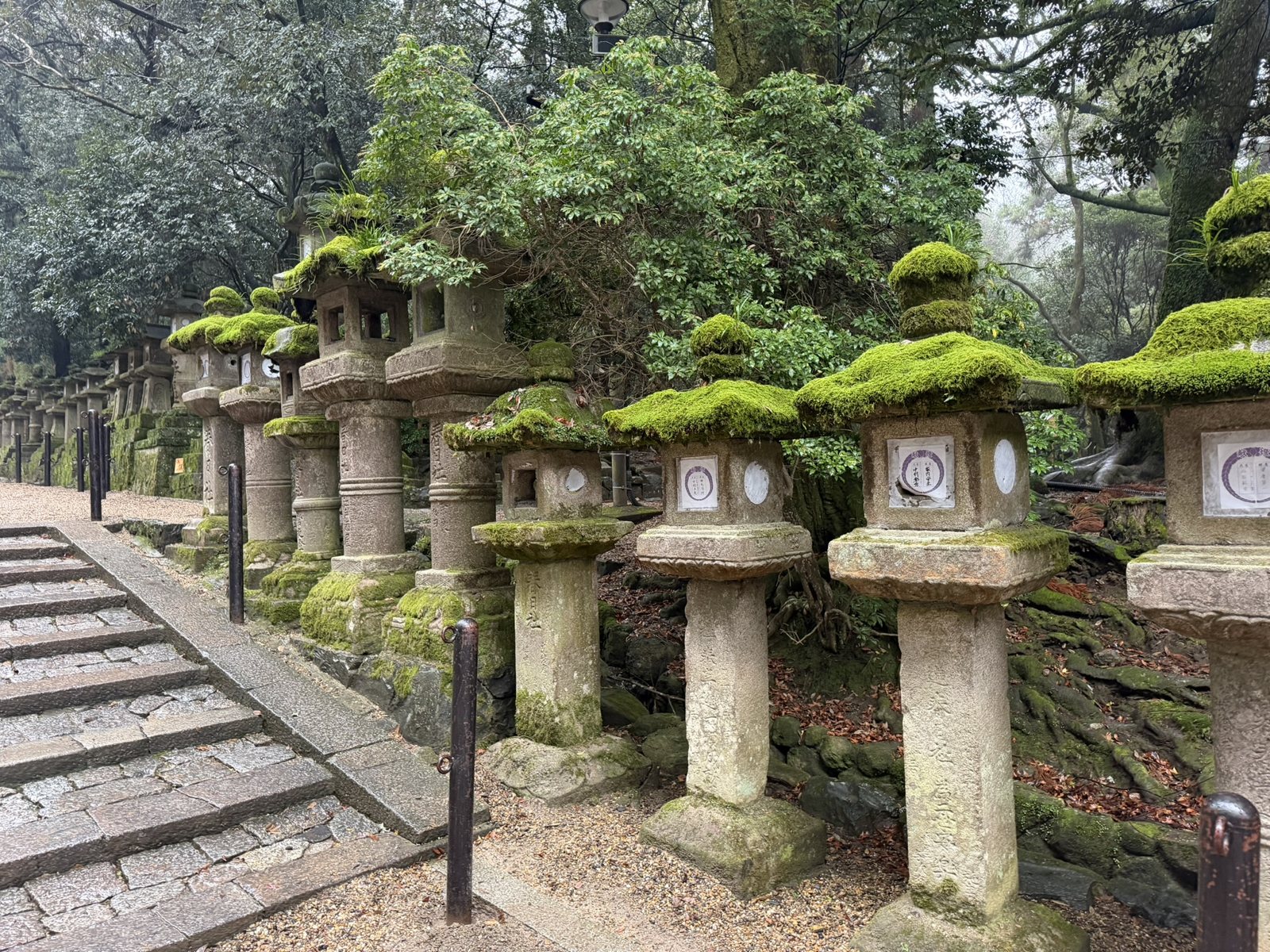 Stone lanterns on the approach to Kasuga Taisha.
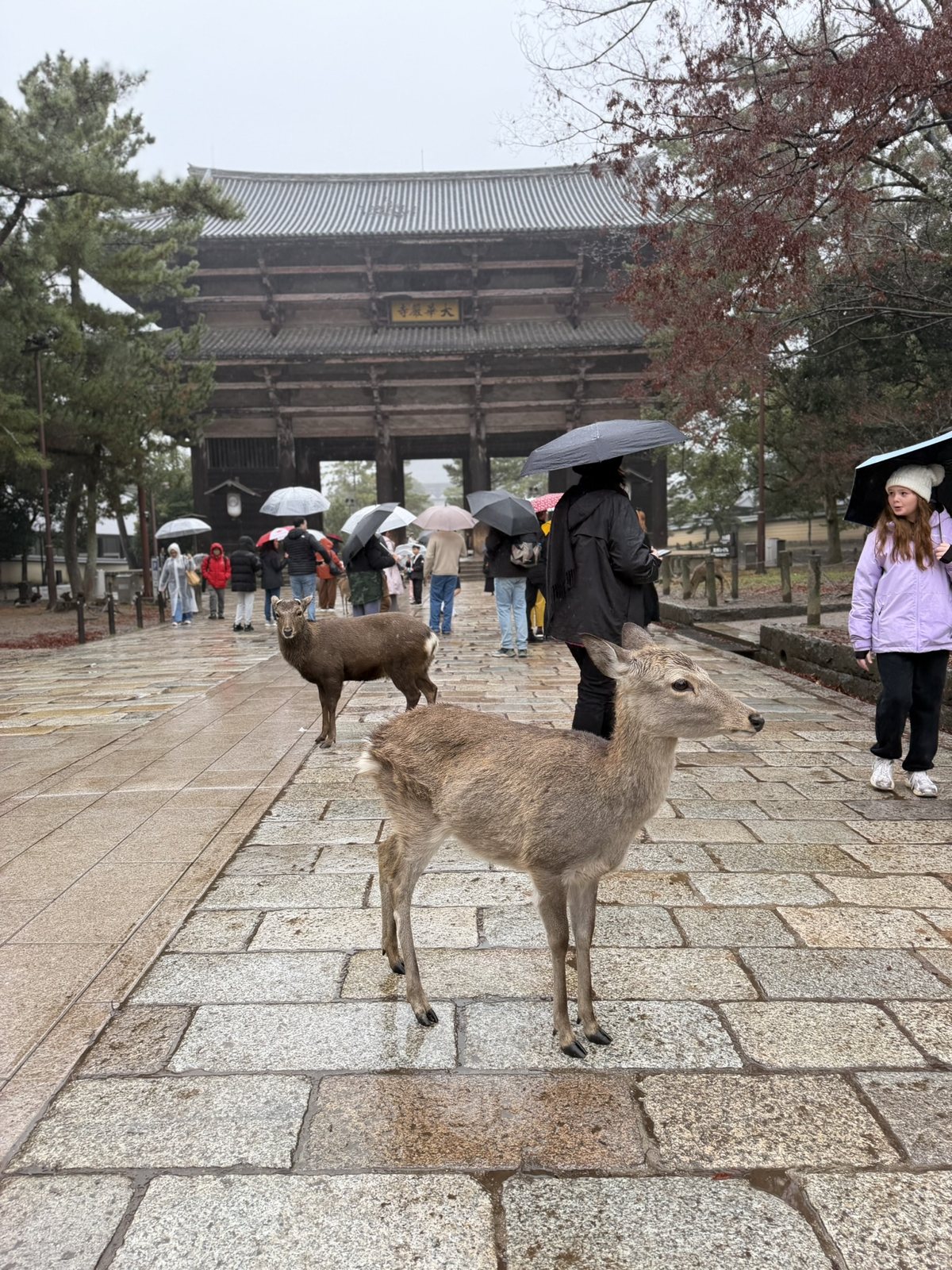 Deer at the Great South Gate of Tōdai-ji. The plaque reads 大華厳寺, “Great Kegon Temple.”
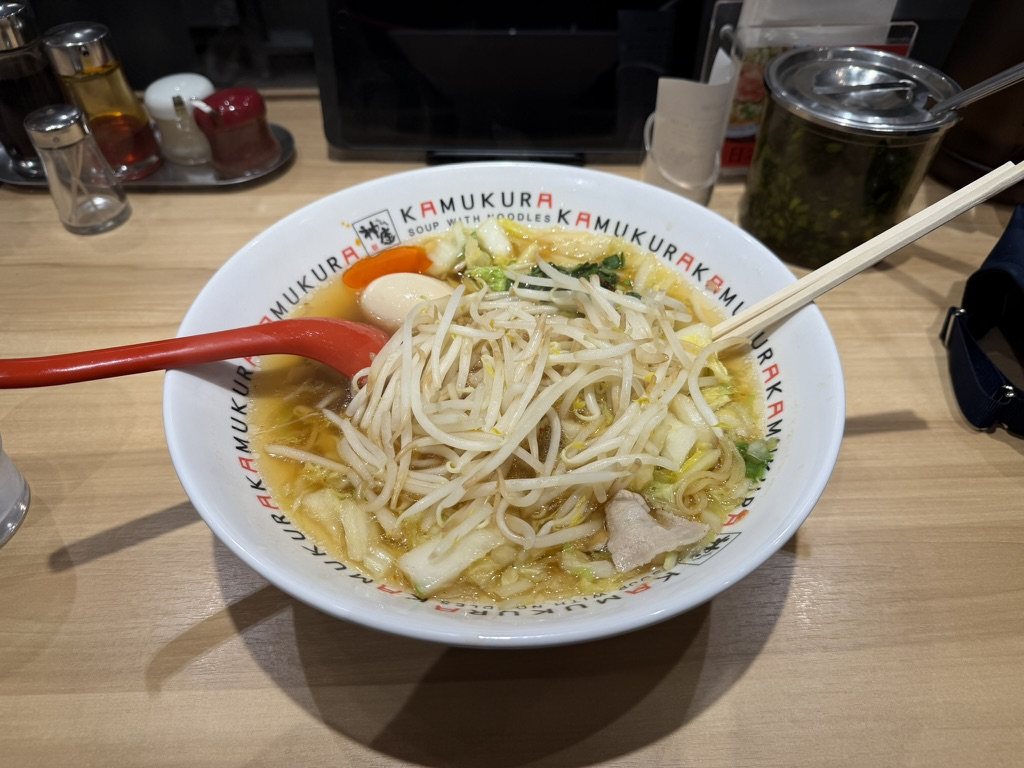 Lunch in Nara, from an Osaka ramen chain: a preview of what was coming.
Zen, Tea, and the Kyoto Table
Kyoto is also where Zen became a way of living rather than only a doctrine. The great Zen temples here were patrons of ink painting and garden design, and the tea ceremony grew out of them. Sen no Rikyū, a merchant’s son trained in Rinzai Zen, refined it in the 16th century as tea master to Hideyoshi, into the spare, rustic style called wabi-cha. The light meal served before tea became kaiseki, Japan’s formal cuisine, and the temples’ vegetarian cooking, shōjin ryōri, shaped it too. What reached the ordinary Kyoto table was obanzai, home-style dishes served in small portions, many at once, nearly all of them built on dashi, the kelp-and-bonito stock that is also the base of miso soup.
On my last morning I went west to Arashiyama, early enough to have the bamboo grove almost to myself; it runs beside Tenryū-ji, one of the city’s great Zen temples. Then I rode out along the Hozu River gorge, where a crowd of ceramic tanuki waits on the platform at Hozukyo station. In folklore the tanuki is a shape-shifting trickster; in ceramics it is a round-bellied figure of good luck.
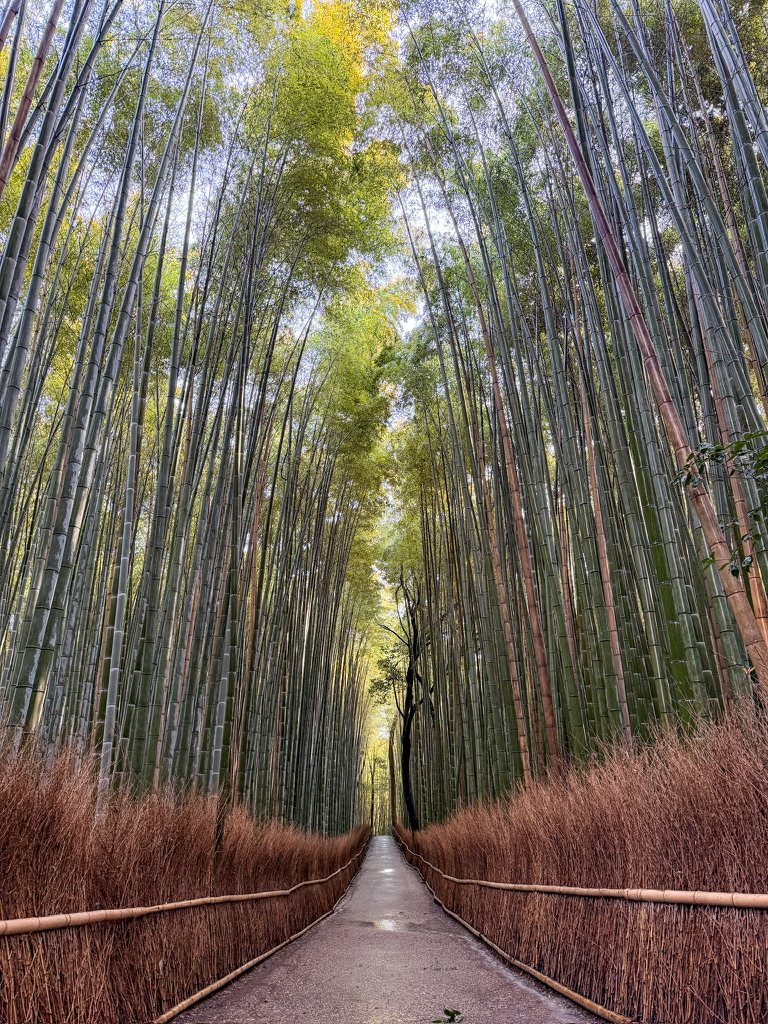 The bamboo grove at Arashiyama, early.
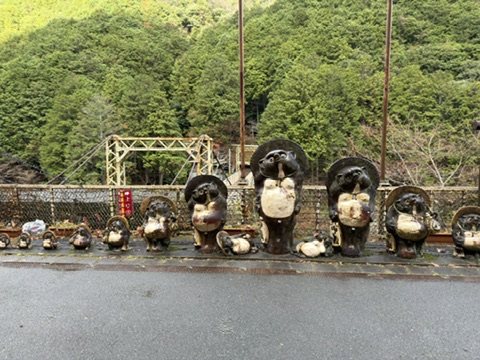 The tanuki of Hozukyo station.
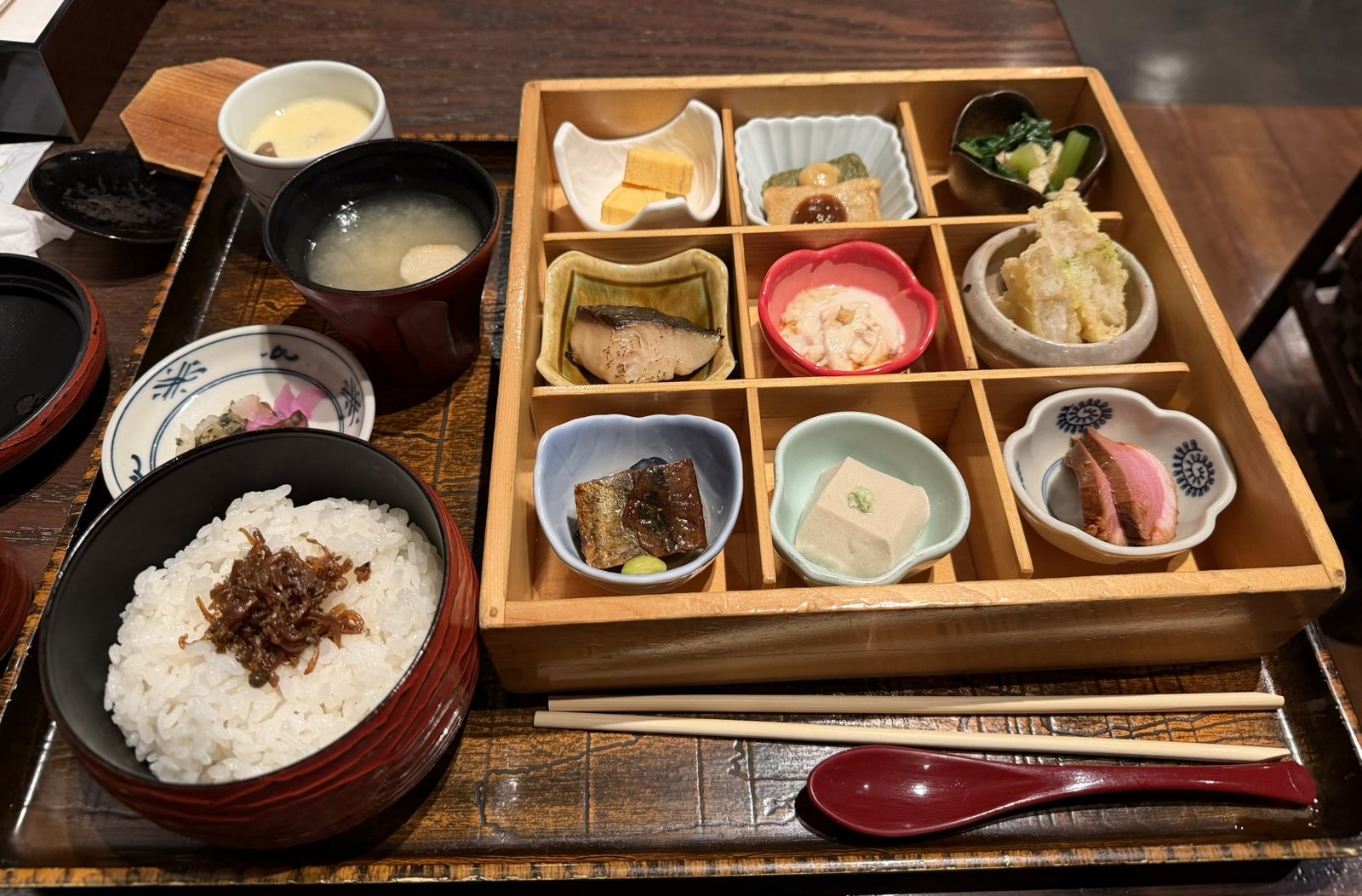 A last Kyoto lunch: nine small dishes in a box, before the train to Osaka.
I noticed the sound of footsteps on stone, how the light changed in the afternoon, how little signage there was, and the restraint in architecture and color. Kyoto reminded me that depth does not need volume.
Osaka: Warmth, Appetite, and Release
Fri 26–Sat 27 Dec · Osaka · Days 8 and 9
Osaka, once called Naniwa, greeted me differently. It was louder, looser, and more human. People laughed more openly, food was everywhere, and it was less polished and more alive. After Kyoto’s introspection, it felt like permission to re-engage.
The Last Battle of the Warring States
Osaka Castle is where the Sengoku period finally ended. Toyotomi Hideyoshi, the second of the three unifiers, began it in 1583. After he died, Tokugawa Ieyasu, already shogun, besieged his heir there in the winter of 1614 and the summer of 1615 and destroyed the Toyotomi line. The defenders’ most famous commander, Sanada Yukimura, led a last charge toward Ieyasu’s headquarters and was killed. The museum inside the castle tells the story with a diorama in front of a painted folding screen, the kind of gold-ground byōbu that warlords commissioned to record their battles; the labels name Sanada Yukimura’s troops on the left and those of Matsudaira Tadanao, who fought them, on the right. The best-known screen of the battle, the Ōsaka Natsu no Jin Zu Byōbu, was commissioned by Kuroda Nagamasa, a general on the Tokugawa side, and is an Important Cultural Property in the castle’s collection.
The main tower today is a 1931 reinforced-concrete reconstruction, paid for by the people of Osaka. From the top, a gilded shachihoko, a fish with a tiger’s head meant to protect the roof from fire, looks out over the moats.
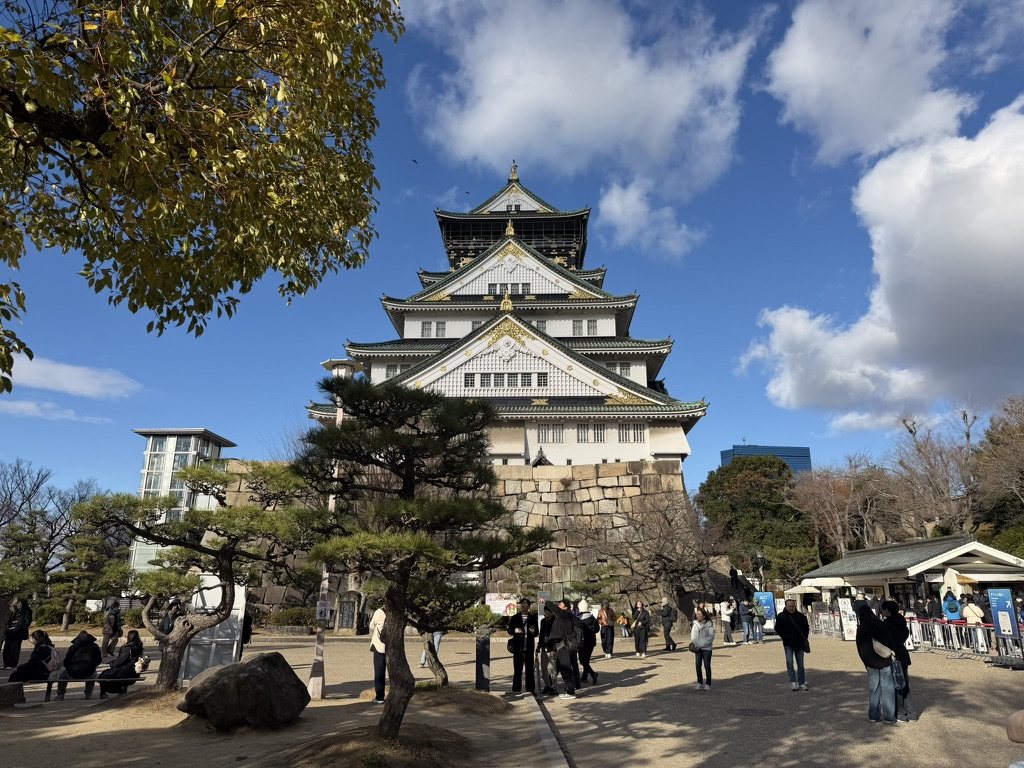 Osaka Castle’s main tower, rebuilt in 1931.
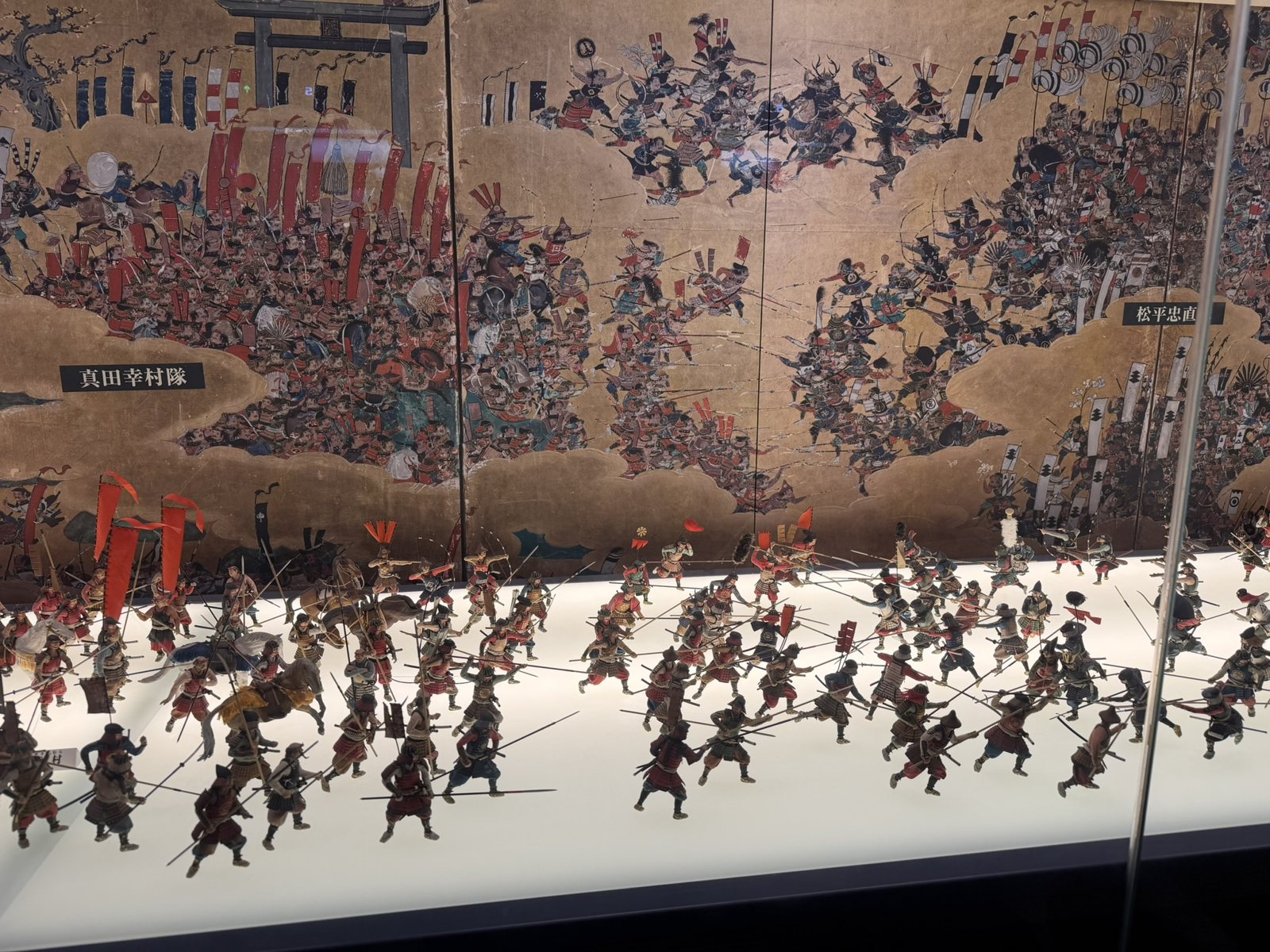 The Siege of Osaka, 1615. Sanada Yukimura’s troops are labeled on the left, Matsudaira Tadanao’s on the right.
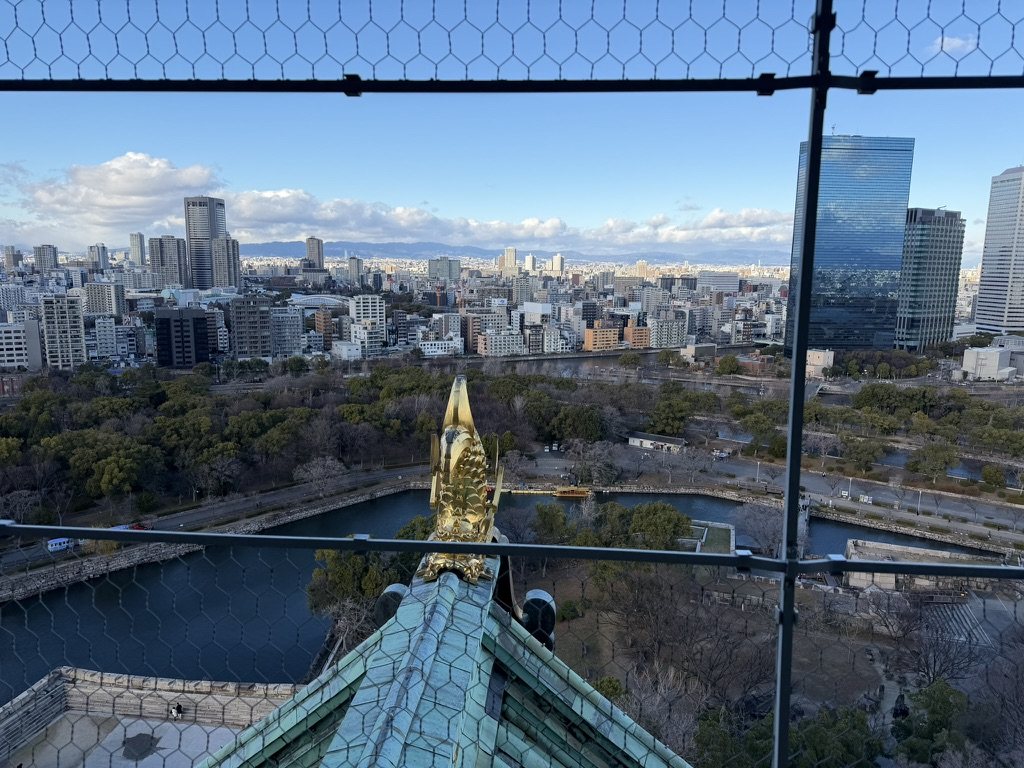 A gilded shachihoko on the roof, with the moats below.
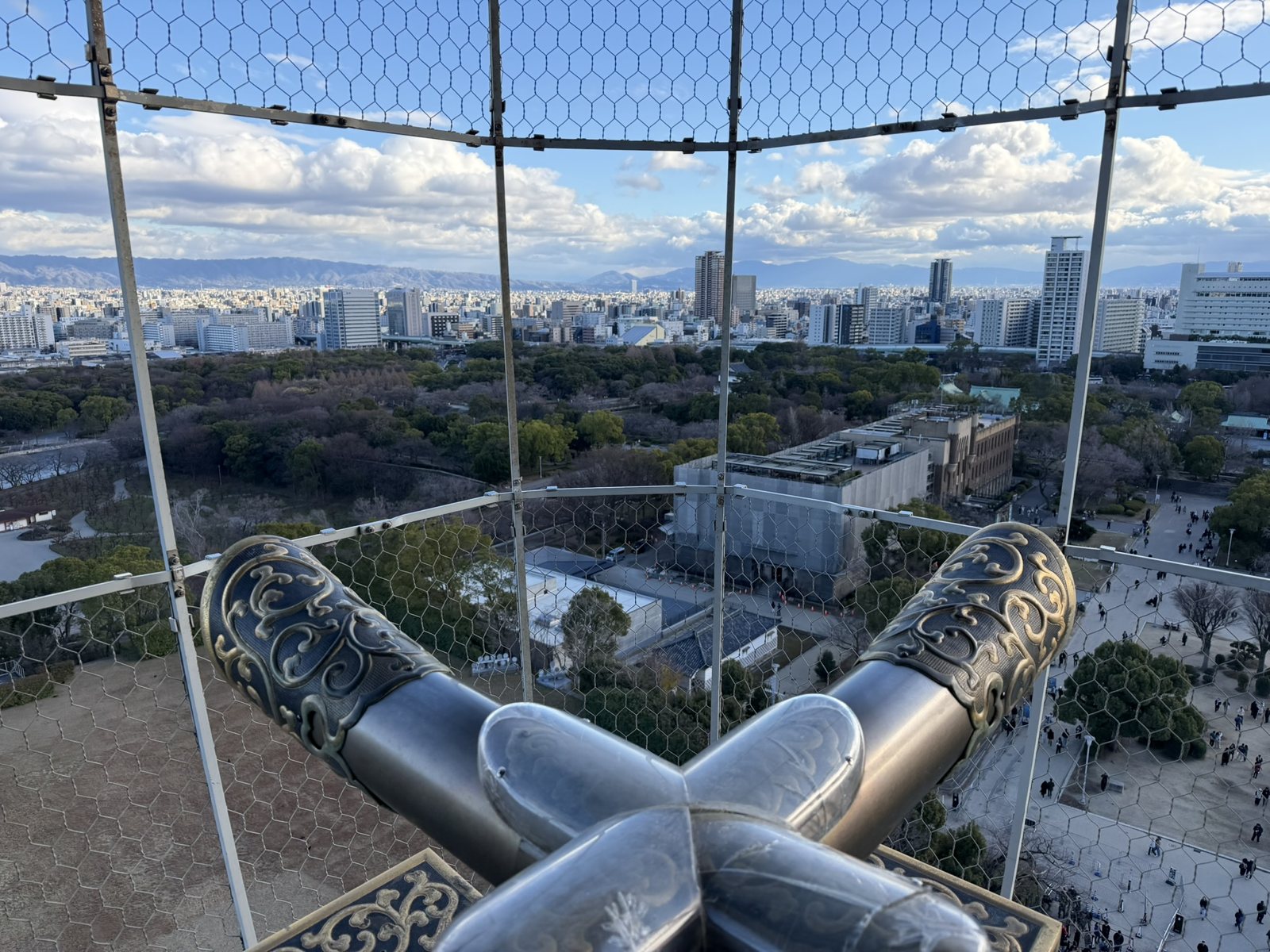 The view east from the top of the castle.
The Nation’s Kitchen
With peace, Osaka became the commercial capital of Edo Japan. Domains from across the country shipped their tax rice here to be sold, and the city became known as tenka no daidokoro, “the nation’s kitchen.” At the Dōjima Rice Exchange, officially recognized by the shogunate in 1730, merchants traded contracts on future rice deliveries, which is why Dōjima is often called the world’s first organized futures market. As someone who works in markets, I liked the thought that futures trading began with Inari’s crop.
The city’s motto is kuidaore, to eat until you drop. In Dōtonbori, the Glico running man, on his billboard in one form or another since 1935, crosses the finish line all night. In Shinsekai, the “New World” district laid out in 1912, a giant tengu mask advertises grilled meat and a shooting gallery promises good luck.
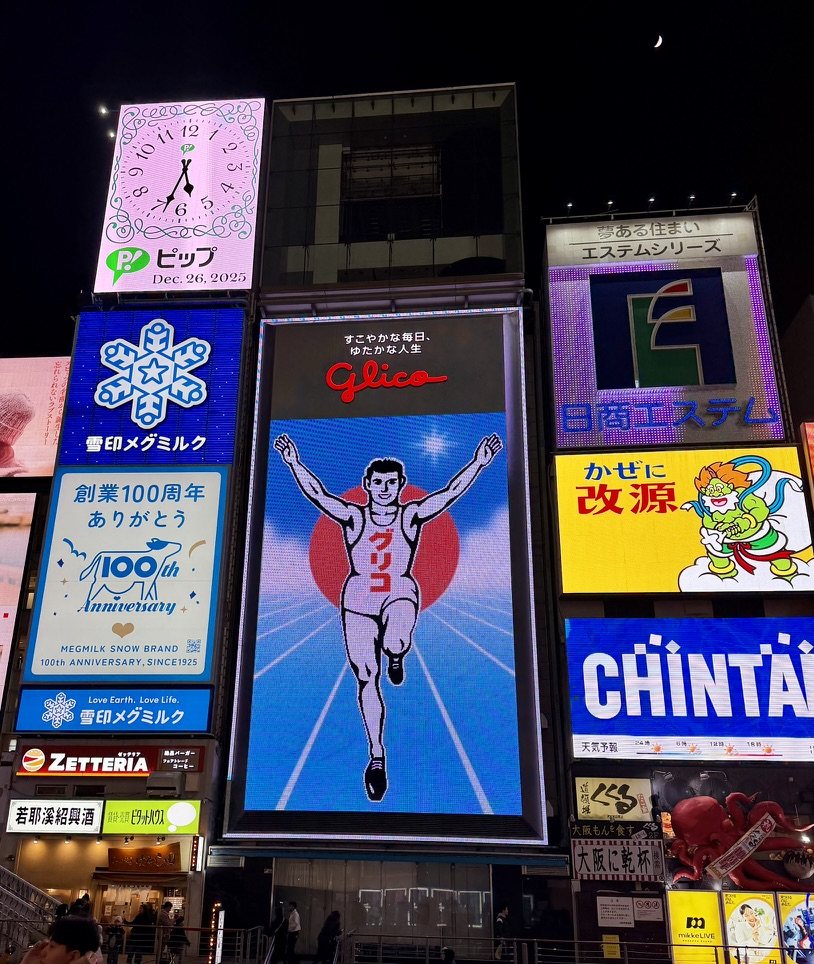 The Glico sign in Dōtonbori, on 26 December 2025.
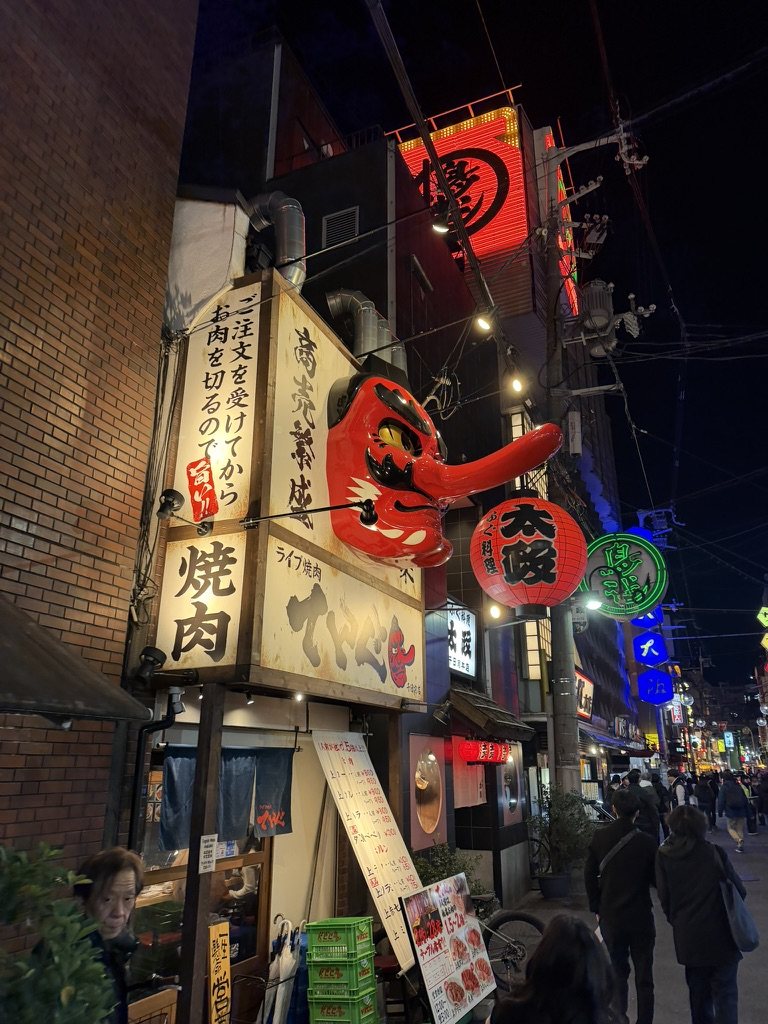
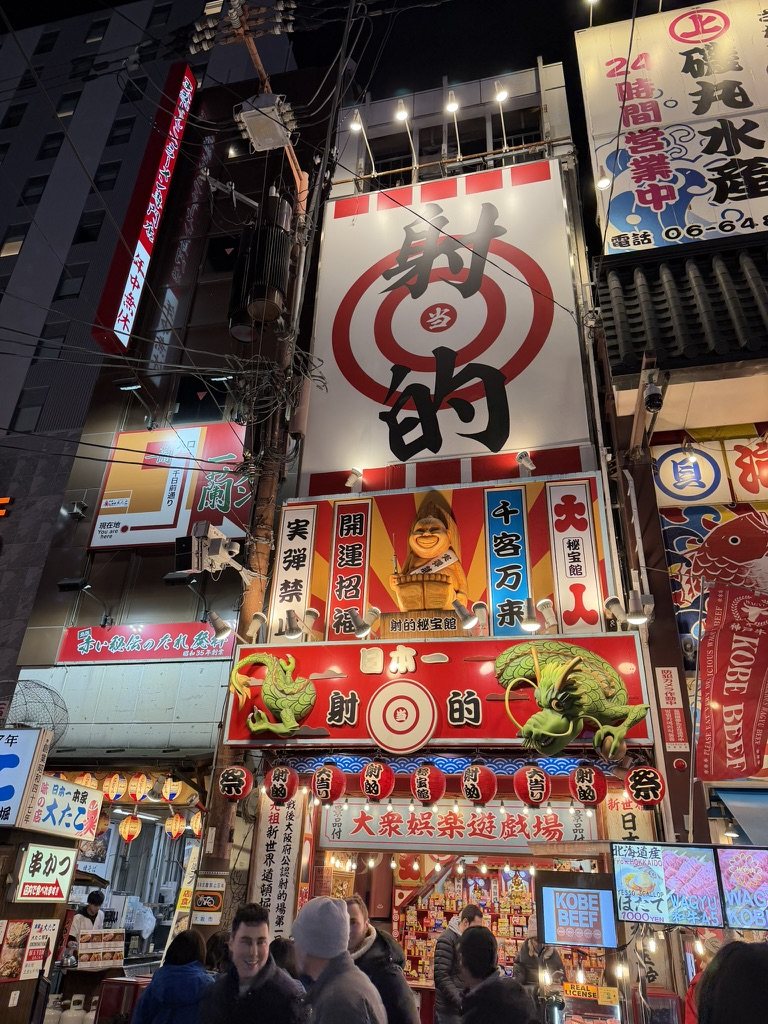
Osaka did not ask me to reflect. It asked me to enjoy. Walking through Dōtonbori on my last night, I realized it was the right ending: I did not leave Japan in silence, I left it with energy. I noticed the warmth in casual exchanges, the way food brings people together, the lack of pretense, and the contrast with Kyoto, and why both matter. Osaka reminded me that life is meant to be tasted, not just understood.
Rebalanced
Looking back, the trip moved in a deliberate arc. Tokyo taught me independence, Kyoto taught me restraint, and Osaka taught me ease. Underneath all three ran the two ideas I started with: kami in the mountains and the trees, and the Buddhist sense that everything passes, which is why the blossom is loved more than the rock. None of the questions I arrived with were answered, and that turned out to be fine; I had come to learn to stand inside them, and the samurai virtue I came home with was the quiet one, restraint as a form of strength. I did not leave Japan transformed. I left it rebalanced, and that was enough.
Getting Around
Japan is easy to move around once three things are sorted.
- An IC card. Suica (JR East) and PASMO in Tokyo, and ICOCA in the Kansai region around Kyoto and Osaka, are rechargeable cards you tap at the ticket gates of trains, subways, and most buses, and at convenience stores and vending machines. The cards largely work across each other’s networks, though not for every journey that crosses between regions. Physical cards are on sale again after a chip shortage in 2023 and 2024; visitors can also buy a Welcome Suica at airports and major stations, or add a Suica to an iPhone’s Wallet and top it up with a credit card, which is what I did.
- Some cash. Cards are now accepted widely, but small restaurants, temple and shrine offerings, market stalls, and the ticket machines at many ramen shops still want yen in coins and notes. Convenience-store ATMs, 7-Eleven’s in particular, generally take foreign cards.
- The Shinkansen. The Nozomi, the fastest service on the Tōkaidō line, runs between Tokyo, Kyoto, and Osaka several times an hour. Reserve a seat on the right side heading west, seat E, for a chance at Mt Fuji between Mishima and Shin-Fuji. Bags larger than 160 cm in total dimensions need a seat reserved with an oversized-baggage area, or there is a ¥1,000 charge. For a single run from Tokyo to Osaka, individual tickets are usually cheaper than the national Japan Rail Pass, whose price rose sharply in 2023; do the arithmetic for your own route.
The Route
This is the order I would follow if I did the trip again. It keeps each day in one part of the city and puts Fushimi Inari on the way to Nara; my own days ran in a slightly different order.
| Day | Date | Where | What to do |
|---|---|---|---|
| 1 | Fri 19 Dec | Tokyo | Arrive; ramen at Ichiran |
| 2 | Sat 20 Dec | Tokyo | Old Edo: the Imperial Palace, Tokyo Station, Nihonbashi and Kyōbashi; lunch in Kanda; Akihabara; Sensō-ji in Asakusa |
| 3 | Sun 21 Dec | Tokyo | West Tokyo: Meiji Jingu; Harajuku and Omotesando; Shibuya Sky at sunset; Shinjuku, Golden Gai, and Kabukichō |
| 4 | Mon 22 Dec | Mt Fuji, Hakone | Fuji’s fifth station and Komitake Shrine; Hakone |
| 5 | Tue 23 Dec | Tokyo | The bay: Tsukiji; teamLab Planets in Toyosu; Odaiba; Zōjō-ji and Tokyo Tower at dusk |
| 6 | Wed 24 Dec | Kyoto | Shinkansen to Kyoto; Gion, Yasaka Shrine, Hanamikoji, and Shirakawa at dusk |
| 7 | Thu 25 Dec | Nara | Fushimi Inari on the way; Kasuga Taisha, Nara Park, and Tōdai-ji |
| 8 | Fri 26 Dec | Osaka | Arashiyama and the Hozu gorge; train to Osaka; Osaka Castle, Shinsekai, and Dōtonbori |
| 9 | Sat 27 Dec | — | Sumiyoshi Taisha; fly home from Kansai |
Appendix: A Short Glossary
| Word | Meaning |
|---|---|
| Kami | A god or spirit in Shinto, often a mountain, river, tree, or force of nature |
| Jinja, taisha | A Shinto shrine; a taisha is a grand shrine |
| -ji, tera | A Buddhist temple |
| Torii | The gate that marks the entrance to a shrine’s sacred space |
| Shogun | The military ruler of Japan, at the head of the samurai, who governed in the emperor’s name |
| Edo | Tokyo’s name until 1868, and the period of Tokugawa rule, 1603–1868 |
| Sengoku | The “Warring States” period of civil war, from 1467 until unification around 1600 |
| Ukiyo-e | Edo-period woodblock prints, “pictures of the floating world” |
| Ohayō gozaimasu | Good morning (おはようございます) |