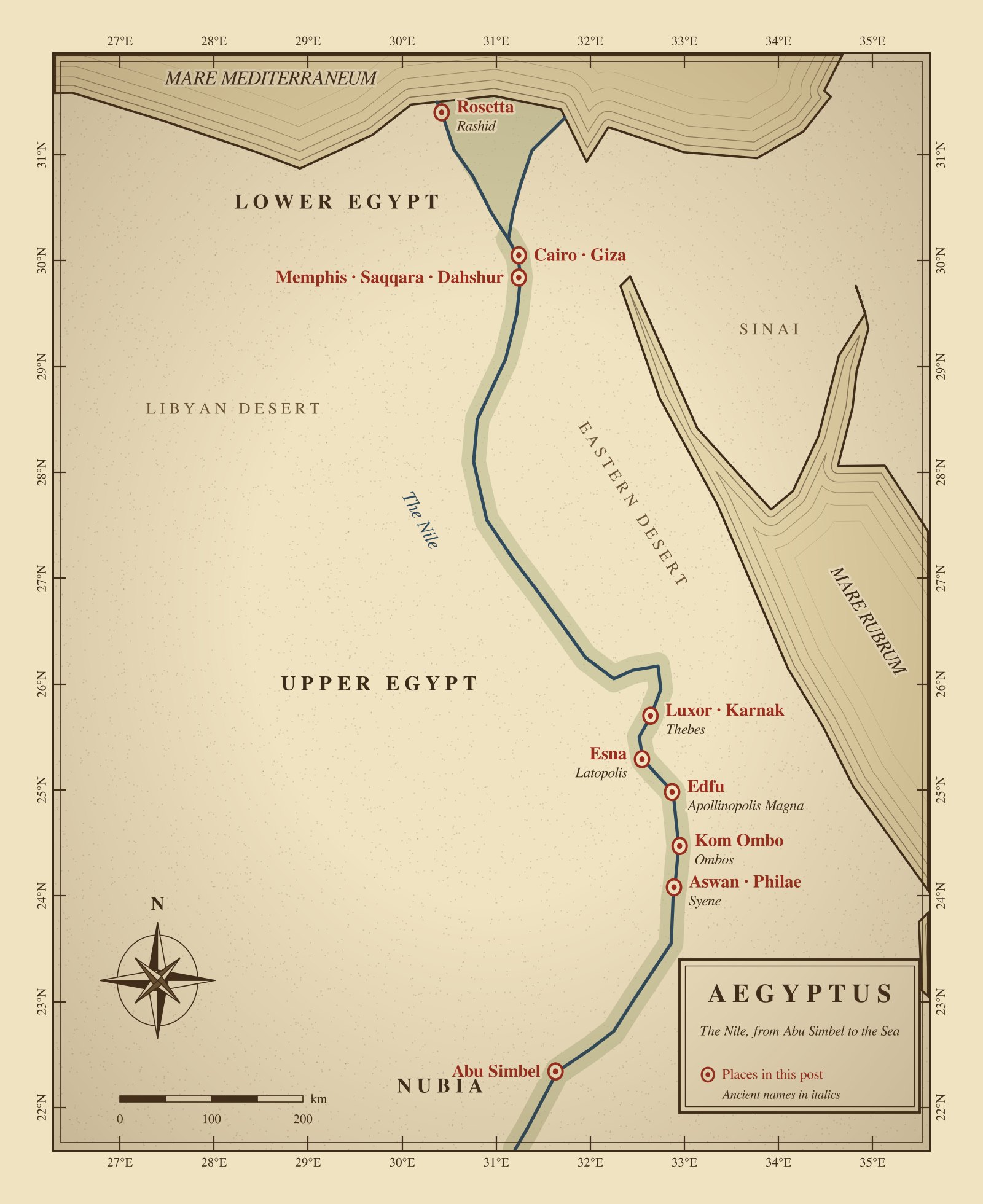
 Egypt, drawn for this post in the style of an old map. The places I visited run along the Nile from Abu Simbel to Rosetta; ancient names are in italics.
On a wall at Philae, near Aswan, there is a short inscription carved in AD 394. It is the last dated text anyone wrote in Egyptian hieroglyphs. No later one has been found, and the script that had recorded some 3,500 years of kings went silent. I stood in front of it in November 2023, and only later realized that the week had covered nearly the whole arc of that civilization, from its first stone building to its last word. So I have written it up in the order of Egypt’s history rather than the order of my route.
The Periods, and Where I Saw Them
Egyptologists divide ancient Egypt into kingdoms, when one king ruled the whole Nile valley, and intermediate periods, when that unity broke down. The dates below are approximate.
| Period | Dates | Where I saw it |
|---|---|---|
| Early Dynastic | c. 3100–2686 BC | The Narmer Palette at the Egyptian Museum |
| Old Kingdom | c. 2686–2181 BC | Memphis, Saqqara, Dahshur, Giza, Djoser’s statue at the Egyptian Museum |
| First Intermediate and Middle Kingdom | c. 2181–1650 BC | — |
| Second Intermediate | c. 1650–1550 BC | — |
| New Kingdom | c. 1550–1069 BC | Karnak, Luxor Temple, the Valleys of the Kings and Queens, Abu Simbel, the Luxor Museum, the Egyptian Museum |
| Third Intermediate and Late Period | c. 1069–332 BC | The Nubian Museum and a Nubian village, Aswan |
| Ptolemaic | 332–30 BC | Kom Ombo, Edfu, most of Philae, the Rosetta Stone (British Museum) |
| Roman | 30 BC–AD 395 | Esna, Philae |
The Nile and the Two Lands
Everything in Egypt depends on the Nile. The river flows north, from Aswan to the Mediterranean, so Upper Egypt is the south, upstream, and Lower Egypt is the north, the Delta. Egyptians called their country Kemet, “the black land” 𓆎𓅓𓏏𓊖, after the dark silt the flood left on the fields. The desert on either side was Deshret, “the red land.”
Each half had its own emblems, and they appear on almost everything I saw:
- 𓋑White crown: Upper Egypt
- 𓋔Red crown: Lower Egypt
- 𓋖Double crown: the king of both
- 𓆸Lotus: the plant of Upper Egypt
- 𓇉Papyrus: the plant of Lower Egypt
- 𓇓𓆤"King of Upper and Lower Egypt": the sedge of the south and the bee of the north
The two plants carry the same idea into architecture. Temple columns are carved as bundles of papyrus or lotus, and the sides of royal thrones, including those of the colossi at Abu Simbel, show the sema-tawy, “uniting the Two Lands”: a lotus and a papyrus tied around the sign for “unite” 𓄥.
Papyrus was also Egypt’s paper. Scribes cut the plant’s pith into strips, laid them crosswise, and pressed them into sheets, and the Greek word for the plant, papyros, gave English the word paper. Carved hieroglyphs were the formal script for monuments; on papyrus, scribes wrote faster, cursive forms.
Royal names were written inside a cartouche, an oval loop of rope that protected the name it enclosed. I have drawn a few in this post, with the signs in a single line for simplicity.
Early Dynastic and Old Kingdom: The Pyramid Age
c. 3100–2181 BC · Cairo, Memphis, Saqqara, Dahshur, Giza · Day 1
Egypt became one country around 3100 BC, when the kings of Upper Egypt took Lower Egypt. The best-known record of that moment is the Narmer Palette in the Egyptian Museum, a siltstone slab about 63 centimeters tall. On one side, King Narmer wears the white crown of Upper Egypt and raises a mace over a kneeling enemy from the Delta; on the other, he wears the red crown of Lower Egypt.
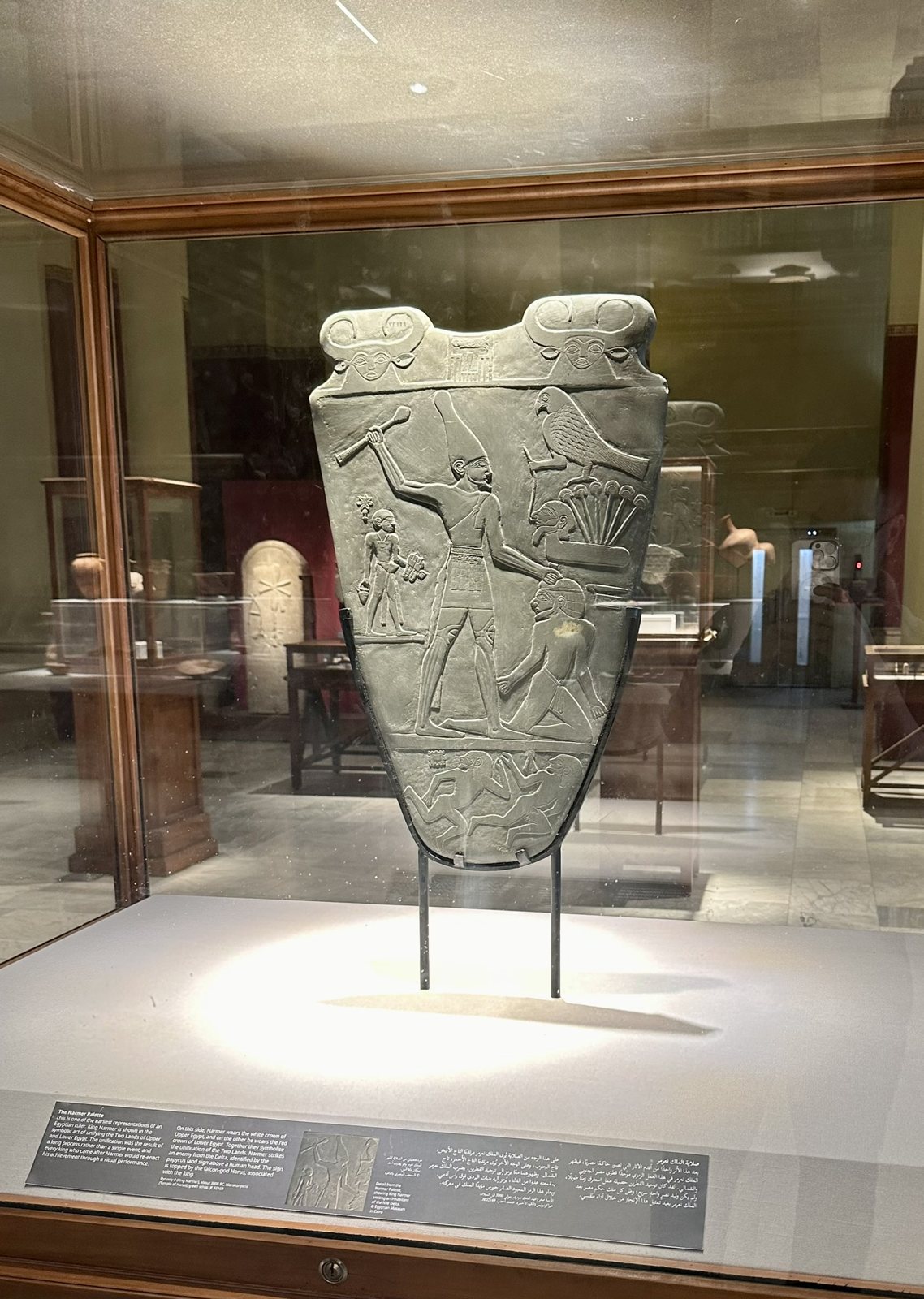 The Narmer Palette, Egyptian Museum, Cairo. Narmer, in the white crown, strikes an enemy from the Delta.
The palette matters less as a record of events than as a template. It is one of the earliest images of an Egyptian king, the earliest to show a king in both crowns, and it carries some of the earliest hieroglyphs. Scholars still debate whether it shows a real conquest or a ritual claim to rule both lands. Either way, its central image of the king with his mace raised over an enemy became the standard picture of kingship for the next 3,000 years, and I kept meeting it, down to the last Greek kings at Edfu and Philae.
Narmer’s successors ruled from Memphis, near modern Cairo. By the Old Kingdom, the king was treated as a god on earth, and the state’s main project was his tomb.
Little of Memphis survives above ground, largely because later builders carried off its stone. At its open-air museum, a limestone colossus of Ramesses II lies on its back, a reminder that the city stayed a royal seat long after the pyramid age.
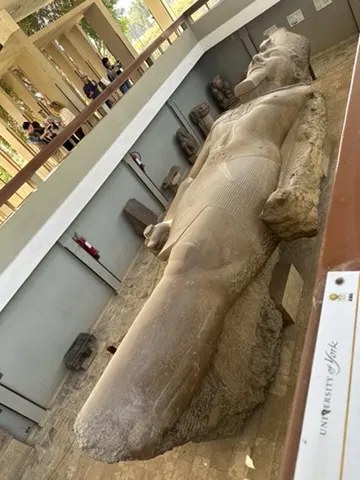 The fallen colossus of Ramesses II at Memphis.
Saqqara, the burial ground of Memphis, is where the tomb-building started. Before the pyramids, kings were buried under mastabas, flat-topped tombs of mud brick or stone, and officials kept using them long after. In one, I found a false door carved into the wall: a doorway that does not open, framed by the owner’s names and titles, with a panel above showing him seated at a table of offerings. Egyptians believed the ka, the part of the soul that needed food, passed through it to collect what the living left on the stone slab in front.
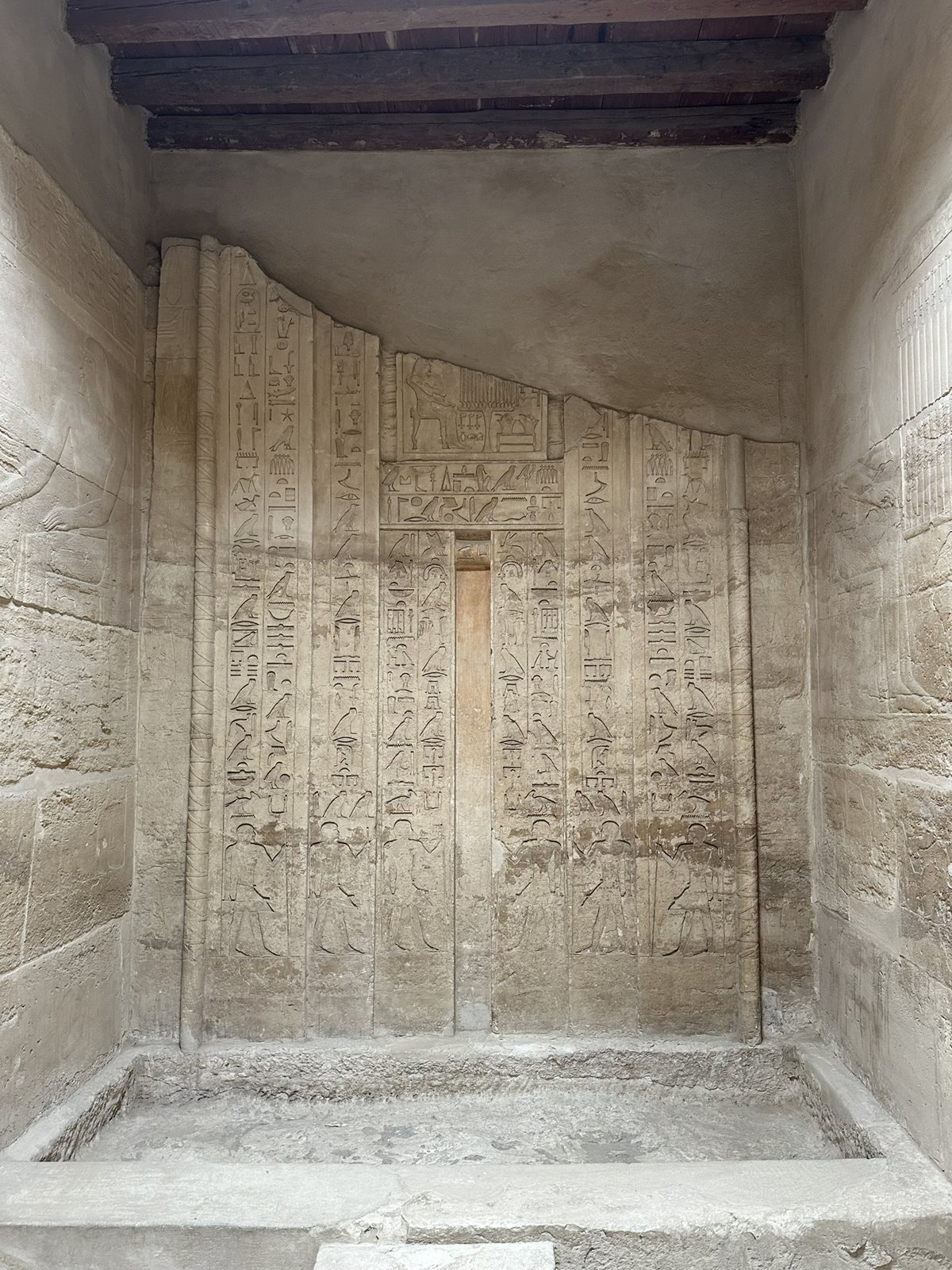 A false door in a mastaba at Saqqara. The doorway is solid stone; only the ka could pass through it.
The Step Pyramid of Djoser at Saqqara, designed by the architect Imhotep around 2670 BC, is the oldest large stone building in the world. It is six mastabas stacked into a staircase to the sky, and you can see the idea being invented.
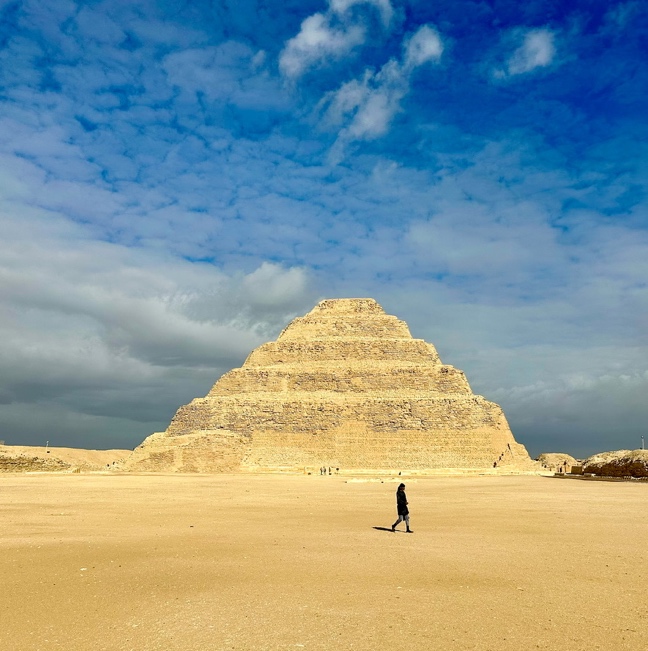 The Step Pyramid of Djoser at Saqqara.
Djoser himself is in the Egyptian Museum. His limestone statue, found in 1925 in a serdab, a sealed chamber beside the pyramid, is often described as the oldest known life-size statue from ancient Egypt. The serdab had two small eye holes so the king could watch the offerings, and a copy now sits in his place. Behind the statue, the museum has set a wall of blue faience tiles from the chambers under his pyramid.
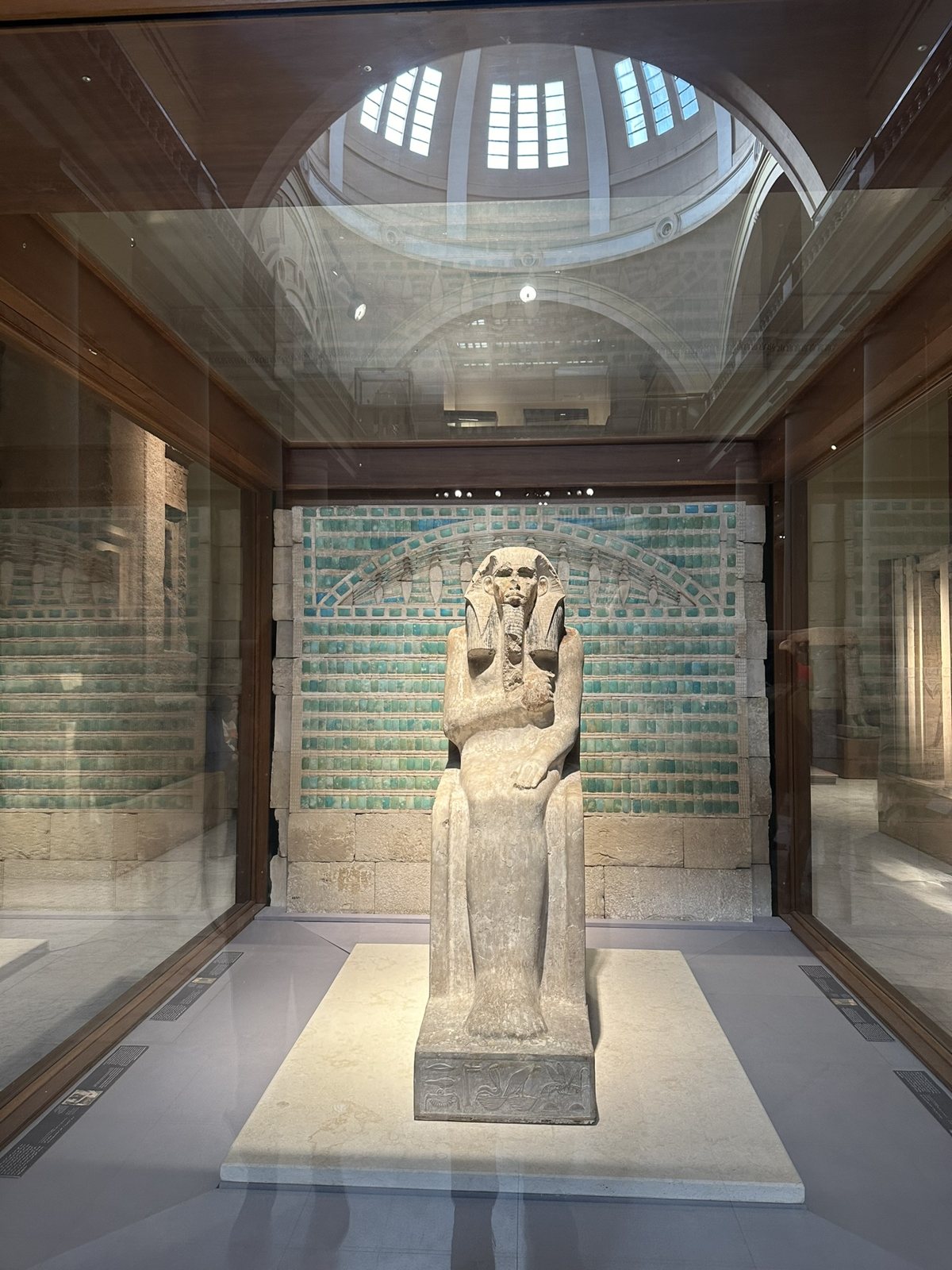 Djoser, Egyptian Museum, Cairo, in front of tiles from the chambers beneath his pyramid.
At Dahshur, the Bent Pyramid of Sneferu 𓋴𓄤𓂋𓅱 shows the next step, from stepped sides to smooth ones, going wrong. Partway up, the builders reduced the angle, probably because the structure was becoming unstable. Sneferu then built the Red Pyramid nearby with the correction applied, and his son Khufu 𓐍𓅱𓆑𓅱 took the lesson to Giza.
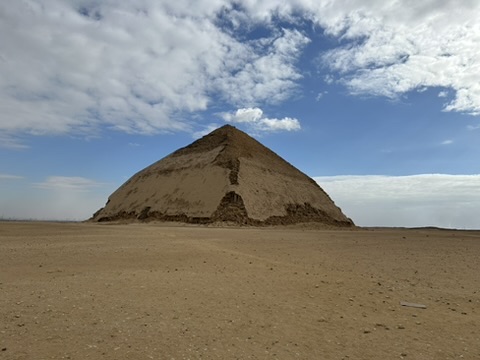 The Bent Pyramid at Dahshur. The change of angle is visible about halfway up.
Khufu’s Great Pyramid remained the tallest man-made structure on earth for nearly 4,000 years, and it did not always look as it does now. The stepped blocks visible today are its core. When it was finished, it was faced with fine white limestone, polished smooth, which would have shone in the sun. Over the centuries, most of that casing was carried off for other buildings, much of it for medieval Cairo. The capstone is gone too. Some pyramid capstones were gilded or covered in electrum, an alloy of gold and silver, but no one knows what Khufu’s was made of.
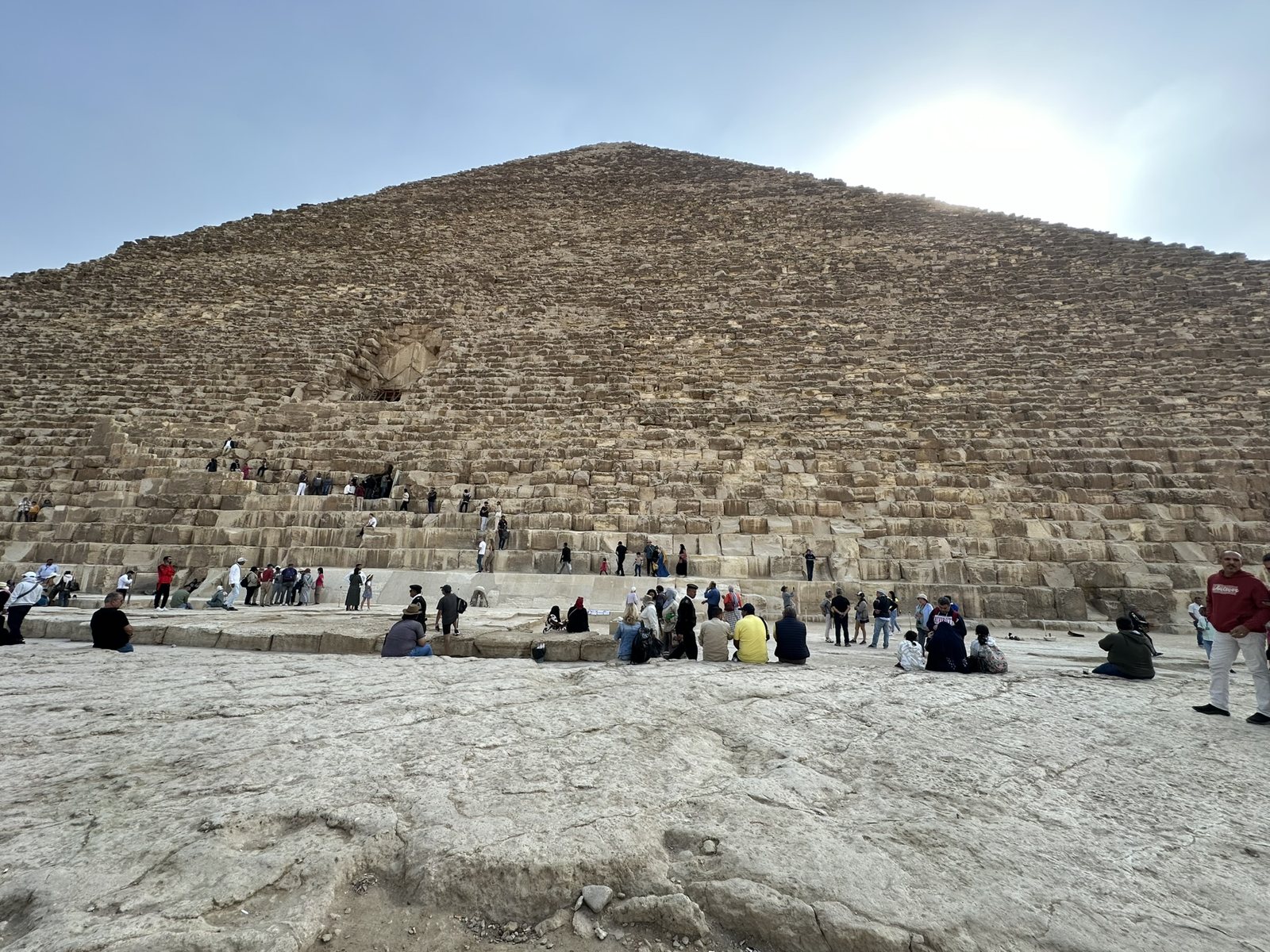 At the foot of the Great Pyramid. What remains is the core; the white casing is almost all gone.
Those bare steps also made the pyramid climbable, and for most of modern history visitors went up the outside. Nineteenth-century travelers treated the summit as part of the tour, hauled up the waist-high blocks by local guides who pulled from above, pushed from below, and expected a tip at the top. Mark Twain made the climb in 1867 and wrote about the help with little affection. Egypt banned climbing in 1951, partly because climbers had fallen to their deaths and partly to protect the stone, though the rule was loosely enforced for decades. In 2020, parliament made climbing an antiquity without a permit a crime, punishable by a month in prison, a fine, or both. My own ascent therefore ended a few courses up, at the tourist entrance, which was as high as the law, and my knees, would allow.
Inside, the climb up the Grand Gallery to the King’s Chamber is steep, hot, and cramped, and the chamber itself is bare granite. That emptiness is the point. Everything else I saw that week, from Abu Simbel’s colossi to the last hieroglyphs at Philae, descends from the confidence this building expressed.
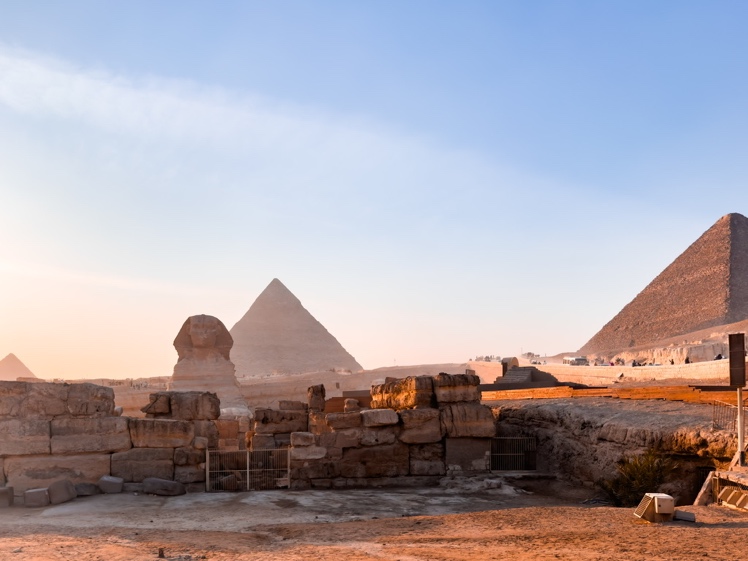 The Sphinx, probably carved for Khafre 𓇳𓈍𓆑, with his pyramid and Khufu’s behind it.
The Sphinx has gone by several names. Egyptians called statues like it shesep-ankh, “living image” 𓊏𓊪𓋹, and the Greek word “sphinx” may be borrowed from it, though it may instead come from a Greek verb meaning “to squeeze.” By the New Kingdom, Egyptians worshipped this one as Horemakhet, “Horus in the horizon,” and Thutmose IV cleared the sand from its body and set up the Dream Stela between its paws. In Arabic it is Abu al-Hol, “the father of dread.”
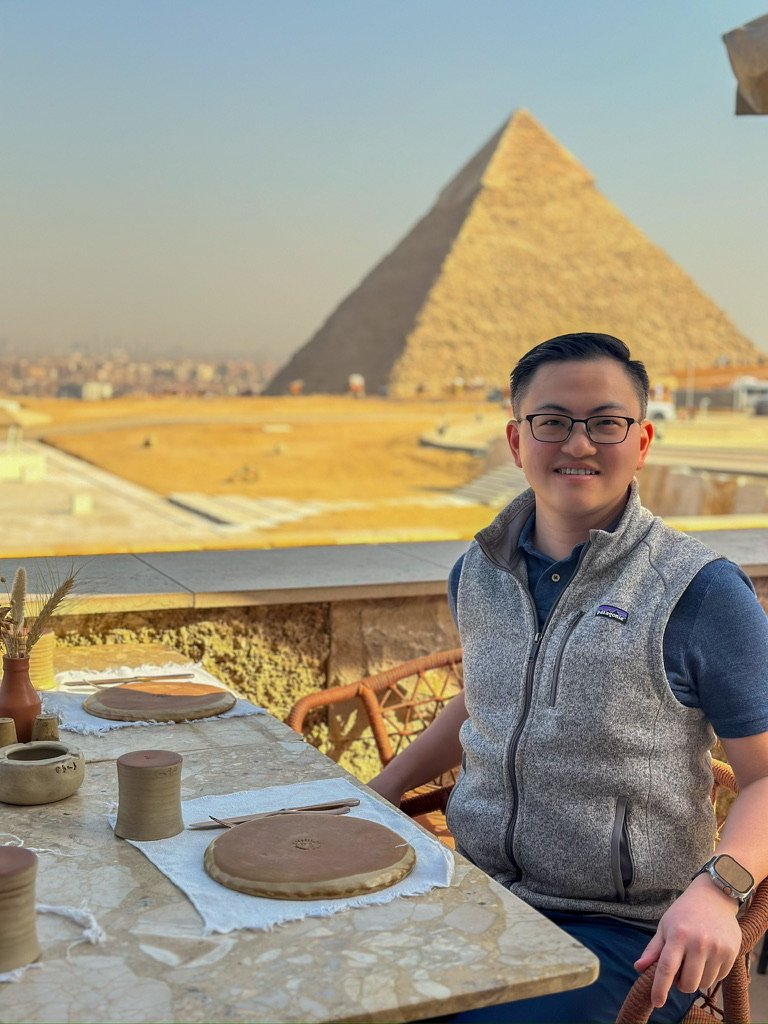
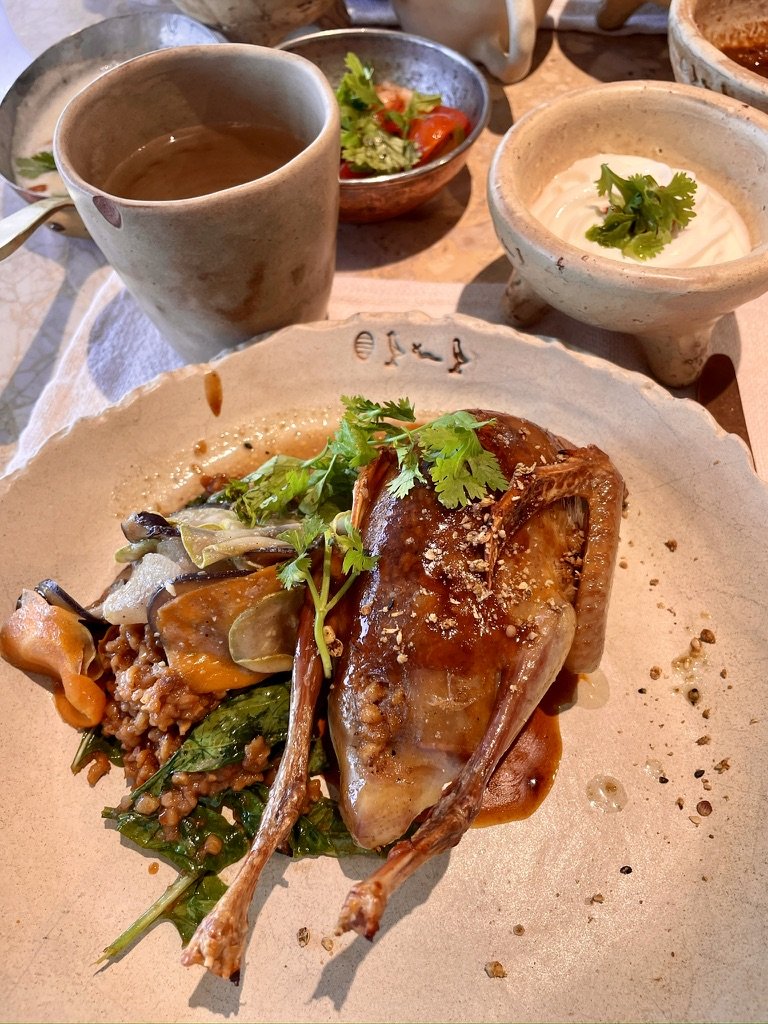
Lunch was at Khufu’s, a restaurant on the Giza plateau whose terrace looks straight at the Great Pyramid. Its chef, Mostafa Seif, reworks the rural dishes he grew up with. The restaurant has since been named the best in Egypt and ranked fourth on the Middle East and North Africa’s 50 Best list for 2025. I ordered hamam, roast pigeon. Pigeon is a staple of Egyptian cooking, and the mud-brick dovecotes that house the birds are still a common sight in villages along the Nile.
New Kingdom: Empire, and the Houses of Eternity
c. 1550–1069 BC · Luxor, Abu Simbel, Cairo · Days 1, 3, 5, and 6
The Old Kingdom ended in more than a century of division. Kings from Thebes, modern Luxor, reunited the country around 2055 BC in what is now called the Middle Kingdom. That unity broke again when the Hyksos, rulers of Near Eastern origin, took the north, and another Theban dynasty expelled them around 1550 BC. The New Kingdom that followed was Egypt at its height: an empire reaching into Nubia and the Levant, run from Thebes and devoted to its god, Amun.
Karnak: A City of Temples
Karnak is less a temple than a city of temples, enlarged by king after king for some 2,000 years. The way in is an avenue of ram-headed sphinxes, the ram being one of Amun’s animals, each with a small figure of the king under its chin for protection. They lead to the first pylon, begun by Nectanebo I in the fourth century BC and never finished. Because the temple grew from the inside out, the first thing a visitor walks through is one of the last things built.
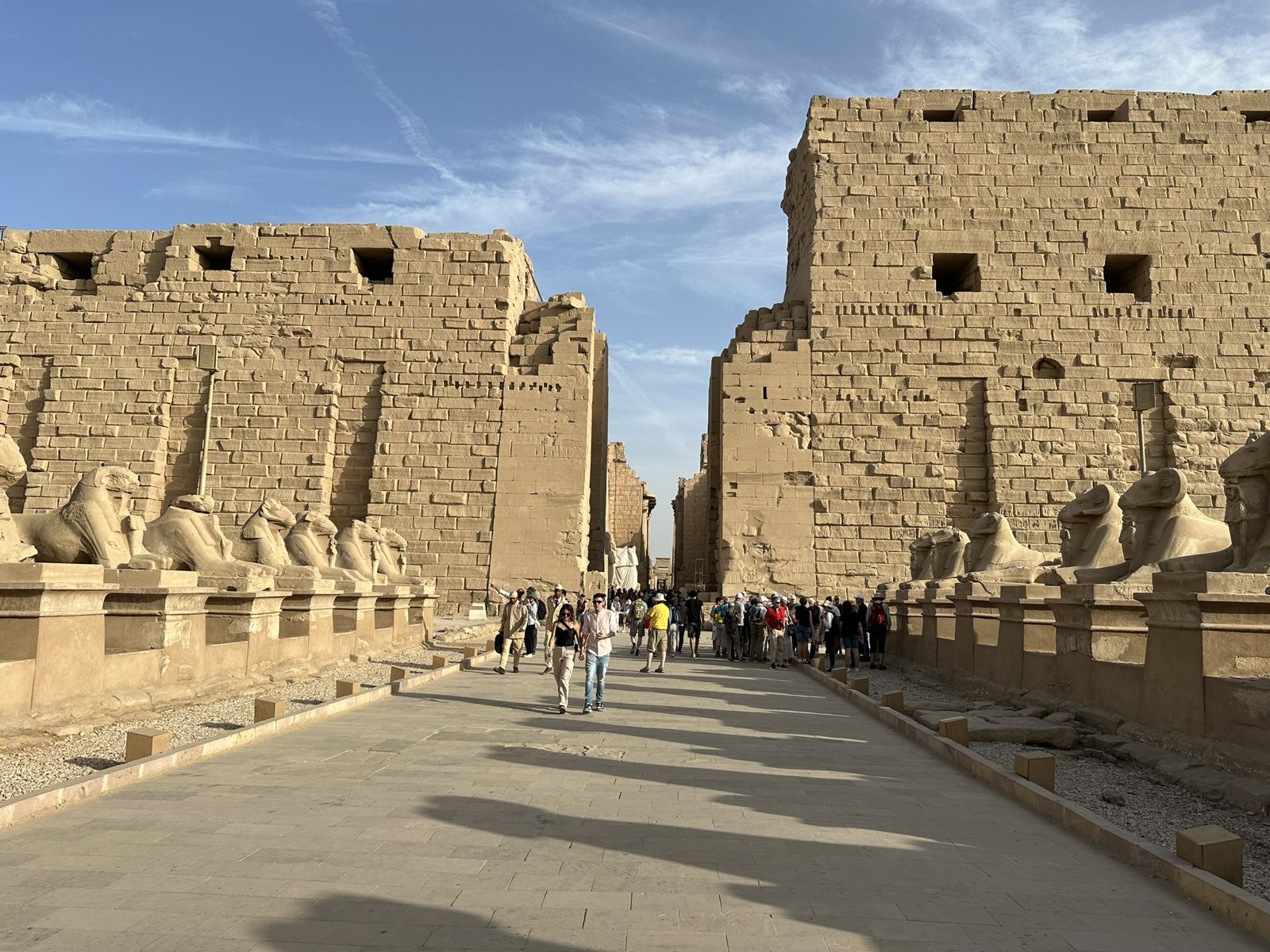 The entrance to Karnak: ram-headed sphinxes and the unfinished first pylon.
Beyond it, the 134 columns of the Great Hypostyle Hall, completed under Seti I and Ramesses II, are the reason to go, and the scale is difficult to convey. Standing among them, you feel the purpose of the design, which was to make a human feel small before Amun 𓇋𓏠𓈖, whose name means “the hidden one.” The columns of the central aisle are carved as open papyrus flowers.
Hatshepsut
The kings of this period also changed how they were buried. Egyptians built for the living on the east bank and buried their dead on the west, where the sun sets. Pyramids had proven too easy to rob, so the New Kingdom’s kings cut their tombs instead into a hidden valley on the west bank, the Valley of the Kings.
Hatshepsut ruled as pharaoh for about 20 years, from around 1479 BC. Her terraced temple at Deir el-Bahari reads almost as modern architecture. Her successor, Thutmose III, later tried to erase her from the record, but her obelisk still stands at Karnak, a reminder that the erasure did not entirely succeed.
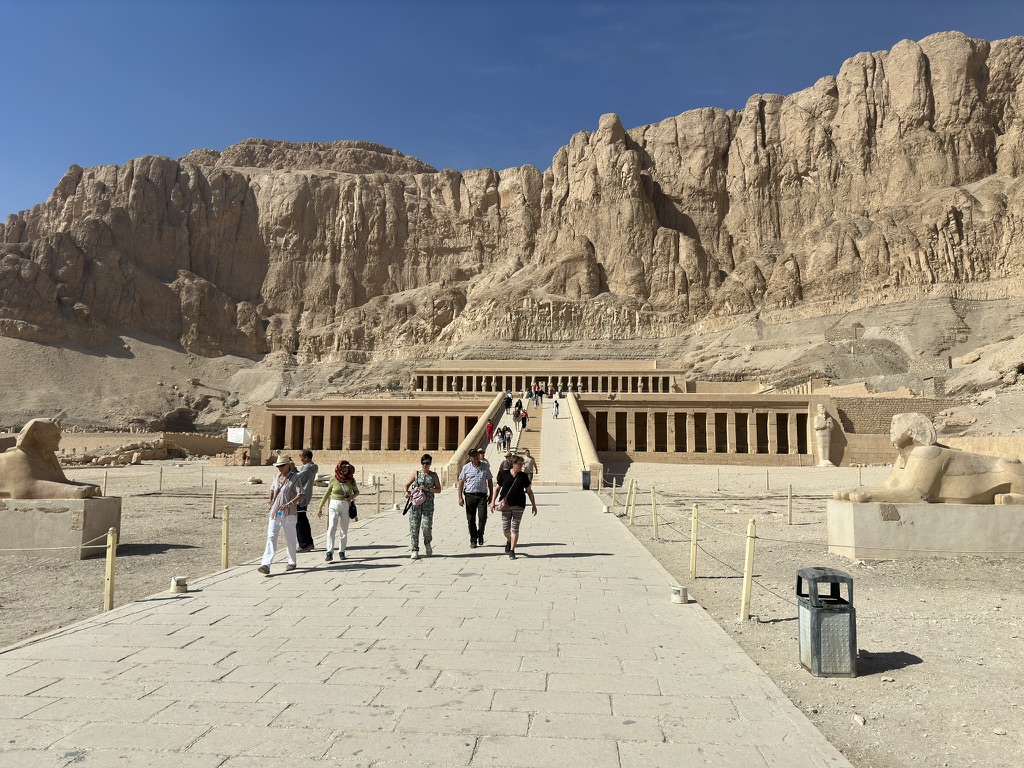 Hatshepsut’s temple at Deir el-Bahari.
Amenhotep III, Akhenaten, and Tutankhamun
Luxor Temple was begun under Amenhotep III around 1390 BC, just before a religious crisis. His son Akhenaten abandoned Amun for the single sun disc of the Aten and moved the capital to a new city. The Luxor Museum, small, well lit, and the best-curated collection of the trip, shows that break directly: one wall is rebuilt from blocks of temples Akhenaten raised to the Aten at Karnak, which later kings pulled down and used as fill inside their own pylons.
The crisis ended with Tutankhamun 𓇋𓏠𓈖𓏏𓅱𓏏𓋹, who was born Tutankhaten, changed his name, and restored Amun. The name means “living image of Amun.” Amun’s name is written first in the cartouche out of respect, and the ankh 𓋹, the sign for life, sits at the end.
Tutankhamun was a minor king who died at about 19, yet his burial alone filled rooms of the Egyptian Museum on Tahrir Square, where I saw it with an Egyptologist on my first day. That made it easier to imagine what the great pharaohs, whose tombs were robbed in antiquity, once took with them. Update, 2026: since my visit, most of the collection, including the gold mask, has moved to the Grand Egyptian Museum near Giza, which opened fully in November 2025 and shows the whole burial in one place for the first time.
I also went down into his tomb in the Valley of the Kings. It is small for a king’s, and only the burial chamber is painted, but the treasure I had seen in Cairo came out of these few rooms, and the king’s mummy still lies here.
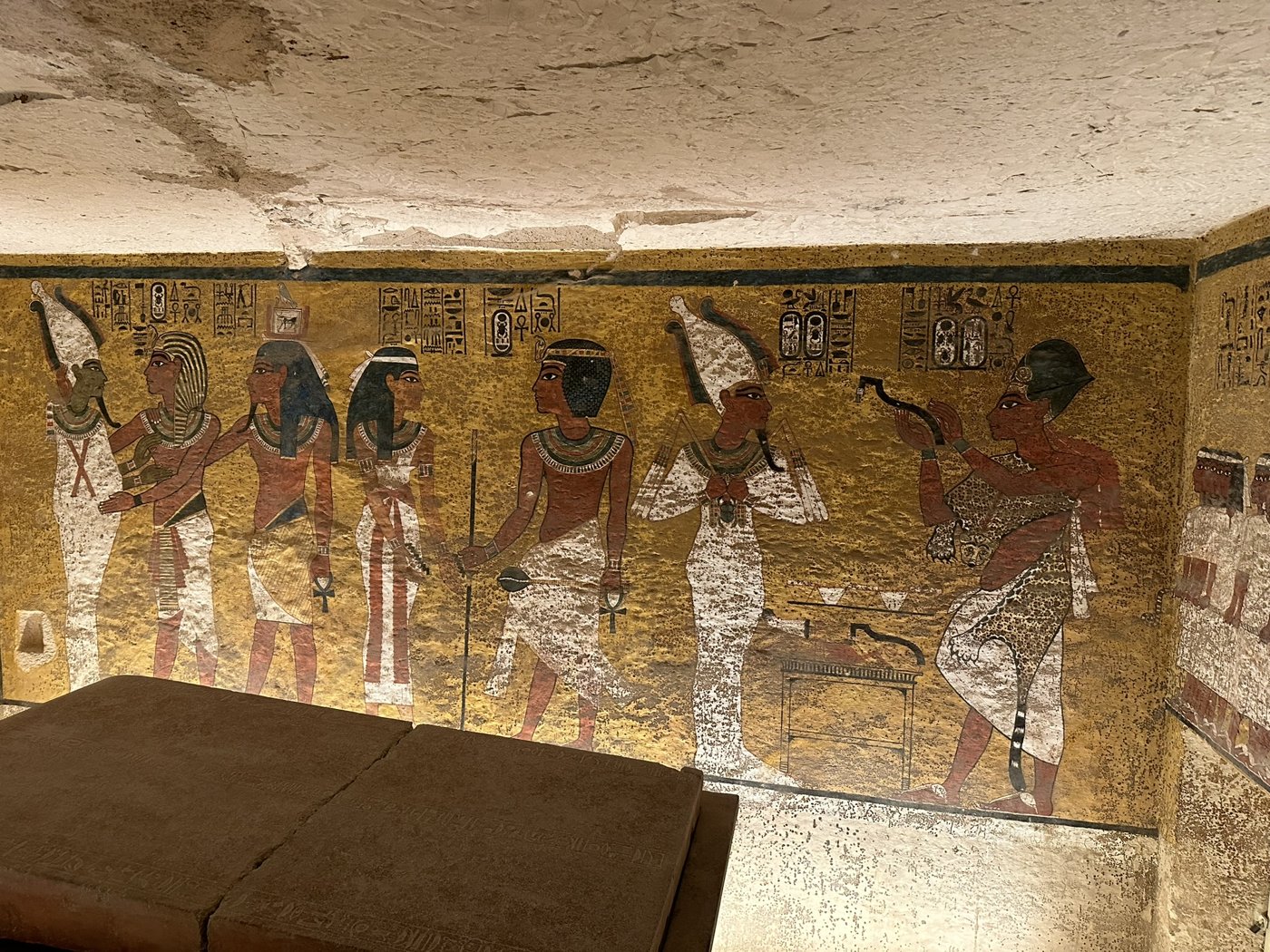 Tutankhamun’s burial chamber. On the right, his successor Ay performs the Opening of the Mouth ritual on the king, shown as Osiris; the stone sarcophagus is in the foreground.
That afternoon I was back at the Winter Palace, which opened in 1907. Lord Carnarvon, who financed Howard Carter’s excavation, was a regular guest. After the tomb was found in 1922, the hotel became the base for the world’s press, and Carter posted news of the find on its noticeboard.
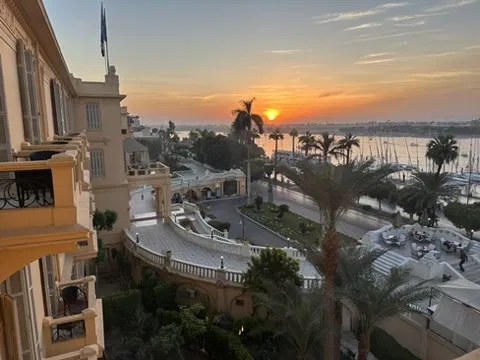 Sunset over the Nile from the Winter Palace.
Seti I and Ramesses II
The tomb of Seti I has the finest painted reliefs I saw in Egypt. His son Ramesses II 𓇳𓄟𓋴𓋴, whose name means “Ra bore him,” reigned for 66 years, and he is everywhere: in the courtyard he added to Luxor Temple, in the tomb of his chief queen, Nefertari, and above all at Abu Simbel.
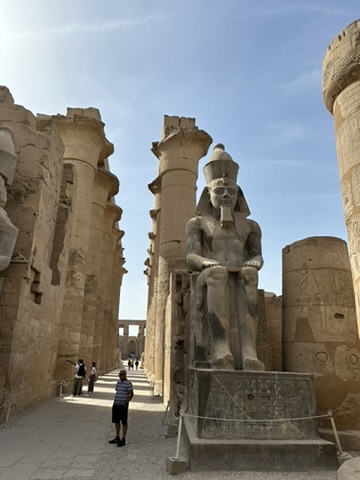 Ramesses II in the courtyard he added to Luxor Temple.
Nefertari’s tomb in the Valley of the Queens has colors that look as if they were painted last year.
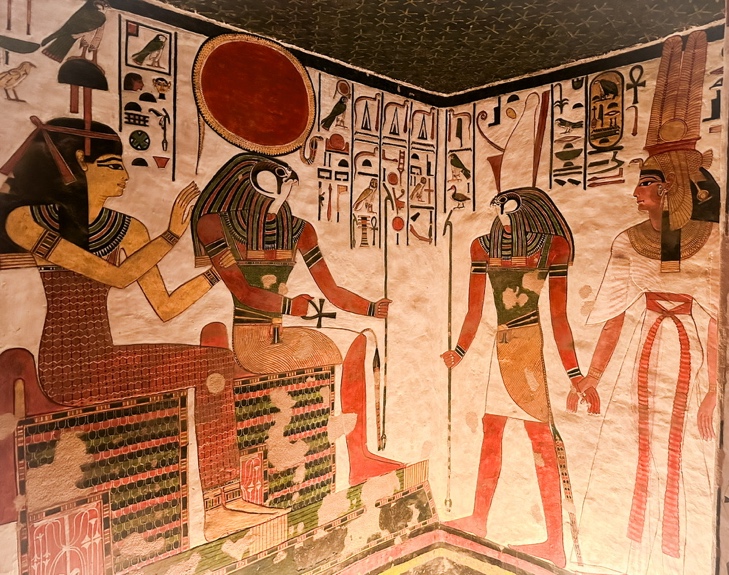 The tomb of Nefertari. The queen, right, is led by the hand by a falcon-headed god.
Abu Simbel sits about 40 kilometers from the Sudanese border, and I flew there from Aswan. Ramesses II cut the temple into the cliff to celebrate what he presented as a victory over the Hittites at Kadesh in about 1274 BC. Its four seated colossi, each about 20 meters high, wear the double crown of Upper and Lower Egypt. Set at the southern frontier, they told Nubia who was in charge.
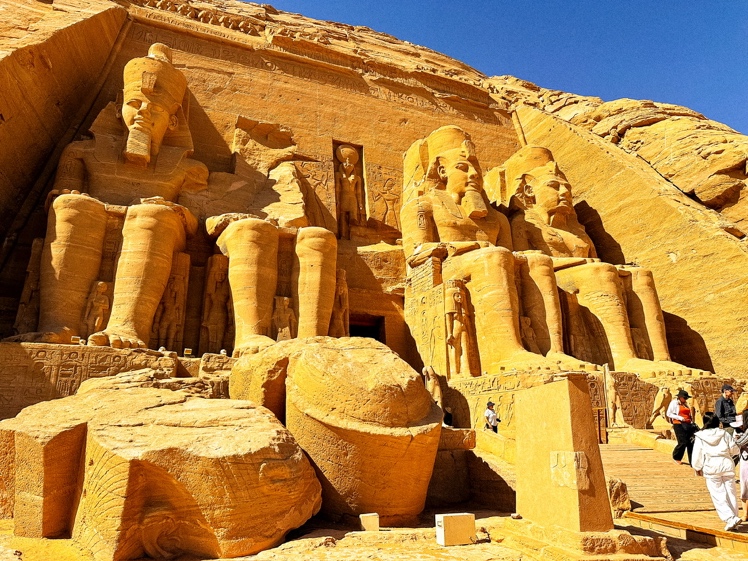 The colossi of Ramesses II. One lost its upper body in an ancient earthquake; the head still lies at its feet.
Inside, the walls of the great hall tell the official story. Ramesses rides into battle in his chariot, bow drawn, far larger than anyone around him, and the Kadesh scene on the north wall comes with a text in which he claims he won alone after his army abandoned him.
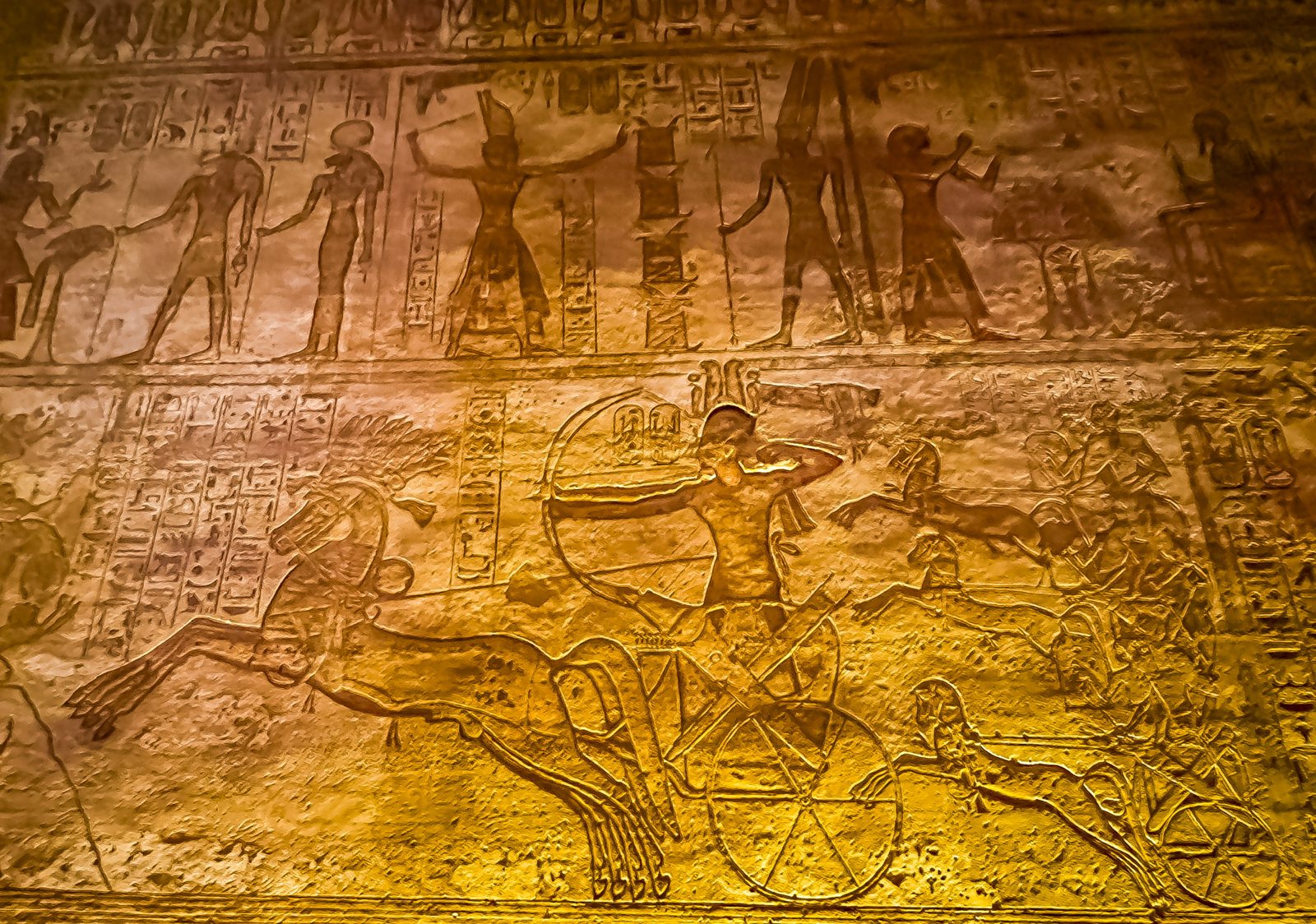 Ramesses II in his chariot, from the battle reliefs in the great hall at Abu Simbel.
The historian’s footnote is that Kadesh was not a victory. It was close to a draw, and some 15 years later Egypt and the Hittites signed what is often cited as the earliest surviving peace treaty. Abu Simbel is therefore one of history’s great works of political messaging. It is also a survivor. In the 1960s, UNESCO cut the whole temple into blocks and moved it 65 meters higher to save it from the lake behind the new Aswan High Dam. The temple faces east, and twice a year the rising sun still reaches the statues in its inner sanctuary.
Third Intermediate and Late Period: Nubia’s Turn
c. 1069–332 BC · Aswan · Days 2 and 3
After the New Kingdom, Egypt split again, and this time the south took over. Aswan was ancient Egypt’s southern border, the point where Egypt ended and Nubia began. Around 750 BC, Nubian kings from beyond that border conquered Egypt and ruled it as the 25th Dynasty, pharaohs whom Egypt’s own records tended to underplay. Assyrian invasions pushed them back south within a century, and Egypt then passed through Persian rule before Alexander the Great arrived in 332 BC.
The Nubian Museum in Aswan tells that story, and it also tells the modern one. The High Dam, built under Nasser in the 1960s, holds the river back in Lake Nasser, one of the largest man-made lakes in the world. It ended the annual flood that had organized Egyptian life since prehistory; the ancient calendar itself had three seasons, named for the inundation, the growing, and the harvest. The lake drowned much of Nubia, displacing its villages and forcing an international rescue of the temples in its path, Abu Simbel and Philae among them.
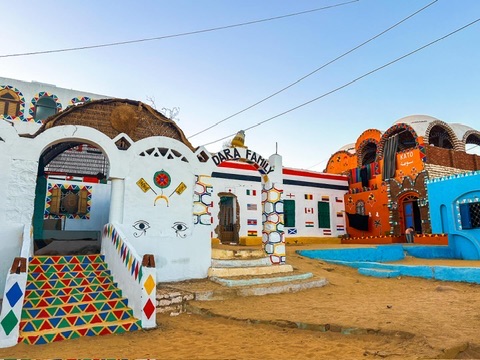 A Nubian village on the west bank near Aswan.
An afternoon in a Nubian village gave the other side of the dam’s story. Nubian houses are painted in bright colors and patterns, and Nubian languages are still spoken at home. Over tea, I kept thinking about the inversion of history the 25th Dynasty represents: for once, Nubia ruled Egypt.
I stayed at the Old Cataract, a Victorian hotel that Thomas Cook built in 1899 for its Nile travelers. Agatha Christie is said to have written part of Death on the Nile on its terrace. The terrace at sunset is still the hotel’s real attraction, and I would not swap it for anything newer. The best view of it, though, is from a felucca, the traditional Nile sailboat, which has no engine and moves only with the wind. At sunset, with sand dunes on the west bank and the hotel lit up on the bluff, it was the best hour of the trip.
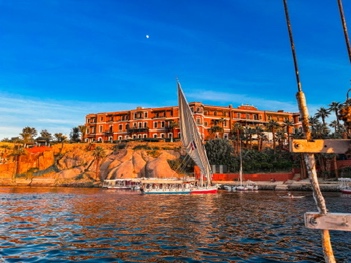 The Old Cataract from the river.
Ptolemaic Egypt: Greek Kings in Pharaohs’ Dress
332–30 BC · Kom Ombo, Edfu · Day 4
After Alexander died, his general Ptolemy took Egypt, and his descendants ruled it for nearly three centuries, until Cleopatra VII died in 30 BC. They were Macedonian Greeks, but they adopted the full costume of pharaonic kingship and built some of the largest temples in Egypt. Three temples line the 3.5-hour drive from Aswan to Luxor, and the first two are theirs.
Kom Ombo is unusual because it is a double temple, split between the crocodile god Sobek and the falcon god Haroeris. Next door, a small museum holds mummified crocodiles, which the priests once kept and buried.
Edfu, dedicated to Horus, is often called the best-preserved temple in Egypt. Granite falcons of the god stand at its doors, and its pylon shows Ptolemy XII smiting his enemies before Horus, the same image Narmer used on his palette some 3,000 years earlier.
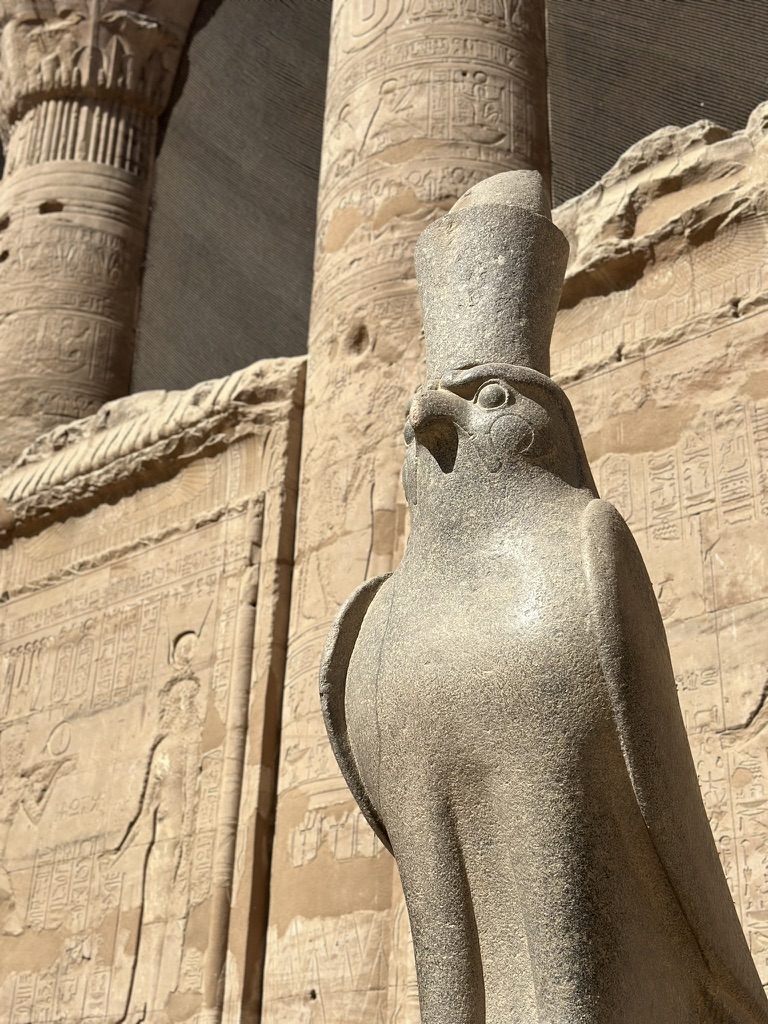 Horus as a falcon, at the temple of Edfu.
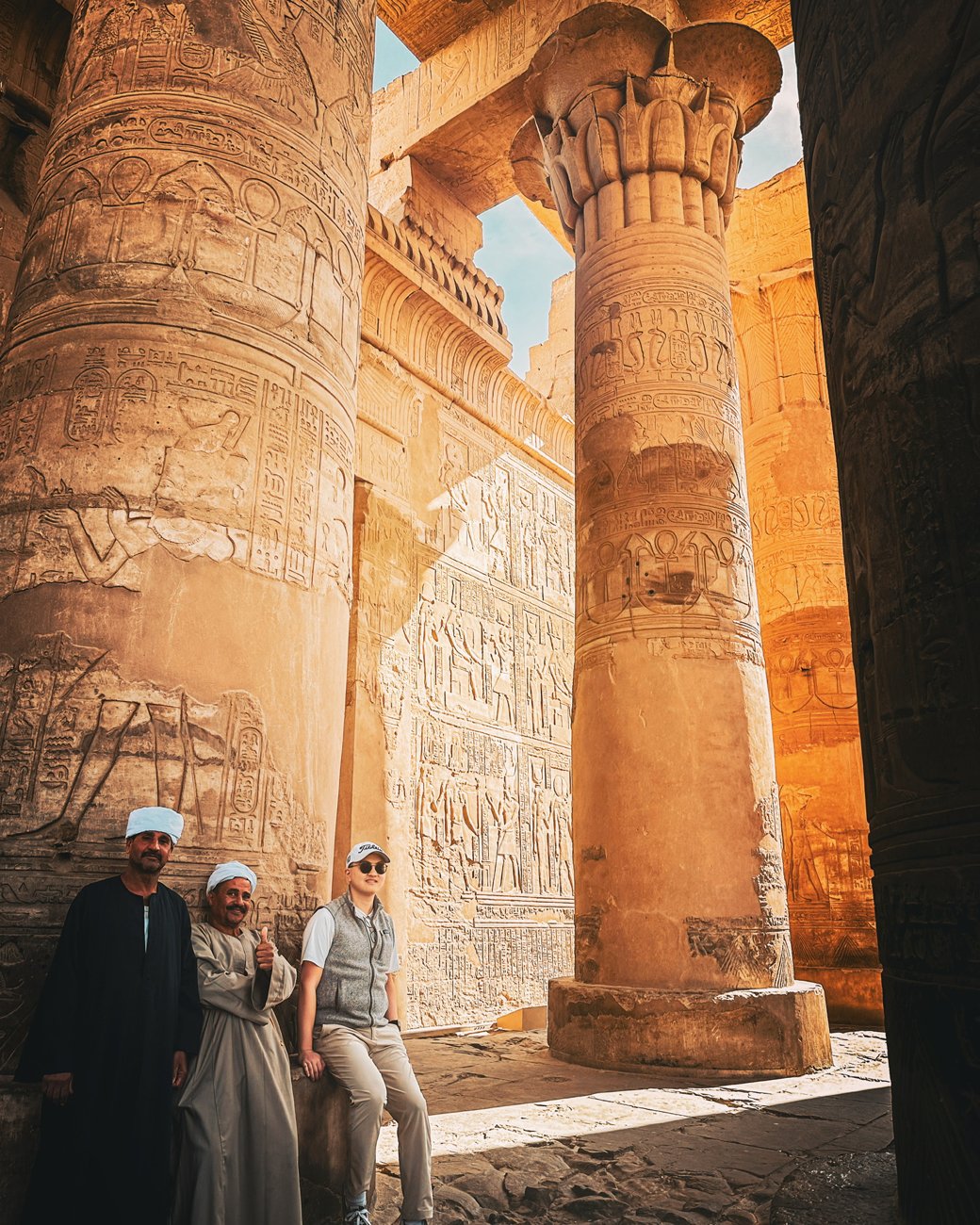 My best impression of an archaeologist, among the columns at Edfu.
High on one wall, a band of text runs under a winged sun disk, the emblem of Horus of Behdet, Edfu’s own form of the god. In the middle of it is an elephant. The elephant is a hieroglyph, read abu. It was the Egyptian word for elephant and also the name of Elephantine, the island at Aswan that marked Egypt’s southern border and traded in ivory from farther south. The Greek name, Elephantine, simply translates it. So the sign here most likely names a place rather than an animal. The Ptolemies who built Edfu knew real elephants as well. They sent hunting expeditions down the Red Sea coast to capture African elephants for their army, an answer to the Indian war elephants of their Seleucid rivals in Syria.
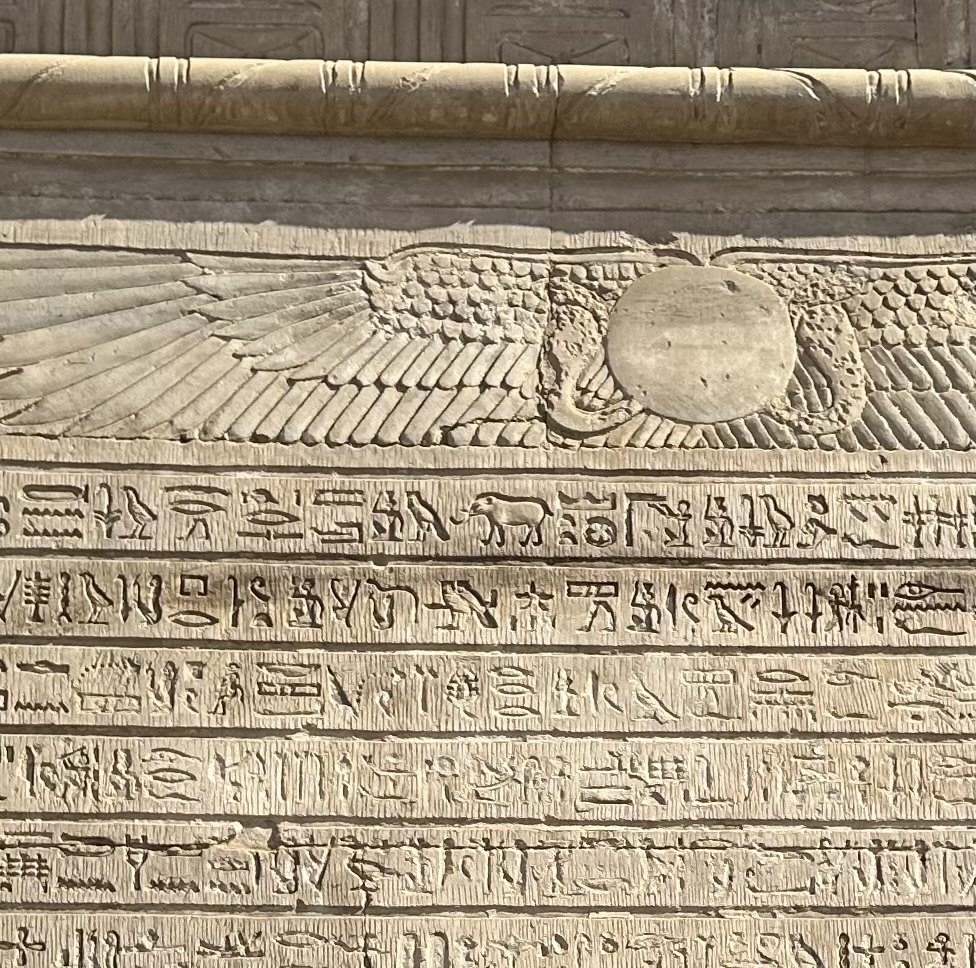 An elephant among the hieroglyphs at Edfu, below the winged sun disk of Horus of Behdet.
Roman Egypt: Where the Writing Ended
30 BC–AD 395 · Esna, Philae · Days 2 and 4
Rome took Egypt from Cleopatra, and Roman emperors in turn had themselves carved as pharaohs. Esna, the third temple on the drive north, is dedicated to the creator god Khnum and sits below the level of the modern town. Its hall, decorated largely under the Romans, has been cleaned in recent years to reveal color that was invisible for centuries.
Philae is where the story ends. In the UNESCO campaign, the temple of Isis was dismantled and rebuilt block by block on higher ground on Agilkia Island, which is why the site I found most romantic in Egypt is also, in a sense, a reconstruction. Its importance lies not in its age, since most of what stands is Ptolemaic and Roman, but in its longevity. Isis was still worshipped here long after Christianity became Rome’s official religion, and the temple stayed open until Justinian closed it around AD 537.
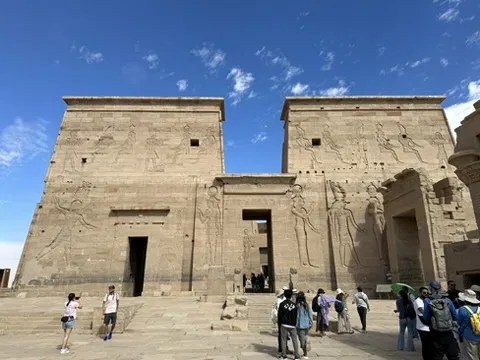 The first pylon at Philae, where Ptolemy XII smites his enemies before Isis, as he does at Edfu.
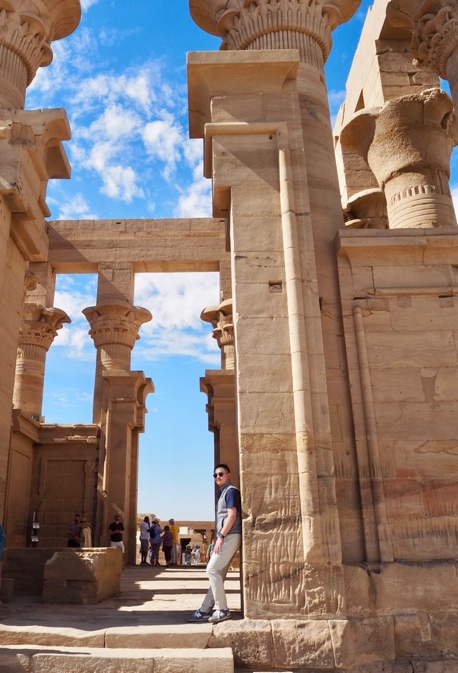 Philae, the temple of Isis, rebuilt on Agilkia Island.
The inscription of AD 394 is a few lines on a wall here. After it, Egyptians wrote their language in Coptic, an alphabet based on Greek, and no one could read hieroglyphs for some 1,400 years.
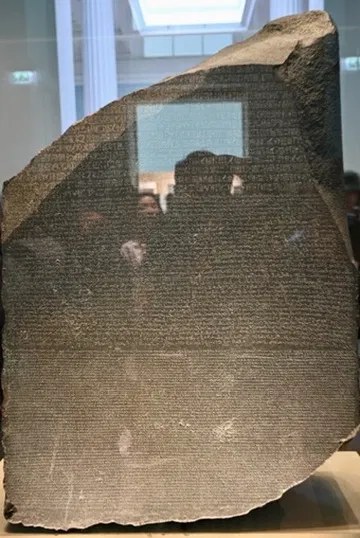 The Rosetta Stone, British Museum.
The key turned out to be a Ptolemaic decree. The Rosetta Stone, which French soldiers found in 1799, records a decree of 196 BC in three scripts: hieroglyphs, Demotic, and Greek. Because the Greek could be read, Jean-François Champollion could match the royal names in its cartouches, Ptolemy 𓊪𓏏𓅱𓃭𓅓𓇋𓇋𓋴 first, and then Cleopatra on an obelisk taken from Philae itself. He announced the decipherment in 1822.
The stone’s significance reaches well beyond Egyptology. Reading hieroglyphs again gave back three millennia of Egypt’s own records, which until then had been known largely through Greek and Roman writers and the Bible. Its name has also become shorthand for any key to a hard problem. The text itself is modest: a decree by priests at Memphis honoring the young Ptolemy V, closer to political messaging than to scripture, much like Abu Simbel a thousand years earlier.
It is also contested. British forces took the stone from the French under the surrender terms of 1801, and it has been in the British Museum since 1802. Petitions in Egypt, including one led by former antiquities minister Zahi Hawass, call for its return, some proposing the Grand Egyptian Museum as its new home. The British Museum’s position is that the 1801 agreement was signed on Egypt’s behalf by an Ottoman admiral, since the Ottoman sultan nominally ruled Egypt at the time.
Some 3,000 years after Djoser’s pyramid, Philae is where the writing ended, and a name carved under the Ptolemies is where it was read again.
The Route
| Day | Date | Where | What I did |
|---|---|---|---|
| 1 | Sun 19–Mon 20 Nov | Cairo | Memphis, Saqqara (Djoser), Dahshur (Bent Pyramid), Giza (inside the Great Pyramid) and the Sphinx; lunch at Khufu’s; Egyptian Museum with an Egyptologist |
| 2 | Tue 21 Nov | Aswan | Flight to Aswan; High Dam, Philae, Nubian village and tea |
| 3 | Wed 22 Nov | Aswan | Flight to Abu Simbel and back; Nubian Museum; felucca at sunset |
| 4 | Thu 23 Nov | Luxor | Drive north (~3.5 h) via Kom Ombo, Edfu, and Esna |
| 5 | Fri 24 Nov | Luxor | West Bank: Valley of the Kings (Seti I, Tutankhamun), Hatshepsut’s temple, Valley of the Queens (Nefertari); afternoon at the hotel |
| 6 | Sat 25 Nov | Cairo | Karnak, Luxor Temple, Luxor Museum; evening flight to Cairo |
| 7 | Sun 26 Nov | — | Flight home from Cairo |
Appendix: Reading a Cartouche
Hieroglyphs are not an alphabet. Most signs stand for a whole word or for two or three consonants, some are silent and only show what kind of word it is, and vowels were not written at all. About 25 signs, though, each stand for a single consonant, and scribes used them to spell foreign names. That gave Champollion his way in: Ptolemy and Cleopatra were Greek names, spelled out sound by sound.
Here are those signs, in the order Egyptologists list them. Each shows what the sign depicts and the letter scholars use for its sound; the sounds themselves are approximate.
- 𓄿Vulture: ꜣ, a catch in the throat, usually read as "a"
- 𓇋Reed leaf: i, read as "i" or "y"
- 𓇌Two reed leaves: y
- 𓂝Forearm: ꜥ, a sound from deep in the throat, usually read as "a"
- 𓅱Quail chick: w, read as "w" or "u"
- 𓃀Foot: b
- 𓊪Stool: p
- 𓆑Horned viper: f
- 𓅓Owl: m
- 𓈖Water: n
- 𓂋Mouth: r
- 𓉔Reed shelter: h
- 𓎛Twisted flax: ḥ, a stronger h
- 𓐍Placenta: ḫ, "kh" as in Scottish loch
- 𓄡Animal's belly: ẖ, a softer "kh"
- 𓊃Door bolt: z
- 𓋴Folded cloth: s
- 𓈙Pool: š, "sh"
- 𓈎Hillside: q, a k made further back
- 𓎡Basket: k
- 𓎼Jar stand: g
- 𓏏Bread loaf: t
- 𓍿Tethering rope: ṯ, "ch"
- 𓂧Hand: d
- 𓆓Cobra: ḏ, "dj"
Ptolemy’s cartouche 𓊪𓏏𓅱𓃭𓅓𓇋𓇋𓋴 uses six of them, plus one extra. Read left to right, it gives p, t, w, then a lion 𓃭, then m, y, and s. Egyptian had no sign for l, so scribes of the Greek period borrowed the lion for it. Without vowels, p-t-w-l-m-y-s is as close as the script gets to the Greek Ptolemaios.
The other cartouches in this post mix in larger signs:
- Khufu 𓐍𓅱𓆑𓅱: placenta, quail chick, viper, quail chick, or ḫ-w-f-w. Every sign is in the list above.
- Sneferu 𓋴𓄤𓂋𓅱: s, then a heart and windpipe 𓄤, one sign for the three consonants n-f-r, meaning “good.” The r after it repeats the sign’s last sound as a reading aid, and w ends the name.
- Ramesses 𓇳𓄟𓋴𓋴: the sun disk is Ra, written first out of respect; three fox skins 𓄟 stand for ms, “born of”; two folded cloths add s-s. Together, “Ra bore him.”
The sign list follows Alan Gardiner’s Egyptian Grammar, the standard reference since 1927.