JZ

Monet to Matisse Field Guide

Art Gallery of Ontario · The Impressionist Revolution: Monet to Matisse · 2026
The one idea to carry through every room

Each generation kept one discovery and threw another away

Between 1870 and 1920, painting stopped being about the thing depicted and became about the act of seeing and, later, the act of feeling. Read each picture as an argument with the one before it, not as a finished object, and at every wall ask two questions: what did this artist keep, and what did they reject?

1 · SalonSmooth finish, drawing first, brown shadows, grand subjects. The rules everyone else breaks.
2 · ImpressionismLight at one moment, caught outdoors in broken dabs of pure color. 1874–86.
3 · StructureCézanne and Seurat keep the color but want weight and permanence back.
4 · FeelingVan Gogh and Gauguin make color express the painter, not the light.
5 · Color itselfMatisse and Mondrian free color from description entirely. 1905–20.

Why we look without seeing

Galleries present these paintings as answers, but they were made as questions. A Monet looks like a pleasant pond unless you know that in 1874 it insulted everything a serious painter was supposed to do. Nothing in the frame tells you that, so you have to bring the "before" with you.

The first move is to reconstruct a correct painting in Paris in 1870. It was made for the Salon, the annual state-sanctioned exhibition that decided careers, and it followed five rules:

  • Finish: smooth brushwork that leaves no visible stroke.
  • Drawing first: careful drawing underneath, with color added last.
  • Grand subject: history, myth, or the Bible.
  • Dark shadow: muted browns and grays.
  • Edge-to-edge resolution: every inch of the canvas resolved.

Bouguereau's polished nudes and Cabanel's Birth of Venus are the models. They took months, and they looked it. Every Impressionist choice reads as a deliberate refusal of one of those rules. Once you can name the rule being broken, you stop looking at a painting and start watching a decision.

Why it is called a revolution

Three things changed for good. First, painters no longer needed the state's permission: the 1874 show is often called the first independent group exhibition, and today's gallery-and-dealer system descends from it. Second, painting moved from subject to perception, then to emotion, then to the painting itself. Third, the visible brushstroke, once the mark of an unfinished sketch, became the artist's signature.

So the feeling to carry into the rooms is not "isn't that pretty" but "someone risked a career on this dab of violet."

My visit · eight paintings I stopped for

Forty-five years of light, from Boudin's sky to Mondrian's farm

These are the paintings I photographed, arranged in the order they were painted rather than the order I walked past them. Read in sequence, they tell the same story as the rest of this guide: from a sky caught outdoors in 1871, through Monet's water lilies dissolving into color, to Mondrian reducing trees to a dark grid.

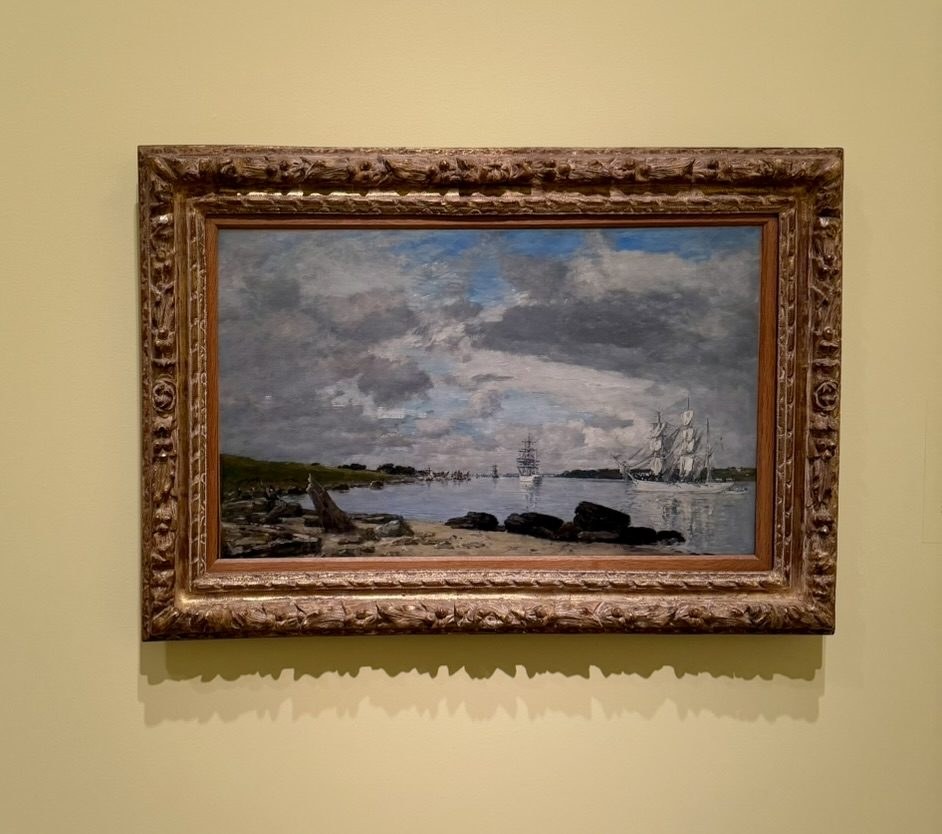
Eugène Boudin, The Bay at the Mouth of the Elorn River, Landerneau, 1871
1 · Before the revolution

The Bay at the Mouth of the Elorn River, Landerneau

Eugène Boudin
Date
1871
Medium
Oil on canvas
Lent by
Dallas Museum of Art

The sky is the subject; the tall ships are there for scale.

Boudin gave more than half this canvas to cloud and used the ships and the dark rocks on the shore to show how large that sky is. He painted outdoors and quickly, to catch weather that changed by the minute, and that habit is his link to everything else in the show. Around 1858 he met the teenage Monet at Le Havre and persuaded him to paint directly from nature.

The Impressionists invited Boudin to their first exhibition in 1874, and he showed six works. He never exhibited with them again and went back to the Salon, so he stands at the door of the revolution rather than inside it.

Look for

The reflections of the hulls, broken into short horizontal strokes. It is an early version of the water Monet would paint for the rest of his life.

↑ All eight
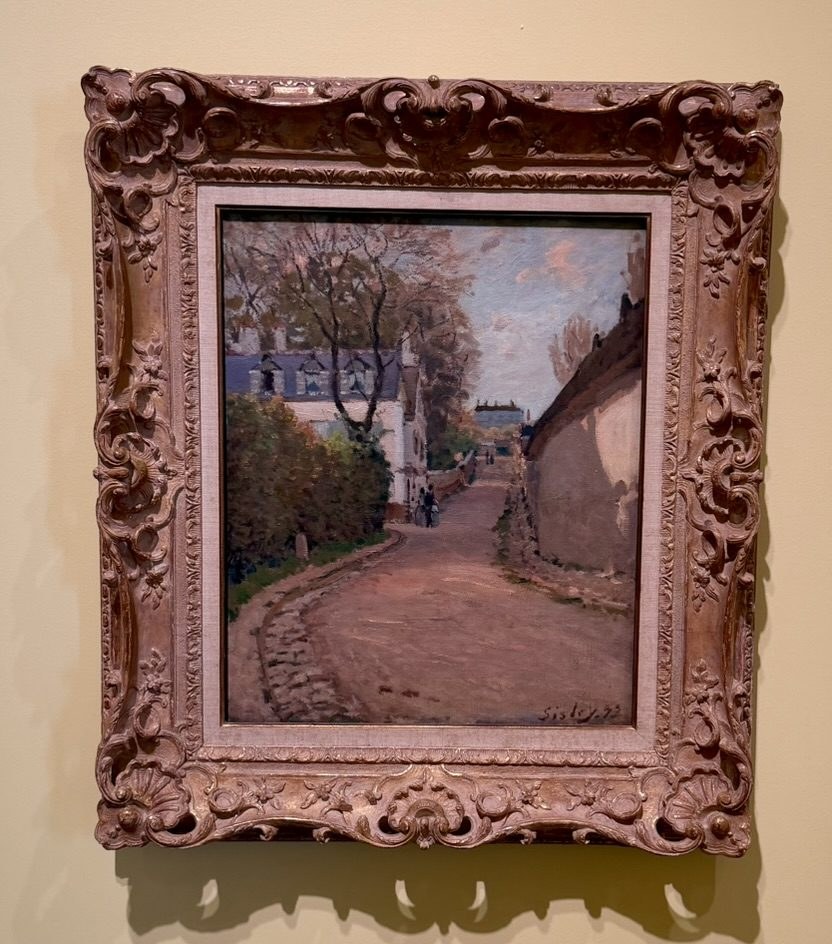
Alfred Sisley, Street in Ville-d'Avray, 1873
2 · The founding group

Street in Ville-d'Avray

Alfred Sisley
Date
1873
Medium
Oil on canvas
Lent by
Dallas Museum of Art

An empty village road, made dramatic by viewpoint alone.

Sisley was a founding member of the group and showed in five of its eight exhibitions, yet he is the least known of the core painters. Here he uses his favorite motif, a road curving away through a village, and makes the subject deliberately ordinary. A low viewpoint and a wide, empty foreground pull the eye down the road and deep into the picture, so the drama comes from space rather than from story.

The painting dates from a year before the first exhibition, when Sisley was working outdoors in the villages west of Paris. It shows the Impressionist rule-break at its quietest: no myth and no hero, just a road on an afternoon.

Look for

The two small figures halfway up the road, which set the scale, and the pale wall on the right catching the light.

↑ All eight
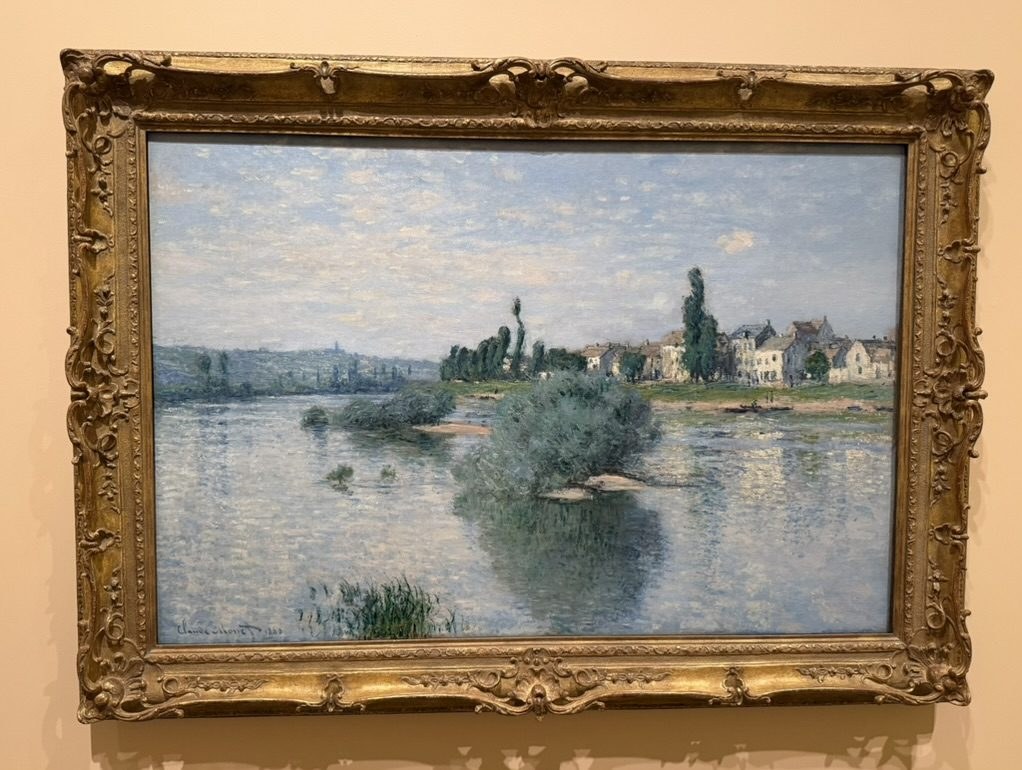
Claude Monet, The Seine at Lavacourt, 1880
3 · The exception that proves the rule

The Seine at Lavacourt

Claude Monet
Date
1880
Medium
Oil on canvas
Lent by
Dallas Museum of Art

Monet's calculated return to the Salon he had helped to defy.

Monet painted this panorama in his studio rather than outdoors, working from earlier versions of the same view near Vétheuil. He made it to submit to the Paris Salon of 1880, his first attempt there since 1870, because he had come to see the group's own exhibitions as unsuccessful. Of the two paintings he sent, only this one was accepted.

His fellow Impressionists saw the submission as a betrayal of the independence they had claimed in 1874. The strategy still worked: it was the first of his paintings that conservative and liberal critics both praised. The painting keeps the broken brushwork but offers the jury a large, calm, balanced view, which is exactly the "kept and rejected" trade this guide asks you to look for.

Look for

The signature and date in the lower left. Then compare its even, deliberate surface with the quick strokes of the Boudin.

↑ All eight
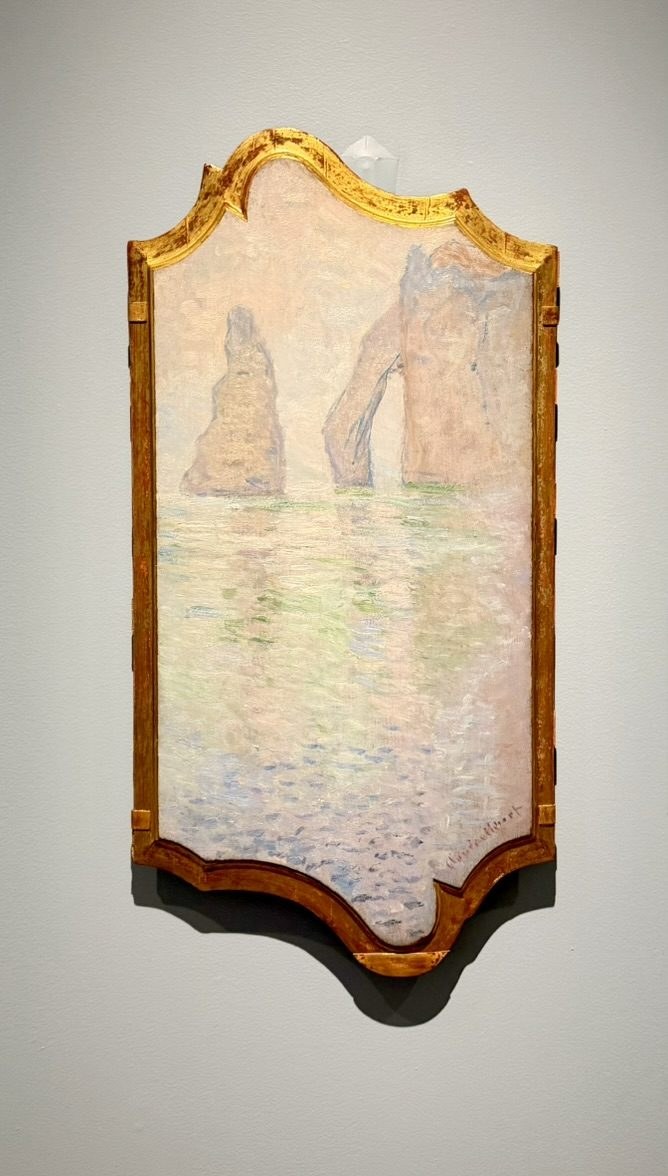
Claude Monet, Étretat, the Needle and the Porte d'Aval, 1885–86
4 · Toronto's own Monet

Étretat, the Needle and the Porte d'Aval

Claude Monet · Étretat, l'Aiguille et la Porte d'Aval
Date
1885–86
Medium
Oil on panel
Collection
Art Gallery of Ontario

The cliffs dissolve into the same pastel light as the sea.

This painting belongs to the AGO rather than to Dallas. It shows two landmarks on the Normandy coast at Étretat: the Needle, a free-standing rock spire, and the Porte d'Aval, the arch in the cliff behind it. Monet returned to Étretat repeatedly in the mid-1880s, and here he paints the rocks with the same pale pinks, greens, and blues as the water, so that solid stone and moving sea become one surface of light.

Look for

The absence of a horizon line and of almost any dark tone. The rocks are built from the same short pastel strokes as the sea.

↑ All eight
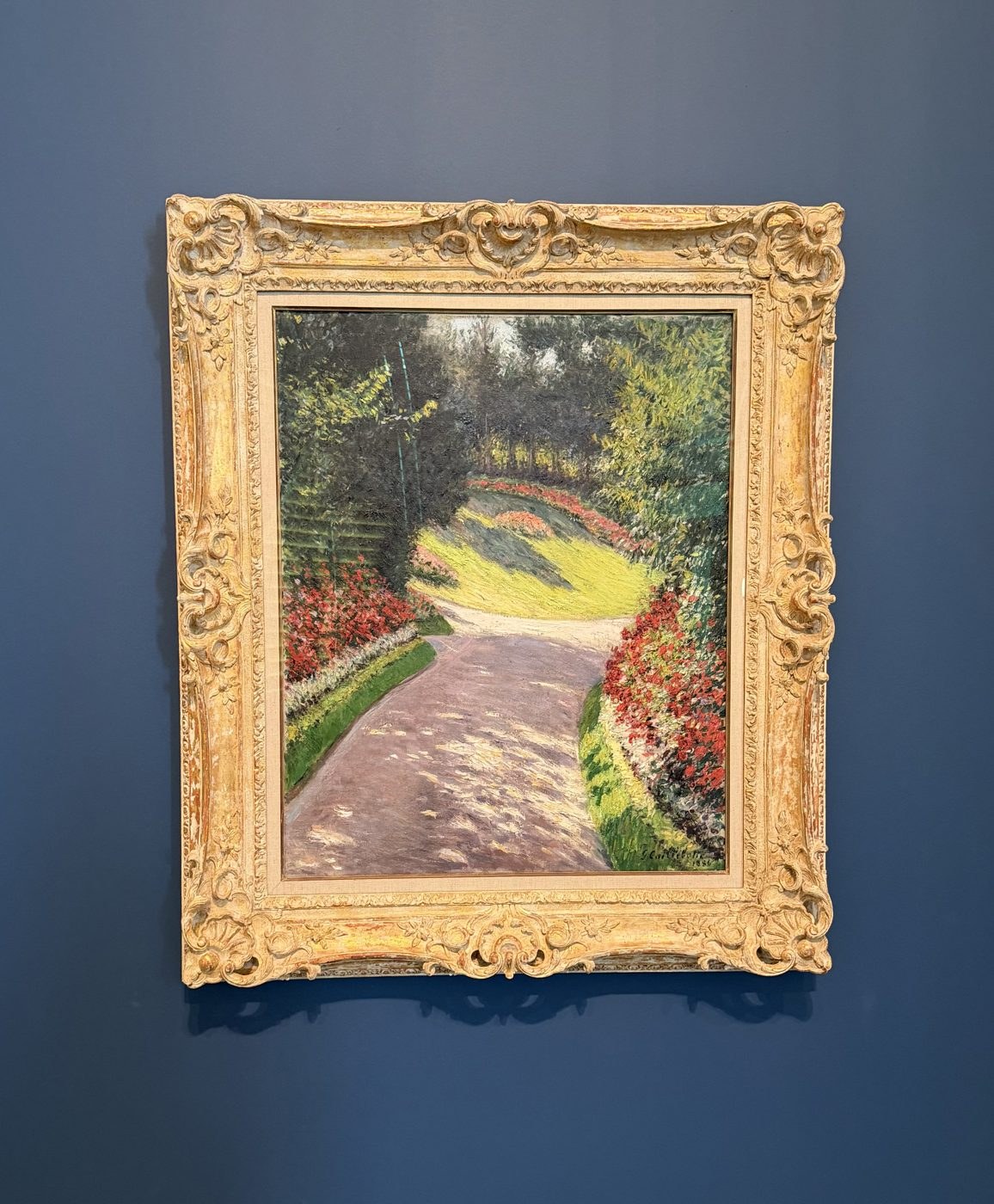
Gustave Caillebotte, The Garden Path, 1886
5 · The patron who painted

The Garden Path

Gustave Caillebotte
Date
1886
Medium
Oil on canvas
Lent by
Dallas Museum of Art

A street painter's deep perspective, turned on his own garden.

Caillebotte joined the Impressionists in 1876 and took part in five of their eight exhibitions. He also helped to organize them and sometimes paid for them, and his wealth kept the group going in lean years. This path runs through the garden of the house he shared with his brother at Petit-Gennevilliers, a suburb west of Paris.

He brings to the garden the steep, plunging perspective of his famous Paris street scenes, and sets bold reds against greens. The result is an ordinary path that feels both still and in motion, pulling the eye up the slope toward the sunlit lawn.

Look for

The dappled shadows on the path. They are violet and blue, not brown, which is the Salon rule this guide tells you to watch being broken.

↑ All eight
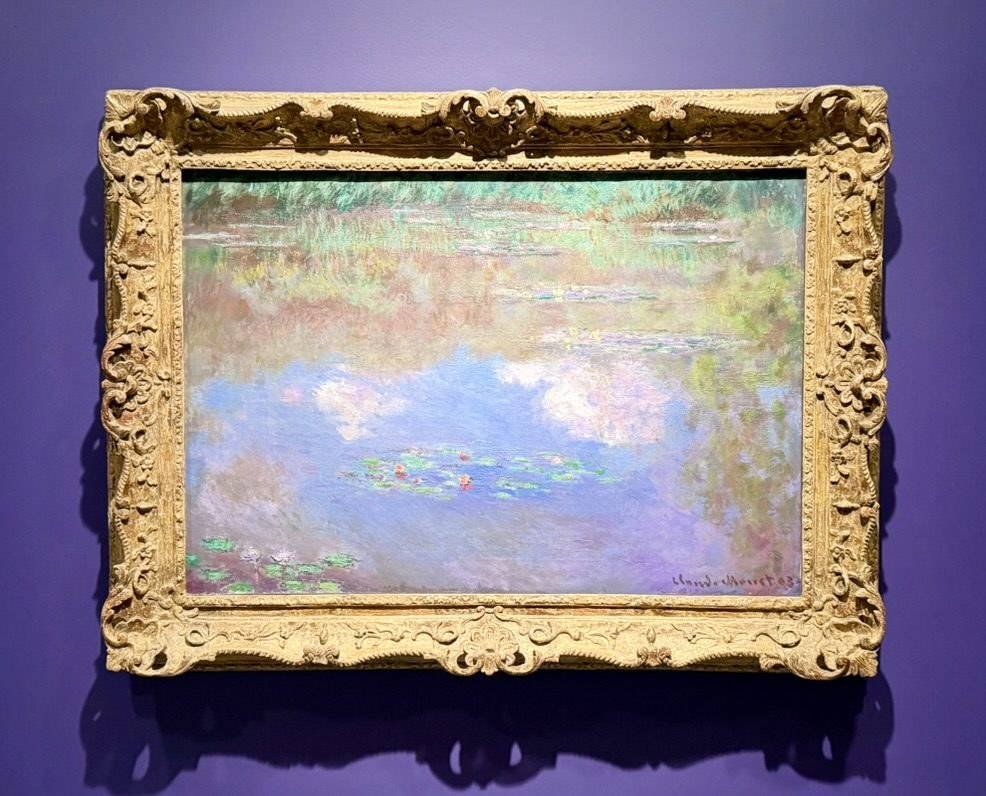
Claude Monet, The Water Lily Pond (Clouds), 1903
6 · Giverny

The Water Lily Pond (Clouds)

Claude Monet
Date
1903
Medium
Oil on canvas
Lent by
Dallas Museum of Art

The sky is painted in the water, and the land has moved to the top edge.

Monet moved to Giverny in 1883 and in the 1890s built a Japanese-style water garden there. The lilies he planted became his main subject for the last two decades of his life. Early versions show the arched footbridge; by 1903 the subject is the surface of the water itself, which works both as a mirror of the sky and as a window into the pond.

The reflected clouds are so convincing that, when the painting was auctioned in 1917, the audience is said to have thought it was hanging upside down. Set it beside the Boudin: both are paintings of clouds, made thirty-two years apart, and the second no longer needs a sky to show them.

Look for

The thin band of reeds along the top edge. It is the only land in the picture, and it sits where the sky should be.

↑ All eight
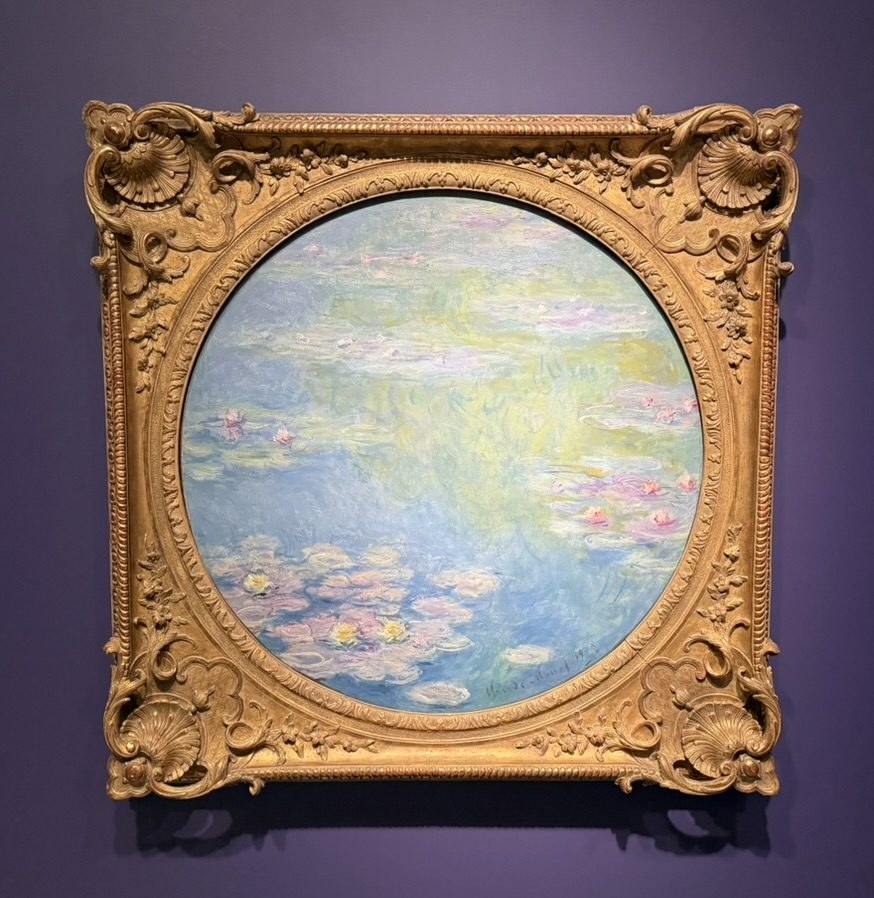
Claude Monet, Water Lilies, 1908, round canvas
7 · Toward abstraction

Water Lilies

Claude Monet · Nymphéas
Date
1908
Medium
Oil on canvas, 81 cm diameter
Lent by
Dallas Museum of Art

Five years on, the horizon has gone, and so have the corners.

In 1903 a strip of reeds still marked the top of the pond. Here even that has disappeared, and nothing tells you which way is up. Monet's early water-lily pictures kept a bank or a horizon to guide the eye; over time he removed solid land altogether, and the lilies became loose, radiant strokes of color moving toward abstraction.

The round canvas completes the effect. Without corners or a top edge, the picture reads as a fragment of an endless surface, an idea Monet would take to its conclusion in the room-sized water-lily panels installed at the Orangerie in Paris in 1927, the year after his death.

Look for

The yellow-green glow at the center. It is reflected light, not an object, and the composition is built around it.

↑ All eight
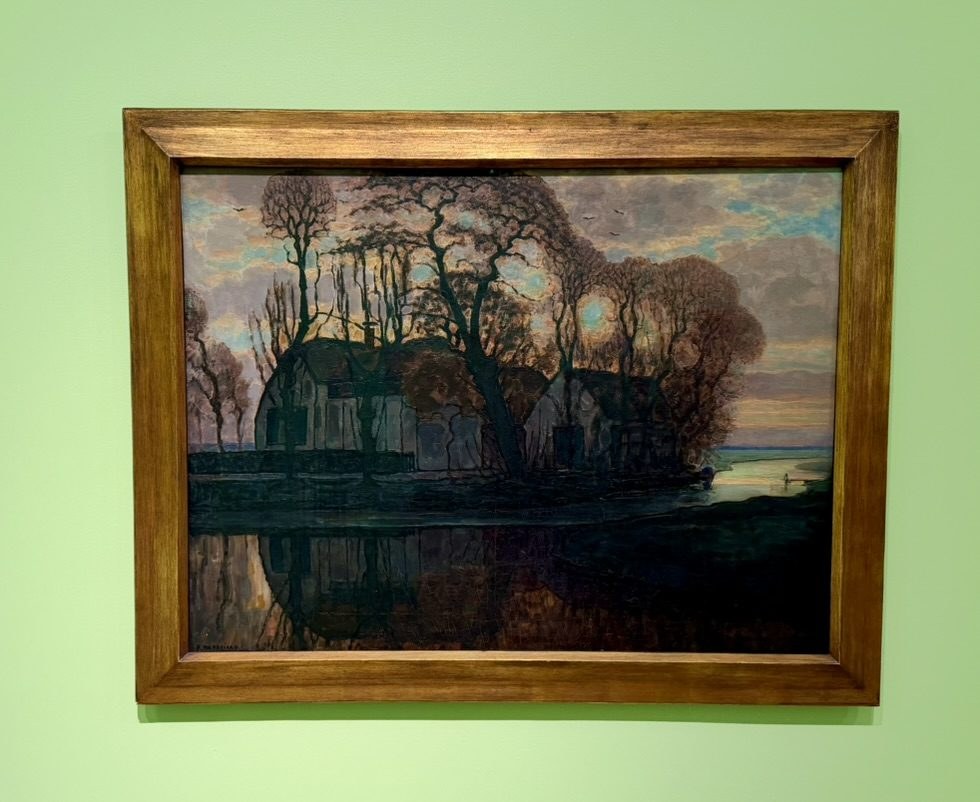
Piet Mondrian, Farm near Duivendrecht in the Evening, c. 1916
8 · The next avant-garde

Farm near Duivendrecht in the Evening

Piet Mondrian
Date
c. 1916
Medium
Oil on canvas
Lent by
Dallas Museum of Art

The future painter of grids, still painting a farm, and already finding the grid in it.

Mondrian returned many times to this farm by the river near Amsterdam and painted it at different times of day, as Monet painted his haystacks and his pond. The flat, stylized house and trees and the patches of expressive color show what came next: Van Gogh and Cézanne, whose retrospectives Mondrian saw in Amsterdam in 1905 and 1909.

This is where the show's lineage arrives. The light still comes from Impressionism, the emotion from Van Gogh, and the structure from Cézanne. Within a few years Mondrian would discard the farm entirely and keep only the lines.

Look for

The bare trees, reduced to a dark lattice of verticals and diagonals against the sunset. It is a grid before the grids.

↑ All eight
The prehistory · 1648 to 1874

Impressionism ended a two-hundred-year argument

Impressionism looks like a sudden break, but it came at the end of a long argument about what painting is for, who decides what is good, and how a picture should be made. To see why a few loose dabs of color caused a scandal, you need three things: the system the Impressionists rebelled against, the rebels who came before them, and the technology and ideas that made their painting possible.

01The Academy and the Salon set the rules

In 1648 the French crown founded the Royal Academy of Painting and Sculpture, to make art a learned profession serving the state rather than a craft run by guilds. The Academy taught a method inherited from Raphael and Michelangelo: learn to draw first, copying antique sculpture and then the live model; build the composition from careful drawing; and apply color last, smoothly, so that no brushstroke shows. From 1667 it held regular public exhibitions, which moved into the Louvre's Salon Carré and gave "the Salon" its name. By the nineteenth century the Salon was the one place a French painter could build a reputation, win state commissions, and find buyers.

The Academy also ranked subjects in a hierarchy of genres. History painting came first: biblical, classical, and historical scenes, painted large to teach a moral. Below it came portraits, then scenes of everyday life, then landscape, and finally still life. A landscape of a real field at a real hour was, by definition, a minor picture. That ranking is what Monet was up against.

02Line against color: the quarrel inside the system

An old argument ran underneath. In the 1670s the Academy split between followers of Poussin, who held that drawing appeals to reason and should govern a painting, and followers of Rubens, who held that color moves the viewer and matters as much. The line side generally won, and it was still winning in the 1800s. Around 1800 Jacques-Louis David and then Ingres led Neoclassicism: crisp contours, cool control, and Roman subjects. Against them, Delacroix and Géricault led Romanticism, with dramatic subjects, energetic brushwork, and color used for its emotional force. Delacroix's shadows already carried color, and his loose handling showed later painters that a visible brushstroke could carry meaning. When you reach Van Gogh, you are watching the Rubens side finally win.

03The rebels before the rebels

  • The English landscape painters. Constable painted oil sketches outdoors to catch passing weather, and his work caused a stir in Paris in 1824. Turner dissolved storms, steam, and sunsets into light and color; Monet and Pissarro saw his work in London in 1870–71.
  • The Barbizon school (1830s–1860s). Corot, Théodore Rousseau, Millet, and others painted ordinary countryside in the forest of Fontainebleau for its own sake, making landscape serious and bringing painters outdoors. Boudin, who painted skies on the Normandy beaches, took the teenage Monet outside to paint at Le Havre around 1858, and Jongkind taught him to paint quickly. Boudin's Elorn bay is in the show.
  • Realism (1848–1860s). Courbet painted peasants and a village funeral on canvases as large as those reserved for history. When the jury of the 1855 World's Fair turned down major works, he built his own "Pavilion of Realism" next door: the first rehearsal for 1874, an artist going around the official system.
  • Manet (1860s). The key figure between Realism and Impressionism. In 1863 the Salon rejected so many works that Napoleon III ordered a "Salon des Refusés" to show them, and Manet's Le Déjeuner sur l'herbe, with a naked woman picnicking beside clothed modern men, was its scandal. His Olympia, a Parisian courtesan posed like a Titian Venus and painted flatly, caused a bigger outcry at the 1865 Salon. Younger painters gathered around him at the Café Guerbois: Monet, Renoir, Degas, Bazille, Pissarro, and Cézanne, the future Impressionist group, a decade before the first show.

04Seven changes made the new painting possible

1841

Paint in tubes

The American painter John Goffe Rand patented the collapsible metal paint tube. Before it, paint was ground by hand and stored in pig bladders, which kept most painting in the studio. Renoir is reported to have said that without tube paint there would have been no Impressionism.

1820s onward

New pigments

Industrial chemistry produced cheap, brilliant colors: synthetic ultramarine, cobalt blue, chrome yellow, and emerald green. The bright palette in the show was partly a purchase.

1839

Color science

Chevreul, who oversaw dyes at the Gobelins tapestry works, published his law of simultaneous contrast: colors placed side by side change how each looks, and complementaries intensify each other. It is the principle behind dabs mixing in the eye, and later behind Seurat's dots.

1839

Photography

Once a machine could record a likeness exactly, painting had to justify itself another way. Photography also taught painters to see like a snapshot: figures cut off by the frame, off-center compositions, a single frozen moment.

1850s–1867

Japanese prints

Japan opened to Western trade in the 1850s, and woodblock prints by Hokusai and Hiroshige flooded Paris, especially after the 1867 World's Fair. Their flat color, strong outlines, high viewpoints, and cropping show up in Degas, Monet, Van Gogh, and Gauguin.

1853–70

The railway and the new Paris

Baron Haussmann rebuilt Paris with boulevards, cafés, parks, and stations, and new railways carried Parisians to the riverside suburbs and the Normandy coast. That gave the Impressionists their subject: modern leisure, modern crowds, boating at Argenteuil.

1870s

A new market

A growing middle class wanted smaller pictures for apartments, not vast canvases for churches and ministries. Dealers such as Paul Durand-Ruel, whom Monet and Pissarro met in London in 1870–71, bought and promoted artists directly. For the first time a painter could live without the Salon.

05The trigger: war, and a decision

The Franco-Prussian War of 1870–71 and the Paris Commune that followed broke the old order. The Second Empire collapsed, and Paris was besieged and then burned. Bazille, one of the group's most promising members, was killed in battle in 1870. Salon juries stayed hostile to the new painting, so in 1873 the group formed its own cooperative society. On 15 April 1874 it opened an exhibition of about thirty artists in the former studio of the photographer Nadar on the Boulevard des Capucines, two weeks before the Salon. In the satirical paper Le Charivari, the critic Louis Leroy took the title of Monet's Impression, Sunrise and mocked the whole group as "Impressionists." Everything in the rooms starts there.

06Key dates

YearEventWhy it matters
1648Royal Academy of Painting and Sculpture foundedArt becomes a state-sanctioned profession with fixed rules
1667First Academy exhibition; hierarchy of genres codifiedHistory painting at the top, landscape near the bottom
1670sPoussinistes vs RubénistesThe line-versus-color argument that Impressionism reopens
c. 1800–1850David and Ingres vs DelacroixNeoclassical control vs Romantic color and brushwork
1824Constable shown in ParisFresh outdoor landscape impresses the French
1830s–60sBarbizon schoolLandscape made serious; painting from nature
1839Daguerre's photography; Chevreul's color lawPainting must do what the camera can't; colors mix in the eye
1841Collapsible paint tube patentedPainting outdoors becomes practical
1853–70Haussmann rebuilds ParisThe modern city and its leisure become the subject
1855Courbet's Pavilion of RealismFirst artist-run show outside the official system
1863Salon des Refusés; Manet's Déjeuner sur l'herbeRejection becomes a public cause
1865Manet's Olympia at the SalonFlat modern painting shocks Paris
1867World's Fair with Japanese exhibitsJaponisme spreads through the avant-garde
1870–71Franco-Prussian War and the CommuneThe old order collapses; Monet and Pissarro meet Durand-Ruel in London
1874First Impressionist exhibition, 15 AprilThe revolution goes public and gets its name
The lineage · room by room

From light, to structure, to feeling, to color itself

The exhibition runs roughly in chronological order. Each movement below shows what it kept from its parent and what it threw out, with the paintings from my visit placed where they belong.

The Salon and the Realists1850s–1860s

The baseline. Courbet and Manet started the trouble by painting ordinary people at life size, the scale reserved for heroes, but they kept the Salon's dark palette and finish. The show has few of these, so carry the mental picture from the Overview.

Subject
Gods and history, then (scandalously) peasants and courtesans
Brush
Invisible, blended
Shadow
Brown and black
My visit
Boudin, 1871: the outdoor sketching that bridged to what came next

Impressionism1874–1886

Monet, Morisot, Degas, Pissarro, Renoir, Sisley, and Caillebotte. Rejected by the Salon, they rented a photographer's studio in 1874 and showed on their own, and a critic's sneer at one Monet as a mere "impression" gave them their name.

Their real subject is not the pond or the port but light striking a surface at one particular moment. That is why Monet painted the same grainstack about twenty-five times: the stack did not matter, the four o'clock light did. To catch it they painted outdoors and quickly, with broken dabs of pure color that the eye blends from a distance. Shadows became violet and blue, because that is how shadows look in sunlight once you stop assuming they are brown.

Kept
Very little. This is the break.
Rejected
Finish, drawing first, dark shadows, grand subjects, and the Salon itself
Subject
Modern leisure: boating, cafés, railway stations, suburban gardens
My visit
Sisley, 1873; Monet, 1880; Monet, 1885–86; Caillebotte, 1886
How to spot it

Stand 30 cm away, then 3 m. Up close it is chaos; from a distance it resolves. Look for unfinished corners (Morisot's Port of Nice), for violet in the shadows, and for a horizon or figure cut off by the frame as a snapshot would cut it.

Post-Impressionism: the structure camp1880s–1906

Cézanne and Seurat loved Impressionist color but thought the pictures had gone soft: everything dissolved into light, and nothing had weight. Cézanne is said to have wanted to "make of Impressionism something solid, like the art of the museums," and rebuilt the scene from slabs of color, treating an apple or a mountain as geometry. Seurat went the other way and systematized the dabs into a scientific grid of dots.

Kept
Bright palette, visible mark, and everyday subjects
Rejected
The fleeting moment. They wanted permanence back.
How to spot it

Parallel marks like hatching, and objects that look faceted or tilted toward you. Cézanne's tables never obey a single perspective because he moves around the object and paints all of it. This is the seed of Cubism.

Post-Impressionism: the feeling camp1886–1903

Van Gogh and Gauguin took the same inheritance and asked a different question: what if the mark and the color expressed the painter's inner state rather than the light? Van Gogh's brushstroke grows thick, directional, and agitated, so a wheat field writhes because he did. Gauguin flattened everything into bold zones of unmixed color, outlined like stained glass, and left France for Brittany and Tahiti in search of something he felt Paris had lost.

Kept
The visible stroke and the pure color
Rejected
Fidelity to what the eye sees. Color is now emotional, not optical.
How to spot it

Ask whether the color could have been in front of the painter. A green sky, a red ground, or blue tree trunks put you in this camp. Van Gogh's Sheaves of Wheat, painted in the last month of his life, is a good test: the strokes are the subject, and the wheat is almost incidental.

The next avant-garde: Monet late, Matisse, Munch, Mondrian1903–1920

Here color comes fully unhooked from description. Monet's late water lilies drop the horizon and drift toward abstraction. Matisse and the Fauves ("wild beasts," another critic's insult) used color for pure sensation, so a face can be green if green makes the picture sing. Munch pushed Van Gogh's emotion into psychology and dread. Mondrian, the surprise of the final rooms, is on his way to pure grids; his Windmill of c. 1917 is painted from a low angle to stress the vertical, and you can watch him wrestling the object into abstraction.

Kept
Everything Impressionism made permissible: any color, any mark, any subject
Rejected
The last obligation to represent. After this, a painting can be about the painting.
My visit
Monet, 1903; Monet, 1908; Mondrian, c. 1916
How to spot it

Cover the label and ask what the picture is "of." If you hesitate, the painter has won. Look at the edges between colors: Matisse lets them vibrate, while Mondrian starts drawing hard black lines. Both are the end of the road that began with Monet's dabs.

The same river bank at dusk, five ways

A quick way to fix the lineage: imagine each painter at the same river bank at dusk.

PainterWhat they'd paintShadowsBrushThe question
Salon academicA nymph by the river, in Roman dressBrownInvisibleIs it correct?
MonetThe light on the water at 7 p.m.Violet, blueBroken dabsWhat does it look like right now?
CézanneThe bank as a set of solid planesCool blue slabsParallel hatchingWhat is its structure?
Van GoghThe river as he feels about it tonightWhatever expresses itThick, swirlingWhat does it feel like?
MatisseA red river and green sky, if the harmony worksNone neededFlat zonesDoes the color sing?
A method for the room

Three paintings, five minutes each

The show rewards depth over coverage. Use these five steps on three paintings rather than skimming fifty.

  1. Look before you read

    Give the picture thirty seconds with the label covered. Decide what it is "of" and what mood it has, then read the wall text and notice where it corrects you.

  2. Walk the distance

    Stand nose to canvas, then move across the room. The distance at which a painting snaps into focus tells you how much work the painter left to your eye.

  3. Find the broken rule

    Name which of the five Salon rules (finish, drawing first, dark shadow, grand subject, and edge-to-edge resolution) is being refused, in one sentence.

  4. Ask what is kept and what is rejected

    Place the painting on the lineage. Is this artist arguing with Impressionism or extending it?

  5. Find the one strange decision

    Every good painting has a choice that does not quite make sense at first: an unfinished corner, a figure cut off, a color that could not have been there. That is usually where the painter speaks to you directly, like the reeds at the top of Monet's 1903 pond.

Practice pair · clouds

Boudin 1871 and Monet 1903

Both are paintings of clouds. Boudin needs a sky and ships to show them; Monet shows them only in the water.

Practice pair · the Salon

Sisley 1873 and Monet 1880

Sisley paints an empty road for its own sake; seven years later Monet paints a calm panorama to win back the Salon jury.

Practice pair · the edge

Monet 1908 and Mondrian c. 1916

Monet removes the horizon and the corners; Mondrian keeps the farm but turns its trees into a grid.